Effective Reading Intervention to Help Struggling Students Achieve Reading Success & How Reading Evaluations Help Us Target Effective Instruction
(This article was originally written to explain to parents, the effective reading intervention program we were implementing at a small rural elementary school. This summary explained why we were pulling their student out for intervention, the process of evaluating their child, and information on conducting direct effective reading intervention with their child.)
Reading is Complex and Many Students Struggle Reading
Reading is a complex learned skill. Because it is not a natural biologic skill, children do not ‘grow into reading’. Learning to read is difficult and many students struggle learning to read.
When we look at struggling readers, we find that these students tend to start ‘behind’ and continue to fall farther behind. As illustrated in the chart below from U of Oregon, the research data clearly shows that most the students who struggle with reading continue to struggle. The evidence confirms that the “struggling readers do NOT ‘catch up’ over time with practice as usual”. Persisting with more of the same, continuing along with status quo, and waiting for the child to ‘grow into reading’ result in a struggling reader getting farther and farther behind. This is why stepping in with early, direct, effective reading intervention is critical.
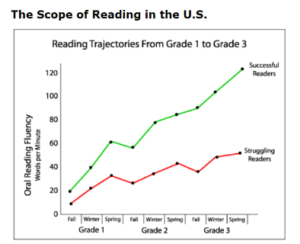 Chart from University of Oregon ‘The scope of Reading in the US’
“Effective reading intervention will help YOUR child achieve reading success! “
Struggling (Dyslexic) Readers Lack Necessary Skills to Read Proficiently & We Need to Use Effective Reading Intervention to Directly Help Them Build Proficient Reading Phonologic Processing
The reading performance data shown above reflects what we have learned about proficient reading. The neuroscience provides us with a wealth of information on the actual process of both proficient reading and dyslexic/impaired reading. We now know that proficient readers use phonologic processing pathways and that the dyslexic/impaired readers have failed to develop these necessary phonologic processing pathways. In other words, the good readers (the green line readers in the chart) turn print to sound and the poor readers (red line readers in the chart) fail to develop these proficient phonologic processing pathways. Struggling readers are literally reading the ‘wrong way’. Reading problems persist because the student has NOT developed neural phonologic processing necessary for proficient reading.
The neuroscience provides us with a ‘map’ to proficient reading. Proficient readers convert print to sound and develop phonologic processing pathways. Struggling or dyslexic readers lack phonologic processing and fail to change print to sound. The key for effective reading intervention is to step in and intentionally help the student develop the proficient phonologic processing neural pathways. It will not help to just bump the student a little farther down the ‘struggling pathway’ (continuing reading the ‘red line’ ‘wrong way’ is not beneficial). You MUST step in with direct effective reading intervention designed to build missing skills so they jump up to the ‘successful reader’ trajectory. We need to intentionally help the student develop the proficient reader phonologic processing neural pathways that are the foundation for proficient reading. Based on reading performance, if your student is below benchmark reading level they would benefit from effective direct reading intervention designed to build correct ‘green line’ successful reader neural pathways!
The Key to Helping Your Struggling Reader Achieve Reading Success is Direct Effective Reading Intervention to Intentionally Build Missing Skills and Develop Proficient Reader Phonologic Processing Pathways
The key for effective reading intervention is to step in and to intentionally help struggling readers develop proficient reading skills. Reading is complex, requiring the mastery and integration of numerous subskills. Gaps in one or more of these essential subskills can hamper reading development. Students struggle learning to read because they lack one or more of the specific skills necessary for proficient reading. Students differ in the specific area they struggle. It is important to identify the specific skill gaps so you can effectively target instruction to strengthen necessary skills and help the student develop proficient reading.
Evaluating to Identify Specific Skill Gaps is Critical for Effective Reading Intervention
In order to implement effective reading intervention to help a struggling student overcome difficulty and achieve reading success, you first have to identify the specific skill gap or gaps. Evaluations provide the information necessary to effectively target instruction. This reading evaluation is not a ‘test’. It is an informal tool to help determine specific reading skills the student may be lacking. You need to know where specific deficiencies exist in order to help the student build and strengthen necessary skills. This is not simply determining the student is struggling but rather identifying the specific reasons WHY they are facing difficulties reading. This is comparable to a coach watching a player perform a task so they can determine the specific weaknesses and then coach to strengthen those areas. Evaluation results help target instruction to develop essential reading skills.
Evaluations are essential in remediation situations. Individuals who struggle with reading vary greatly in the specific skills they are lacking. For example, one student may have poor phonemic awareness, not know the sounds and not be processing print phonetically. Instruction would need to directly establish all fundamental skills to develop the proficient phonologic pathways. Another student may know his sounds in isolation but not know how to smoothly blend sounds together. Direct instruction in the essential skill of smooth blending would allow the student to succeed at reading. Another student may be ‘sounding out’ words but struggling with some of the complexities because their code knowledge was incomplete or indirect. This student would need to learn the complexities and strengthen phonologic processing. Another reader may only have difficulty with multisyllable words. The evaluation helps identify the skill gaps so you are able to target your instruction to build these necessary skills.
The evaluation typically includes checking the following:
- Phonemic Awareness: Assess the student’s ability to perform phonemic awareness activities. Can the student distinguish and manipulate sounds. If they have difficulty recognizing the sound structure of language, where exactly do they have difficulty? Is it with beginning, ending or middle sounds, blended consonants, blending, segmenting or sound manipulation? Results indicate what specific phonemic awareness skills you need to help the student develop. Phonemic awareness is essential to reading success as it allows the student to access efficient phonologic processing. **phonemic weakness is the characteristic of the majority of the dyslexic population so it is an effective indicator of potential reading difficulty. If you have poor PA, you are least likely to tap into the phonologic/sound processing pathways that are essential for proficient reading. Those with poor PA should receive direct intervention early as possible! (you can identify poor PA in kindergarten)
- Knowledge of the complete phonemic code: Evaluate the student’s knowledge of the complete phonemic code. Check their direct print=sound knowledge of all basic sounds, alternate vowel sounds, vowel combinations, r-controlled vowel combinations and other complexities. Determine if they have specific gaps in their code knowledge. Also check that the code knowledge is direct and automatic. It is not a coincidence that many struggling readers have major gaps in their code knowledge especially of the vowel combinations and other complexities. Identify if code knowledge is direct, automatic and complete.
- Spelling: Spelling indicates how the student is transferring sound to print, the converse of reading. Evaluate spelling from words the student has NOT studied or uncorrected writing samples. Patterns of spelling errors often indicate how the student processes words. Spelling errors can also reveal phonemic weakness.
- Reading Performance: Have the student read some level appropriate material (both word list and passage). Don’t comment or make any corrections. Simply record the exact reading performance and errors the student makes. Close scrutiny of the student’s exact mistakes usually reveals repeated mistakes and patterns of errors. Look for errors with incorrect words, skipped words, replacing one word for another, missing parts of the word and problems with multisyllable words. The particular type of reading errors indicates deficiencies in specific skills such as tracking, blending, attention to detail, and absence of phonologic processing. Careful evaluation of the specific reading errors is particularly helpful in determining the skills the struggling reader needs to develop.
- Reading Comprehension: Reading Comprehension is a higher-level skill. To evaluate comprehension, the student reads appropriate level material. As the student reads ask some questions about what he is reading. Check to see how well the student understands what they read. If they have poor comprehension skills, you then check to see if the poor comprehension skills are based on decoding/reading difficulty or on a lack of comprehension skills, or both.
*Important Note: The evaluation techniques are only informal tools for indicating possible gaps in reading skills. If you have any concerns at all about the student’s hearing, vision, development or other medical concern, the student must be evaluated by a doctor or other appropriate professional.
General Information on Effective Remediation to Help a Struggling Reader Improve Reading Skills
We use the results of the evaluation to help set a specific remediation plan targeted to the student’s needs. Most students who struggle with reading are missing essential fundamental skills. It is important to go back and directly establish the correct skills. An effective remediation plan directly teaches and develops essential skills to build up and raise the students reading level. In making an effective reading remediation plan, there are several important factors to consider.
- Direct intervention is essential: In almost all cases, students do not ‘outgrow’ reading problems on their own. Struggling readers are lacking essential skills and need direct effective reading intervention. Intervene immediately to develop correct proficient reader skills. Do not wait for the student to ‘pick it up’ on their own. Research data reveals this rarely happens. As students get older, difficulty reading will handicap them further and further in all subject areas. The ideal situation is one-on-one direct intervention as early as possible.
- Effective reading intervention is essential: To establish the foundation, use an effective direct systematic phonics program to specifically develop essential proficient reading skills (direct knowledge of complete code, tracking, blending, phonologic processing). The brain imaging research shows that effective direct systematic phonics programs not only improve reading skills but actually develop proficient reader neural pathways. Continuing practice with reading the ‘incorrect’ way or applying incorrect strategies, or repeating instruction that failed the student the first time around will NOT help the student overcome their difficulties. You must redirect the student and build essential skills with effective reading intervention. To learn more about why direct systematic phonics is effective see the article Direct Systematic Phonics Instruction Proven Effective – Why Parents & Teachers Should Use Direct Systematic Phonics http://www.righttrackreading.com/directphonicsworks.html
- An intensive remediation schedule is critical: An effective remediation program builds specific skills and helps the student develop and advance. Especially for older students it is important to complete the remediation stage of the program as quickly as possible. Ideal is one-on-one instruction 30min session 4-5 times/week for 1st/2nd grade and 45min sessions 4-5 times/week for 3rd grade and up. An intensive program is necessary to overcome incorrect habits and establish correct proficient reader skills.
While individual evaluations will be conducted & used to identify your student’s specific gaps the following summarizes a few skill gaps that are commonly encountered in struggling readers and a few notes on remediation/intervention needs:
- poor phonemic awareness: Students with weak PA are at greatest risk for dyslexia. Targeted instruction needs to directly link print to sound and intentionally develop PA. The sound tile activities (word making, word changing w/ tiles) are VERY effective in building these PA skills as it allows the child to actually ‘see’ and understand how the phonemic structure of our language works.
- lack of knowledge of the code: To decode proficiently, the student needs direct (print to sound), knowledge of the complete phonemic code. Gaps tend to be in direct knowledge (child has indirect pathways where they recall a word or object before extracting sound) or not automatic (must think real hard, scratch their head..etc… before remembering the sound). Many struggling readers have significant gaps in their direct automatic knowledge of complete code knowledge. Students frequently know their ‘basic code’ but lack knowledge of the complexities (vowel combinations, r-controlled combinations, other complexities). Because they don’t know the complete code, they can’t sound out correctly and then adopt incorrect strategies to reading. Target instruction to systematically build direct print to sound knowledge of the complete cod (and sufficient practice to become automatic!). Direct sound practice s/ sound cards and ‘writing the sounds’ are effective techniques.
- choppy/segmented blending: The ability to smoothly blend sounds together is one of the essential subskills to developing proficient phonologic processing. Choppy/segmented sounding out alone can trip up reading development. If the child is chopping/segmenting sounds, directly teach him how to smoothly blend sounds together.
- Incorrect tracking: To read proficiently, the student must process all sounds in order left to right. If the child is not tracking properly then they need to learn to master & apply the essential tracking skill. Requiring physical tracking w/ a finger/toothpick/pointer is the most effective way to directly build proper tracking.
- Poor attention to detail: To read proficiently, the student must process all sounds in order paying careful attention to details! (the neuroscience shows us good readers pay attention to the details within a word!). If the child has poor attention to detail (only looking at a few sounds or missing sounds/details), then they need to learn to pay attention to detail. Requiring physical tracking w/ a toothpick/fine pointer and stopping/requiring attention the most effective way to directly build this essential skill.
- b-d-p: confusion is common with these similar letters (different orientations of same shape). Teach the child how to recognize the difference between these similar letters. See effective technique to overcome b-d-p letter confusion. Also use letter formation instruction to help differentiate.
- Lack of phonologic processing or weak phonologic processing: Phonologic processing (reading by sounding out the word) is the foundation of proficient reading. To process print phonologically the student must master, integrate and apply all the essential subskills (tracking, code knowledge, blending, PA, attention to detail) in the process of sounding out words. Knowing isolated skills is not sufficient; the child must learn to how to integrate and apply these skills and must practice to build proficiency! Sufficient practice of sounding out decodable words is essential. Students must turn print to sound. If they are using ‘other’ strategies to read, they will NOT develop proficient reading (can eventually learn to read but will always be slow/require much effort and will NOT ever develop fluent neural processing). If the child is NOT sounding out and instead using visual recognition (whole word strategy) or word guessing you must step in extinguish incorrect habits and force the development of correct phonologic processing pathways. This is why direct systematic phonics is effective. Having the child read decodable word lists are the one of the most effective tools to directly build correct phonologic processing. Direct systematic phonics is proven by neuroscience to build correct pathways in dyslexic readers! Systematic direct systematic phonics instruction builds and strengthens phonologic processing.
- Difficulty handling multisyllable words: As students advance from lower elementary (1st-2nd) to upper elementary (3rd & up) they encounter many multisyllable words. These ‘big’ words ARE ‘harder’ to read! Directly teaching students how to tackle and read multisyllable words helps the child succeed as they move from beginning to advanced reading. Teach strategies and provide direct practice handling multisyllable words.
- Developing higher level skills in comprehension and fluency: Comprehension and fluency are higher level skills students need to develop. For remediation to be successful, the foundation of proficient phonologic processing must FIRST be established. If the foundation is lacking, higher level skills will continue to suffer. In fact, the neural system for fluency/’instant reading’ is NEVER established for those who do not have the foundation of phonologic processing in place. The neuroscience reveals, the system for fluent reading is entirely dependent on the development of correct phonologic neural processing pathways and you can NOT develop fluency without phonologic processing. After the foundation is established, students benefit from direct instruction to build fluency and develop reading comprehension.
The free information page of righttrackreading.com has additional detailed information on all of these skills and importantly how to build and develop these skills. Start at the article Overview and Visual representation of Skills Needed for Proficient Reading and then explore the FREE READING INFORMATION PAGE for additional information.
Summary ~
This summary is a little lengthy, but the bottom line is students struggle because they lack specific skills that are necessary for proficient reading. It is important to identify the specific skill gaps and then step in with direct effective reading intervention and build necessary skills. To help struggling students develop proficient reading we need to look closely at the neural research that provides us with the neural “map” of how proficient reading works. We can then target our instruction to intentionally develop the foundation of phonologic processing that is essential to proficient reading. With direct effective reading intervention, we can help your child build skills and learn to read proficiently.
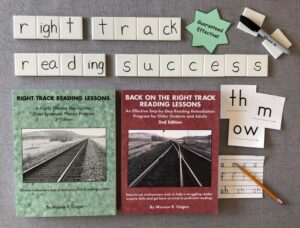
Empowering parents & teachers with information & effective resources to lead their student to reading success!
Reading is complex and requires mastering and integrating many different essential skills. For additional informative articles and resources on teaching students to read CLICK TO EXPLORE FREE READING INFORMATION
If you are ready to learn more about the effective tools to help your child or student achieve reading success, CLICK TO PREVIEW EFFECTIVE RIGHT TRACK READING PROGRAMS. Right Track Reading Lessons is designed specifically for younger children and Back on the Right Track Reading Lessons is specifically targeted to helping older struggling readers (3rd/4th grade to adult).
This information was written by Miscese Gagen, a mother with a passion for teaching children to read proficiently by using effective methods. She is the author of the effective reading instructional programs Right Track Reading Lessons and Back on the Right Track Reading Lessons as well as a reading tutor with over 20 years’ experience successfully building proficient reading skills in her students. The purpose of this article is to empower parents and teachers with information to help their children achieve reading success. We CAN improve reading proficiency, one student at a time! More information located at www.righttrackreading.com ~ Copyright 2004-2021 Miscese R. Gagen