How to Develop & Improve Reading Comprehension Skills
Overview of Reading Comprehension & Specific Actions to Help Students Develop & Improve Reading Comprehension
Overview of Reading Comprehension
Comprehension is acquiring meaning from the text. Reading comprehension is a complex higher level skill. Obviously, comprehension is critically important to the development of a student’s reading. Comprehension is an active process that requires an intentional and thoughtful interaction between the reader and the text. Vocabulary development is critical to comprehension.
While readers acquire some reading comprehension strategies informally, explicit or formal instruction in the application of comprehension strategies has been shown to be highly effective in enhancing understanding (from the Report of the National Reading Panel). In other words, you can take specific actions to help a student develop and improve reading comprehension skills.
Remember the student must first develop accurate phonological decoding skills and build fluency. This fluency that is critical to reading comprehension is accomplished word by word and is absolutely dependent on repeated accurate phonological processing. Comprehension strategies focus on teaching students to understand what they read not to build skills on how to read/decode. If the student struggles with accurate fluent decoding, then reading comprehension will continue to be limited. Basically, if decoding is not automatic and easy then the student has little energy left to devote to thinking about what they are reading. Remember, if the student has decoding difficulties you need to first establish the necessary fundamental decoding skills of proficient phonologic processing BEFORE you can develop the more advanced comprehension. This article addresses techniques for developing the higher level reading comprehension skills. If your child or student struggles with reading see the article Students Who Face Difficulty learning to read: Information on Reading Problems and Dyslexia.
“…explicit or formal instruction in the application of comprehension strategies has been shown to be highly effective in enhancing understanding.” (NRP Summary Report p. 14)
Specific Actions You CAN Use to Help Students Develop and Improve Reading Comprehension
This article explains specific techniques you can use to help students develop and improve reading comprehension skills and provides examples to better demonstrate how to implement these skill development actions. These strategies will help the student think about what he or she is reading, understand what he is reading, and remember what he read. These strategies to improve reading comprehension are effective for non-impaired readers. The following reading comprehension strategies should be implemented as a part of guided reading. See the article Guided Reading Explained for additional information.
Overview Material BEFORE starting to read:

Overview material BEFORE starting to read: Use various techniques to focus the student on the material before they begin reading. Basically, when you help the student think about the material before they start reading, they improve reading comprehension.
- Before the student begins reading, provide statements to direct the student toward what they will be reading. Quickly summarize previous text and overview the section/chapter they are about to read. Make statements such as: “In the last chapter you already learned about ___. This chapter is going to discuss ____”. For example: “The last chapter was on invertebrates, now you will be reading about vertebrates.” or “You just finished learning about the Roman Empire. Now you are going to read about the fall of the Roman Empire”. “You are continuing to learn about energy. This section discusses thermal or heat energy.”
- Before they start reading, ask questions to ensure the student is actually on target. Ask questions such as: “What will this chapter be about?” “What will this chapter discuss?” “What are you learning about now?” Make questions specific to the material such as: “Which region of the country does this chapter cover?” “What form of energy is this chapter discussing?” These types of targeted questions improve reading comprehension.
- In non-fiction, preview the titles and headings of the sections before starting to read the chapter. This overview of the chapter outline is especially helpful with textbooks. This preview helps the student understand the overall intention of the chapter or section.
- Review key vocabulary before reading the chapter. Some textbooks highlight key words, and important new vocabulary terms. Defining the keywords before reading is especially critical with subject terminology. For example, knowing the definition of the term ‘Axis Powers’ is important before reading about WWII history. Knowing the difference between exothermic and endothermic reactions is important to understanding text discussions on chemical reactions. To comprehend the basic physics of motion the student needs to understand the difference between the terms speed, velocity and acceleration.
- With fiction, you can summarize the previous chapters and ask the student to briefly review key events. Ask specific questions on the plot or key events to ‘set the stage’ for reading such as: “So what is going on in the story?”, “What happened so far?” “Where are they at?”.
- With fiction, in addition to having the student give you the quick overview of key events ask the student what they think may happen next. Ask questions along the lines of “What do you think will happen now?” Make questions as specific as possible: “How do you think Sarah will be able to help her grandmother?” “Do you think the old man will be able to land the fish?”
Help the student understand the structure & organization of writing
Help the student learn & understand the structure and organization of writing to improve reading comprehension: By recognizing important fundamentals about the structure and organization of writing, the student is better able to extract the important material and achieve better reading comprehension.
- Specifically point out the structure of paragraphs, sections and chapters. In informative writing most sections should have a main idea and supporting details. Most paragraphs have an opening, a middle and an end. The opening sentence usually outlines the main idea of the paragraph. The supporting points and details should be in the body of the paragraph and the concluding sentence at the end. Awareness of the structure of paragraphs, sections and chapters helps the student better understand material and improve reading comprehension.
- Non-fiction can be organized differently. For example, stories usually contain a conflict with the typical plot structure of exposition, rising action, climax and conclusion or catastrophe. Awareness of elements including the point of view or voice the author uses to tell the story, situation, setting, and characterization all contribute to overall comprehension. Help the student understand key writing elements.
- Techniques such as story mapping can also help a student understand organization. (more later on using graphic organizers)
Teach the Student How to Identify & Extract Main Ideas:

Help the Student Learn to Identify and Extract the Main Ideas: The ability to find, identify, extract and understand main ideas is critical to not just to improve reading comprehension but to meet educational objectives. Much of the reading students do is to acquire specific information. Some students have high reading comprehension on fictional stories yet have difficulty extracting necessary information from textbooks and other non-fictional informational reading. These students need direct instruction on how to identify and extract necessary information. Many of the new textbooks contain a style of writing that many students need to learn how to read. The short paragraphs, numerous interruptions, interesting but irrelevant trivia, and tidbits of boxed information at various locations can sometimes make it more difficult to locate, identify and extract pertinent information. For example, if the student is reading a social studies chapter on United States expansion, the photo of a grizzly bear and sentences about how Thomas Jefferson had a grizzly bear in a cage on the White House grounds may distract the student from the main point. For content comprehension, the student can’t just relate the trivia of the grizzly bear in the cage. The student needs to understand Thomas Jefferson made the Louisiana Purchase and sent the Corps of Discovery expedition to explore this new territory. They need to understand how Lewis and Clark mapped this new region and recorded information not just on many new plants and animals but also on the peoples that lived there. When you help the student learn how to look for and identify the main idea both before reading and during the reading process it will improve reading comprehension.
- As discussed in the ‘overview materials’ techniques, introductory statements and questions can point the student in the right direction before they start reading.
- Review the main headings and overall outline of the chapter.
- As the student reads, help them identify and focus on main ideas by asking specific questions. Stop the student at appropriate paragraphs or sections and ask targeted questions that direct the student to important information. “What was the Lewis and Clark expedition?” “What were the primary missions of the Corps of Discovery?” “What important information did Lewis and Clark gather during their expedition?” “Explain the process of oxidation?” “What happens in an exothermic chemical reaction and how is it different from an endothermic reaction?” “Why did the Greeks begin the first Olympic Games? “What weakened the Greek civilization and made is susceptible to defeat?” Help the student learn how to focus on important information. Ask specific questions that help the student identify and understand the key concepts.
- By asking questions you can help target the student toward the key concepts that they do not recognize or understand. For example, if you ask the student to explain complete metamorphosis and he gives you the answer ‘a frog’, then you would ask the student a follow up question such as “Yes, a frog is an example of an animal that undergoes complete metamorphosis, but can you explain the primary difference between complete and incomplete metamorphosis?”. You do not want to ‘give’ the answers to the student, but rather help direct them toward locating and understanding the main ideas.
- If the student cannot answer questions or is missing pertinent details, then have them re-read the paragraph or section. Not only does this allow the student to find necessary information but it teaches the student the essential skill of looking back and re-reading text to find necessary information. Compliment the student when he looks back at text for answers. Learning to look back when necessary is an important skill to improve reading comprehension.
- Outlining can be a highly effective tool for helping students identify main points and improve reading comprehension. Show the student how to make an outline. Outlining does not have to be detailed. Short bullet statements are often effective in identifying main ideas. The student can then orally explain the bullet points.
Actively engage the student during reading to directly encourage & develop skills in processing & understanding the text
Actively engage the student during the reading to think about and process the material. Directly encouraging and developing the student’s skills in processing and understanding text as they read will improve reading comprehension. These engagement techniques help the student develop the interaction between the reader and the text that is important for reading comprehension. Encourage and develop skill in actively processing the material. Help the student think about and interact with what they are reading.
- Stop or pause at appropriate paragraphs or sections and ask specific questions that make the student think about what they are reading. Once again design questions to help the student think about specific aspects of the text. Ask both direct informational as well as more advanced interpretative questions to improve reading comprehension.
- Use interaction and questions to help the student develop the skill of active engagement with the text. Flip it around and have your student tell you what questions were answered in the passage.
- As the student comes across unknown vocabulary or expressions, stop and see if they understand what they are reading. Explain or define the word or expression and then have the student re-read the paragraph or section. For example, the reader comes across the phrase “take the bull by the horns” make sure they understand the phrase means “to tackle tough issues head on with direct action”. The English language is full of many sayings and phrases that do not make sense if read literally. The student needs to not just read the phrase correctly but understand what that phrase means to comprehend the overall meaning of the text.
- Once again, if the student cannot answer a question or is missing pertinent details, have him go back and re-read the section.
- Begin helping the student develop the higher-level processing skills of interpretation and inference. Ask both ‘what do you think’ and ‘why do you think’ type questions. The process of explaining “why” helps the student think through and back up their answers with reasoning.
Help the Reader Learn to Summarize:
Help the student learn to summarize material as they read. In other words, teach the reader how to integrate all the various aspects of the material and give the ‘nuts and bolts’ of a short and quick summary of the text will improve reading comprehension. This ability to summarize is a more advanced skill than simply pulling out the main points. Summarizing main points can be harder for some students because they need to understand the material well enough to be able to explain the key points in their own words.
- Have the student practice this essential skill by asking “What was that about?” “Can you give me a briefing about what you just read”, “How would you summarize that in your own words?” If the student is unable to ‘pull out’ and summarize important information, give guidance that teaches him how to do this. Sometimes students will remember small details but are unable to summarize the important points. Once again questions and discussions are effective in helping the student learn this important skill of understanding and summarizing important points.
- Being able to summarize/explain the content to someone else is a great technique to build and improve reading comprehension of content. If you learn a subject or idea well enough to explain it to someone else, you tend to meet high reading comprehension goals.
Develop Vocabulary Knowledge:
Specifically Develop Vocabulary Knowledge: The importance of vocabulary knowledge to reading comprehension, is well documented in the research. Vocabulary instruction leads to gains in reading comprehension. Please see the article Expanding Vocabulary Knowledge for further details and specific techniques you can use to help your child or student expand their vocabulary.
Develop Comprehension Self-Monitoring:

Directly help the student develop comprehension self-monitoring skills: Self-monitoring is where the reader checks themselves and recognizes if they understand the material. The goal is for the student to develop self-awareness of his or her reading comprehension.
- The student needs to ask themselves at the end of each paragraph or section “Do I understand this material?”. To develop this essential skill, have the student ask themselves out loud, “What was that about?” By asking and answering this question out loud, the student learns to check himself. The out loud self-questioning is a temporary tool. When the student learns to automatically check and monitor their own reading comprehension, the out loud self-questioning is no longer necessary.
- Another technique for developing reading comprehension self-monitoring is for the student to generate questions about various aspects of the content. By coming up with their own key questions, it allows them to review their understanding of the material. The student answers these questions himself or asks you the questions. Learning to check themselves for understanding as they read will improve reading comprehension.
- If the student does not understand what they read, they need to learn to go back on their own and re-read the section. This self-directed ‘going back’ and re-reading is critical to improve reading comprehension. Be sure and compliment the student when you notice them going back on their own for an answer.
- Be sure and point out to the student that this self-monitoring of reading comprehension is a characteristic of skilled readers.
Use Graphic Organizers:
Techniques where the student makes various graphic representations of the material such as story maps, outlines and timelines can effectively enhance and improve reading comprehension. The key with graphic organizers is to ensure these tools are carefully targeted to achieve comprehension goals and the tools are appropriate for the content areas.
- Maps are virtually mandatory when studying content areas dealing with geography. Maps are also critical in understanding and improving reading comprehension of history. For example: It is difficult to understand the importance of the Panama Canal without looking at a map, and understanding the ancient Egyptian civilization is dependent on understanding the influence of the Nile River and the geography of the region.
- Timelines are a highly useful tool. The timelines allow students to ‘see’ the progression of events chronologically. Once again history is a prime candidate for timelines. The timelines are also useful in other subjects that relate to chronologic progression such as medical advancements, scientific discoveries, and advancement in technology.
- Sketches, illustrations, diagrams and other visual representations can be highly effective in improving reading comprehension when they are properly applied. For example, sketches of the various landforms help students define and understand geography terms. Diagrams are important in describing and understanding the physical structure and function of item such as atoms, molecules, cells, and life cycles.
- Story maps are a tool for visually outlining fiction.
- Outlining is a highly effective tool for improving reading comprehension across a wide range of subjects and material context.
- Once again, all these tools need to be properly targeted to develop the necessary content objectives. It is important to realize that not all ‘projects’ or ‘visual representations will improve reading comprehension. For example, spending weeks making an elaborate paper pirate ship mobile is unlikely to improve reading comprehension of ‘Treasure Island’. Building a model of a pyramid out of sugar cubes is unlikely to help the student learn the importance of the ancient Egyptian civilization. Remember to target and focus graphic organizers to what the student needs to learn.
Cooperative Learning:
Cooperative learning is where students learn and discuss material with others. As can be expected, effectiveness of ‘cooperative learning’ strategies varies greatly. To improve reading comprehension, these cooperative learning strategies need to be properly applied and carefully monitored.
- Discussions guided or facilitated by a knowledgeable instructor are more effective than unguided discussions in improving comprehension. Even if the instructor does not direct the details of the discussions, facilitation is important. Students who start off discussing their thoughts about “The Old Man and the Sea” can easily drift off into a series of unrelated fishing stories. Facilitation is important, particularly for keeping a group of students on target.
- The open discussions between students to improve reading comprehension are usually more appropriate for fictional text than for non-fictional informational reading. Students can learn from each other when discussing elements such as ‘what do you think will happen? “Why did this character do this?” “Why do you think…” etc. These types of discussions can bring out elements of the story that the student had not previously thought of.
- Common sense dictates the effectiveness of these ‘cooperative’ discussion strategies with factual informational text. Obviously, it does not help students’ comprehension if the ‘cooperators’ share incorrect or inaccurate information. Particular care and careful monitoring are essential so that uninformed students do not share misinformation with other students. (Actual example: I had a student who ‘learned’ there were 14 inches in a foot since that was the information determined by their cooperative discovery group of other misinformed students
 !) The ‘cooperative’ discussions among students often have limited benefit when students are learning new concepts and information. While question generation from students is helpful, the answers and factual information need to be provided by knowledgeable sources.
 - Cooperative learning with knowledgeable individuals or subject experts can be highly beneficial and will improve reading comprehension. For example, if my son discusses WWII military history with his grandfather while reading his history book, the cooperative discussions between them provide incredible opportunities for him to expand his comprehension and knowledge base. Obviously, he would not achieve this enhanced reading comprehension if he discussed the same topic with his buddy whose knowledge of WWII history was limited to a fictional TV show.
- Monitoring is always important with cooperative learning to ensure accurate information is shared and the students remain on target.
Concluding Statement on Reading Comprehension:
In summary, reading comprehension is the essential higher-level skill of actually understanding the material being read. Obviously, comprehension is the goal of proficient reading. The research shows you can successfully help your child or student develop these critical reading comprehension skills with various direct instruction strategies. Most activities that develop and improve comprehension skills can be effectively applied as a part of guided reading.
Comprehension is just one skill necessary for proficient reading. Reading is complex and requires mastering and integrating many different essential skills. For a visual representation outlining of necessary skills and integration of skills necessary for proficient reading See Overview and Visual Representation of Overall Processes Required for Proficient Reading
For additional informative, useful articles and effective resources on teaching students to read proficiently EXPLORE Right Track Reading’s FREE READING INFORMATION PAGES
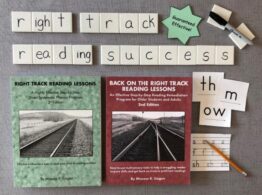
The tools to achieve reading success!
Learn how Right Track Reading’s effective direct systematic phonics reading programs provide you with the tools to directly build reading skills and achieve reading success. Right Track Reading Lessons is designed specifically for younger children and Back on the Right Track Reading Lessons is specifically targeted to helping older struggling readers (3rd/4th grade to adult). Preview these effective, easy-to-use and affordable tools. Translating the science and evidence based research into actions YOU can use with your student!
————————-
This article was written by Miscese Gagen, a mother with a passion for teaching children to read proficiently by using effective methods. She is the author of the effective reading instructional programs Right Track Reading Lessons and Back on the Right Track Reading Lessons as well as a reading tutor with over 20 years’ experience successfully building proficient reading skills in her students. The purpose of this article is to empower parents and teachers with information to help their children achieve reading success. We CAN improve reading proficiency, one student at a time! More information located at www.righttrackreading.com ~ Copyright 2004-2021 Miscese R. Gagen