Expanding Vocabulary Knowledge: How to Help Your Child or Student Build Vocabulary
Overview of Vocabulary Development
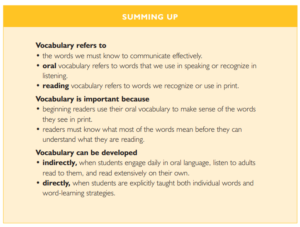
As can be expected, vocabulary knowledge is critical to reading development. Vocabulary is beyond correct decoding. Vocabulary is understanding the meaning of the word. Expanding the student’s knowledge bank of vocabulary words is important to comprehension. The greater the student’s vocabulary the easier it is to make sense of and understand text. Vocabulary is generally related to understanding individual words where comprehension generally refers to understanding larger parts of the text. Vocabulary and overall comprehension are closely related.
Vocabulary knowledge is distinct from the skill of decoding print. A student can fully understand words that he is not able to read. For example, a five-year-old has a much larger speaking and understanding vocabulary than a printed reading vocabulary. He may not be able to read the printed words ‘gorilla’, ‘vacation’ or ‘chocolate’ but knows exactly what the words mean. He has the necessary vocabulary knowledge even though he can’t read the print. In contrast a student may be able to correctly decode a word perfectly and still now know what it means. This would be a vocabulary knowledge issue. Of course, for comprehension, the student needs to both accurately decode the word and know what the word means.
“Expanding vocabulary knowledge is important to reading development. You can directly help your student build vocabulary “
Expanding vocabulary knowledge is important to reading development. Vocabulary instruction leads to gains in comprehension (noted by the National Reading Panel). A comprehensive reading program needs to include vocabulary development. The student can learn vocabulary both incidentally and through direct instruction. Various techniques designed to directly build vocabulary are effective in expanding vocabulary knowledge and improving reading comprehension. Optimal learning occurs when vocabulary instruction involves a combination of different techniques.
Specific Actions to Help Students in Expanding Vocabulary Knowledge
Vocabulary is enhanced by both direct instruction and incidental exposure. Expanding vocabulary knowledge can be effectively accomplished with various techniques and explicit activities including:
Directly Teach New Vocabulary to the Student
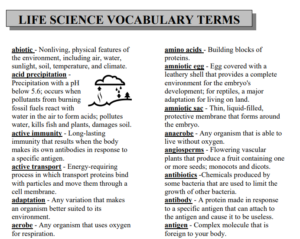
Directly teach new vocabulary to the student. To maximize effectiveness the student should learn and practice new words both in isolation and in context. The student can practice the meaning of the words in isolation (word lists with definitions) and in context (using the word in a sentence). In other words, the “old-school” English teacher method of presenting a list of new vocabulary words and having students write both the full definition and writing a complete sentence using the word is highly effective in helping students learn new vocabulary. These direct methods of expanding vocabulary knowledge have beneficial impacts on reading comprehension.
Highlight and Define Key Words BEFORE Student Reads Passage
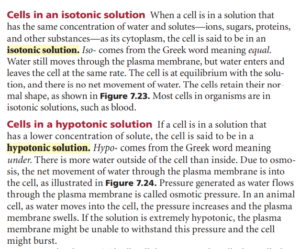
Highlight and define key words before having the student read a passage. Comprehension is improved when students to learn new vocabulary words before reading text. This strategy is especially beneficial with subject terminology that is critical for overall comprehension. Acquiring and expanding vocabulary knowledge prior to reading the text enhances overall understanding of the material. For example, before reading a science chapter on energy, highlight and learn the meanings of kinetic energy, potential energy, thermal energy, conduction, convection and radiation. The picture below illustrates an example from a science textbook.
Learn Meaning of Unknown Words & Expand Vocabulary as the Student Reads
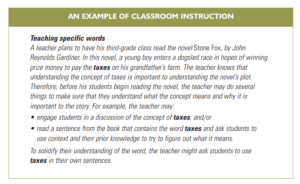
As a part of guided reading, have the student stop if he does not know the meaning of the word. You can verbally explain the word and then have the student reread the sentence. As they read, the student will also ‘figure out’ the meaning of many new vocabulary words simply from context. Sometimes it is important for the parent or teacher to explicitly explain and cover new vocabulary terms to allow comprehension. The illustration below from page 31 of Put Reading First: The Research Building Blocks for Teaching Children to Read is a fantastic example of how it is important to directly build vocabulary knowledge as students encounter unknown words while reading so they are able to improve comprehension.
Multiple Exposure to a New Vocabulary Word Enhances Learning
Repetition and multiple exposures to new vocabulary enhance vocabulary knowledge. In other words, teach words more than one time and have the student practice words more than once.
Build Self-Awareness of Unknown Vocabulary & Encourage Student to Find & Learn New Words
Help the student learn to notice new unknown vocabulary words. The student can then either look up the word as they are reading or they can write down the word for later. It is helpful for the student keep a small notepad to record new words. The student can then look up and learn these unknown words at a later time. My older daughter preferred the ‘write down for later’ method, because she didn’t have to stop reading a good book to look up a definition. To encourage the student, you can even come up with a system of rewarding a certain number of new vocabulary words. Promote learning a new word every day. Multiple sites have ‘word of the day’ listings that are terrific for expanding vocabulary.
A Dictionary is a Fantastic Tool to Learn New Vocabulary

Help the student learn to use a dictionary as a resource. You want to help the student learn how wonderful and informative a good dictionary is. The goal is to help the student to progress from the stage where they need direct orders to ‘go look it up’ to where they voluntarily reach for the dictionary to determine word meanings. Directly practice looking up new words in a dictionary. You can even give your student a challenge to find x number of new words in the dictionary.
Vocabulary Learned Through Exposure
Vocabulary can also be learned indirectly/incidentally through exposure. Vocabulary knowledge can be acquired through oral conversations, discussions and other verbal presentations. In general, written language contains a higher level of vocabulary than oral language.
Use Audio Books to Supplement Exposure to Vocabulary
Because vocabulary is acquired through exposure, audio books can be an excellent supplemental tool for exposing students not only to expanded vocabulary but also the benefits of a wide variety of literature and information. A collection of fiction and non-fiction audio books are found at most libraries. Podcasts are readily available from many sources. While these audio books should not replace reading, they offer an opportunity to expose your family to a vast wealth of literature at times when sitting down and reading a book is not feasible. These audio books can be listened to while driving in a car, preparing dinner, conducting chores or while engaged in other activities. For example, we frequently listened to audio books on road trips and my son listened to audio books while playing basketball in the driveway.
Games, Puzzles and Challenges Can Be Used for Expanding Vocabulary Knowledge
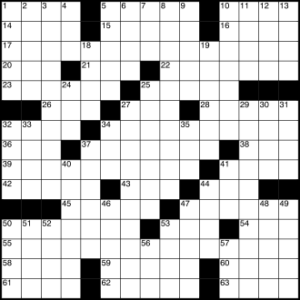
Students can also learn new vocabulary from various word games. Fun vocabulary games, crossword puzzles and the vocabulary quizzes such as found in Reader’s Digest magazine and other sources can be used for expanding vocabulary in an entertaining manner. You can also make your own games where members of the family find, learn and quiz each other on their ‘new’ words.
Learning Common Affixes Helps in Expanding Vocabulary Knowledge
Direct instruction in the most common affixes (prefixes and suffixes) helps in expanding vocabulary knowledge. Learning the meaning of these common ‘building blocks’ helps students understand many new words. The definitions of common prefixes and suffixes and lists of words are included in Section 6 (Multisyllable Words) of both Right Track Reading Lessons and Back on the Right Track Reading Lessons. Other lists and definitions of common prefixes and suffixes can be found in dictionaries, other lists and vocabulary programs.
Directly Teaching the Common Latin and Greek Root Words Is Effective in Expanding Vocabulary
Direct instruction in the common Latin and Greek root words is highly beneficial in expanding vocabulary knowledge. Study of the Greek and Latin root words provides a strong foundation for vocabulary development. For example, if the student knows the Latin root script=write they can better understand the meaning of the words scribe; transcribe, manuscript, prescription, inscription, describe, transcript.
Lists of root words are readily available through internet searches for ‘common root words’. Many sources can be found on organization (.org) and education (.edu) websites. In addition, complete structured root word programs such as “English from the Roots Up” by Joegil Lundquist are also available.
A partial list of common Greek and Latin root words is given below:
Greek Roots:
astron – star (astronaut, astronomy, astrology, astronomical)
auto – self (automobile, automatic, autobiography, autograph, automate, autonomy)
biblio – book (bibliography, Bible, bibliomania)
bio – life (biology, biodegradable, biography, biosphere, antibiotic)
chron – time (chronology, chronic, synchronize, chronological)
demos – people (democracy, demography, democratic)
dia – across or through (diameter, diagonal, diagnosis, diagram, dialect)
geo – earth (geology, geometric, geography, geopolitical, )
graph – to write or draw (graph, telegraph, graphic, autograph, homograph)
hemi – half (hemisphere)
homo – same (homograph, homogeny, homonym, homophone)
hydro – water (hydrant, hydrate, hydroelectric, hydrology)
logos – word study (logic, -ology = ‘the study of’ – biology, geology)
mega – large or great (megaphone, megapod)
meter – measure (thermometer, barometer, diameter, optometry, altimeter)
micro – small (microscope, microbe, micron, microfilm)
mono – single (monorail, monologue, monarch, monopoly)
para – beside (parallel, parable, parenthesis, paragraph, parachute)
pathos – feeling (pathetic, apathy, sympathy)
philia – love friendship (Philadelphia= city of brotherly love, philosophy, philanthropist)
phobia – fear (claustrophobia, hydrophobia)
phone – sound (phonics, telephone, symphony, microphone, phonological, homophone)
photo – light (photograph, phototropic, photocopy, photosynthesis)
poly – many (polygon, polymer, polynomial, polygamy, polyhedron)
psych – mind, soul (psychology, psychic, physics, psyche)
scope – to look at inspect (scope, microscope, telescope, periscope)
sphere – ball (hemisphere, sphere, spherical, atmosphere)
syn/sym -together or with (synonym, symphony, synchronize, synthesis, symmetry)
techne – skill or art (technology, technical, technician)
tele – distant, far away (telephone, telegraph, telescope, television)
therm – heat (thermometer, thermostat, thermodynamics, thermos)
thesis – place position (thesis, theme, synthesis)
tropic -turning (tropics, phototropic)
Latin Roots:
annus – year (annual, anniversary, perennial, annuity)
aqua – water (aquarium, aquifer, aqueduct)
audio – hear (audible, auditory, audience, auditorium)
bene – well, good (beneficial, benefit)
bi – two (bisect, bicycle, bipartisan, biped, binary, binocular bicentennial, bifocal)
capitis – head (capital, captain, cabbage, capitalism)
centum – hundred (centimeter, cent, percent, century, centipede)
circum – around (circumvent, circumference, circulate)
contra – against (contrary, contradict, contraband, contrast)
dict/dictum- say or speak (dictate, dictionary, contradict, dictation, predict, verdict)
duct – lead (conduct, aqueduct, conductor)
duo – two (dual, duet, duel, duplex)
equi – equal (equitable, equator, equal)
finis – end (finish, final, finite, infinite)
fix – fix or attach (fix, affix, prefix, suffix)
fract – break (fracture, fraction, infraction, refract)
ignis -fire (ignite, igneous)
ject – throw (reject, interject, object, project)
junct or join – join or connect (join, joint, junction, rejoin)
manus – hand (manuscript, manufacture, manual, manipulate, manicure)
migrat – move (migrate, migrant, migratory)
ped – foot (pedal, pedestrian, pedestal, centipede)
populus – people (people, popular, population, republic, publish)
port – carry (portable, porter, deport, transport, import, airport, portage)
pre – before (predict, prepare, predawn, preset, preamble)
quartus/quad – fourth (quart, quadrant, quarter, quadrilateral)
scribe/script – write (script, transcribe, prescribe, scribble, inscribe, describe, manuscript)
spect – look (inspect, speculate, spectacle, perspective, introspect)
struct – build (construct, structure, destruction, instruction)
tempor – time (temporary, contemporary, temporal, tempo)
trans – across (transfer, transcript, transplant, transparent, transaction, transmit)
verb – word (verb, verbiage, proverb, verbal, verbose)
vid/vis – see (video, visible, evident, visual, visit, visitor)
Summary & Conclusion
In summary, expanding vocabulary knowledge is a critical element of reading development in advancing as a skilled reader. You can take direct actions to help your student expand their vocabulary.
Vocabulary is just one skill necessary for proficient reading. Reading is complex and requires mastering and integrating many different essential skills. For additional information see the articles:
- For a visual representation outlining of necessary skills and integration of skills necessary for proficient reading See Overview and Visual Representation of Overall Processes Required for Proficient Reading
- For additional details on the multiple skills needed for proficient reading, see the article Skills Necessary for Proficient Reading: Explanation of Foundational Skills for Phonologic Processing and Higher-Level Skills to Advance to Proficient Reading
Important Note: If you are working with speakers of other languages who need to learn the spoken English language, vocabulary instruction is much broader in scope. Teaching an entire new language to a student is vastly different than expanding vocabulary knowledge with students who grew up speaking the English language. If a student is new to English, they must learn the meaning of virtually the entire spoken English language. They need “language instruction” not just “new words /vocabulary instruction” that is the focus of this article.
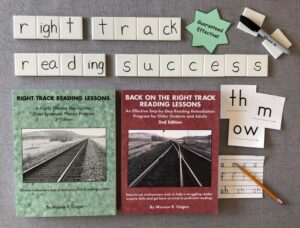
Empowering parents & teachers with information & effective resources to lead their student to reading success!
Reading is complex and requires mastering and integrating many different essential skills. For additional informative articles and resources on teaching students to read CLICK TO EXPLORE FREE READING INFORMATION
If you are ready to learn more about the effective, easy-to-use and affordable tools to directly help your child or student achieve reading success PREVIEW Right Track Reading Lessons (designed for younger children) and Back on the Right Track Reading Lessons (specifically targeted for older struggling readers 3rd/4th grade to adult). Translating the science and evidence based research into actions YOU can use with your student!
This information was written by Miscese Gagen, a mother with a passion for teaching children to read proficiently by using effective methods. She is the author of the effective reading instructional programs Right Track Reading Lessons and Back on the Right Track Reading Lessons as well as a reading tutor with over 20 years’ experience successfully building proficient reading skills in her students. The purpose of this article is to empower parents and teachers with information to help their children achieve reading success. We CAN improve reading proficiency, one student at a time! More information located at www.righttrackreading.com ~ Copyright 2004-2021 Miscese R. Gagen