Skills Necessary for Proficient Reading
Explanation of Both Foundational Skills to Develop Phonologic Processing and Higher-Level Skills Necessary for Proficient Reading
This article lists and describes the complex set of elements and individual skills necessary for proficient reading. This includes both the foundational skills essential for establishing phonologic processing and the higher-level skills necessary for proficient reading.
Proficient reading is a complex learned skill requiring the mastery, integration and application of numerous sub-skills and knowledge. Skilled reading involves both 1) establishing a foundation of phonologic processing of print and then 2) developing higher level or advanced skills. To become a skilled reader, the student must first convert print to sound and establish ‘proficient reader’ neural processing pathways. To correctly process print phonologically, the student needs to master, integrate and apply skills and knowledge in phonemic awareness, knowledge of the complete phonemic code, smooth blending, proper directional tracking and attention to detail. After the essential foundation of phonologic processing is established, it is equally important for the student to develop the advanced or higher level skills necessary for proficient reading including handling multisyllable word, building fluency, expanding vocabulary and developing comprehension skills and strategies. The complex process of proficient reading outlining the multiple interrelated necessary skills is shown in the flow chart diagram below. While this visual representation provides a beneficial overview of proficient reading, in reality, the skills necessary for proficient reading are not isolated tasks that fit into rectangles. These interrelated skills necessary for proficient reading must be acquired, mastered, integrated, applied and PRACTICED for the student to become a skilled reader!
For a visual representation outlining of necessary skills and integration of skills for correct phonologic processing of print and development of advanced skills necessary for proficient reading See Overview and Visual Representation of Overall Processes Required for Proficient Reading.
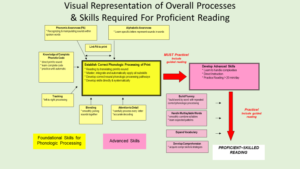
To become a proficient reader, the student needs acquire, master, integrate & apply these skills necessary for proficient reading.
The Skills Necessary for Proficient Reading are organized into the following Sections:
*Scroll down the page or click toon each skill to see description and learn more about the each of these skills necessary for proficient reading.
A) Essential Fundamental or Foundational Skills Necessary for Proficient Phonologic Processing
- phonemic awareness
- knowledge of the complete phonemic code
- directional tracking
- smooth blending
- attention to detail
B) Establishing the Foundation of Proficient Phonologic Processing of Print (reading by sounding out words!) Combining, Integrating & Applying Fundamental Skills and Developing Correct Efficient Phonologic Processing
C) Proficient Reading is MORE than phonologic processing. Developing Higher Level Skills Necessary for Proficient Reading
D) Summary of Skills Necessary for Proficient Reading
“Proficient reading requires the mastery, integration and application of many subskills. Learn about the skills necessary for proficient reading and how to help your child or student acquire these essential reading skills.”

A) Fundamental or Foundational Skills Essential for Developing Proficient Phonologic Processing
1. Phonemic Awareness
Phonemic awareness is literally ‘sound’ awareness. Phonemic awareness is understanding words are made up of sounds and being able to hear, recognize and manipulate the individual sounds that form the word. Phonemic awareness is primarily an auditory skill of distinguishing and recognizing the sound structure of language. For example, phonemic awareness is realizing the word ‘puppy’ is made up of the sounds /p/ /u/ /p/ /ee/ or the word the word ‘shape’ is formed by the sounds /sh/ /ay/ /p/. Phonemic awareness is developing an ‘ear for sounds’ and it is critically important to reading and spelling success.
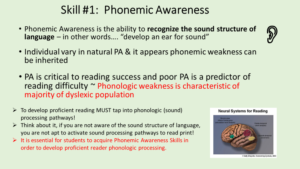
Individuals vary greatly in their natural ability to hear sounds within words. Hearing the individual sounds within a word is difficult because spoken language is so seamless. When we speak, we naturally and effortlessly blend all the sounds together to say and hear the overall word. The natural ease of seamless speech hides the phonetic nature of our spoken language. For example: The child says and hears the word “puppy” as one seamless word /puppy/ and does not recognize or distinguish the separate sounds /p/ /u/ /p/ /ee/ that make up the word.
Research shows children with poor phonemic awareness struggle with reading and spelling. Individuals who do not distinguish sounds within spoken words have difficulty recognizing the necessary link between print and sound critical to proficient reading and spelling. It is important to realize phonological abilities are not related to intelligence. Highly intelligent individuals can have phonological weakness that leads to reading difficulty. In addition, tendency for natural phonologic weakness may be an inherited trait as it appears to run in families.
Although some children and adults have a definite natural phonological weakness, the good news is phonemic awareness (PA) can be taught and learned. Validated scientific evidence shows PA instruction has a significant positive effect on both reading and spelling. Phonemic awareness is one of the skills necessary for proficient reading.
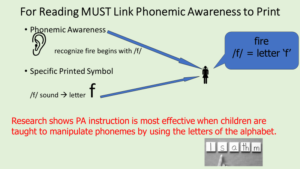
It is important to realize oral PA instruction alone is not sufficient. Research shows PA instruction is most effective when students are taught to manipulate sounds with letters. In other words, the greatest effectiveness in helping children learn to read occurs when essential PA training (auditory skill of recognizing the sounds) is linked directly to the printed letters (knowing the specific black squiggles). The student needs to recognize the word ‘fire’ starts with the /f/ sound AND know this /f/ sound is represented by the printed letter ‘f’. To read, the student must link oral & auditory PA skills directly to the printed phonemic code.
For additional information including the specific PA skills that should be developed see the article What is Phonemic Awareness? Why is Phonemic Awareness Important? and Why You Must Link PA to Print.
2. Knowledge of the Complete Phonetic Code
The complete phonemic code is the specific print=sound relationships written English is based on. The English phonemic code is complex. Letters and sounds do not have a one-to-one correspondence. There are 26 letters and 44 sounds. Some letters represent more than one sound. Many sounds are made from a combination of letters. There is overlap where one sound can be represented several ways in print. Then to top it off, our language includes spellings from other languages and some irregular words. Although it is complex, English is not complete random chaos. English is mostly phonetic or follows predictable patterns. If all sounds are learned and patterns practiced, most words can be phonetically decoded. Knowledge of the complete phonemic code is one of the essential foundational skills necessary for proficient reading.
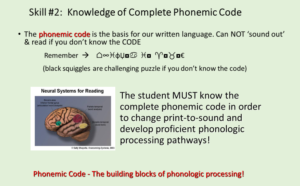
The student needs to acquire knowledge of the complete phonetic code. Knowledge of the basic alphabet is not sufficient. The student needs to know the multiple vowel sounds, consonant digraphs, vowel-combinations, r-controlled vowels, and other complexities that comprise the vast majority of printed words. Phonograms are the distinct printed letters or combinations of letters that symbolize specific sounds within written English words. Depending on exactly how they are classified, there are between 70 to 80 phonograms. In addition to the 26 single letters of the alphabet, the student needs to learn consonant digraphs (th, sh, ch, wh, ck, ph, wr…), vowel combinations (ee, oa, oe, ai, ay, oi, oy, ea, ow, ou, ue, au….), r-controlled vowels (ar, or, ore, er, ur, ir, ear, eer, air…) and other combinations (a+l, w+a, c+e, igh, ough…). It is no surprise the vowel combinations and other complexities are frequently the source of reading and spelling difficulties. Many students lack necessary knowledge of the complete phonetic code. Instruction often fails to teach these complexities or teaches them in an indirect, incomplete or haphazard manner. The most effective way to ensure students acquire complete and accurate knowledge of the complex phonemic code is to directly teach all phonograms to the student.
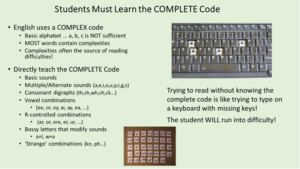
To read proficiently, the student must process print phonetically. The student needs to accurately convert the printed phonograms directly to sound. To maximize efficiency, the processing of print needs to be accurate, direct and automatic. The student effectively learns this ‘printed letter=sound’ association through direct instruction and repeated practice. The goal is for the student to automatically know the printed alphabetic character equals sound association (printed letter(s)=sound) of the complete phonemic code. When the sound is automatic, the student does not have to spend any effort consciously think about what it is and can then concentrate on higher reading skills. By acquiring direct automatic print=sound knowledge for the complete phonemic code the student can then process print phonetically and establish proficient reader phonologic processing pathways.
Additional information on knowledge of the complete phonemic code, one of the foundational skills necessary for proficient reading, is found in the article The Building Blocks of Written English-The Phonemic Code Explained.
3. Directional Tracking (Correct left-to-right straight line processing)
In English, we read and write from left-to-right. Proper directional tracking of looking at and processing all the letters in order from left-to-right is essential for reading success. Although this simple sub-skill may appear self evident, many students do not apply this essential element. Remember, scanning left-to-right in a straight line is not a natural process. Instinctively, looking all over is a superior way to gather information. Left-to-right processing is one of the arbitrary artificial components of our man made written English language that the student must learn and automatically apply. Knowing the individual sounds is not sufficient. For accurate reading, the student must process sounds in order from left-to-right. The following words demonstrate order of the letters is important: (stop-pots-tops) (thorn-north) (no-on) (miles-limes-smile) (step-pets-pest) (every-very) (felt-left). Poor readers have frequent tracking errors where they improperly process letters out of order. Poor readers often exhibit erratic eye movement as they look around for ‘whole words’ or jump around searching for familiar hunks or word families. These incorrect tracking strategies contribute to reading difficulty. To read proficiently the student must not only know the individual sound but must process the letters in order left-to-right. The most effective way to ensure the student acquires this essential skill is to directly teach and require proper directional tracking.
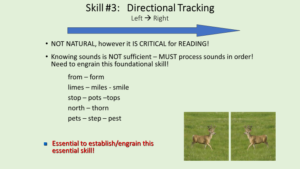
Additional information is found in the article Directional Tracking Explained: Why Directional Tracking is Important to Reading Development
4. Smooth Blending
To read proficiently, the student needs to blend individual sounds smoothly together into words without choppy pauses between the sounds. This essential blending skill does not come easily and automatically for some students. Difficulties blending are usually evident as ‘choppy sounding out’. Some student’s inability to blend smoothly creates a hurdle that blocks reading development. The critical importance of this skills is often overlooked. If the student chops sounds apart, they are not able to put all the sounds together and ‘smoothly’ say the word, and build fluency. They might know the sounds in isolation but are unable to ‘hook’ the sounds together. They may initially get by with short words but quickly run into trouble with words containing four or more sounds. To avoid potential difficulty, it is important to directly teach smooth blending skills from the beginning or to specifically work on blending with any student who has not acquired this essential skill. For example, teach the student to read the word ‘mast’ with smoothly blended sounds /mmaasst/ instead of a choppy /m/…./a/…./s/…./t/. When sounding out it is essential the parent or teacher demonstrates the correct blending skills of not stopping between the sounds.
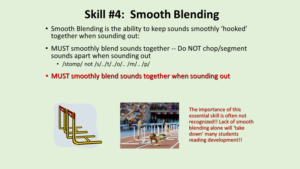
The ability to blend smoothly is a critical and often overlooked skill. Choppy segmented sounding out (lack of smooth blending skill) will flat out ‘take down’ a development of proficient reading.
For additional information see the article Blending Explained: Why Smooth Blending is Important to Reading Development & How to Help Students Develop Smooth Blending.
5. Attention to Detail
Attention to detail is carefully looking at all the letters/sounds in a word. The details are critical to accuracy. Skilled reading involves focus on the internal details of the word. The student must process all sounds in order, without skipping any sounds or adding sounds that are not actually there. Words are too similar (insist-insect-inspect) (stain-strain) (play-ploy) (stay-stray) (form-from) (tree-three-there) (then-than) (change-charge)(strange-strong-string). Only 26 letters make up ALL our words! Listen to a student who struggles with reading and you will quickly observe how they make numerous errors because they miss details. Many struggling readers have not developed skills in paying attention to detail. Students need to learn to look carefully at the details. Despite some claims, the fact is you do not read accurately by only looking at the first and last letter. Research shows skilled readers recognize the internal details of the word. Not only are the details critical for accurate reading, but careful attention to detail is also important in forming the accurate neural model of the word that allows development of fast/fluent reading. You can help a student develop the attention to detail skill that is so critical to reading success. Paying attention to detail is closely intertwined with helping the student develop skills in proper tracking, knowledge of the complete code and correct phonologic processing
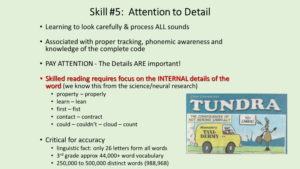
For additional information see the article Attention to Detail Explained: The Importance of Paying Attention to Detail When Reading & How to Help Your Student Develop Attention to Detail for Reading Success
B) Establishing the Foundation of Proficient Phonologic Processing ~ Learning isolated skills is not sufficient! Must combine, integrate & apply fundamental skills and develop correct efficient phonologic processing (learn to read by sounding out words!)
Correct phonologic processing is a complex process and requires mastering, integrating and applying the foundational subskill. Students need to convert print to sound so they can tap into the brains phonologic processors designed for effortlessly processing spoken sound. To do this efficiently the student must recognize the sound structure of language (phonemic awareness), directly and automatically know the phonemic code including the complexities (knowledge of the complete code). They must process print from left to right (tracking), smoothly combine sounds (blending) and pay close attention to all the letters in the words (attention to detail). Learning essential foundational skills in isolation is not sufficient. The student must not only acquire and master these individual skills but also integrate and automatically apply these skills when they read. In addition, as with all learned skills, practice with correct phonologic processing is essential to developing proficiency.
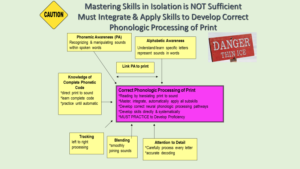
It is important to also keep in mind this initial step of ‘sounding out’, the strong phonologic processing base, is essential to develop the advanced skill of ‘fast’ fluent reading. Neural research shows fluent or ‘fast’ reading is built word by word and based on repeated correct phonologic processing. Without the essential process of correct phonologic processing (sounding out) the student will not develop ‘fast’ reading/ fluent reading pathways. Students who do not develop and use phonologic processing may work hard and eventually learn to read accurately but they will not achieve the quick and almost ‘effortless’ process of skilled reading. See How Reading Works: The Biologic Process of Proficient Reading for additional information.
In summary, to become a skilled reader the student needs to develop proficient phonologic processing pathways. To develop these proficient phonologic processing pathways the student needs to integrate and apply individual skills in phonemic awareness, knowledge of the complete phonemic code, directional tracking, blending, and attention to detail in correct print to sound processing. When teaching young children and when remediating struggling readers, it is imperative you use targeted activities and explicit instruction to make sure the student acquires all skills, converts print to sound, and develops phonologic processing pathways. The most effective and efficient method of ensuring your student develops proficient reading neural pathways is to explicitly teach the student all necessary skills with an effective complete direct systematic phonics reading program.
To learn more about establishing phonologic processing, see the article Key Points for Developing Phonologic Processing
For more information on effective instruction see Direct Systematic Phonics Instruction Proven Effective – Why Parents & Teachers Should Use Direct Systematic Phonics
C) Proficient Reading is MORE than phonologic processing. Developing Higher Level Skills to Advance to Proficient Reading
Obviously proficient or skilled reading is more complex than correct phonologic processing. Correct phonologic processing provides the essential foundational process of accurate and effortless decoding. Proficient reading is more complex and requires higher level skills in fluency, handling multisyllable words, comprehension, vocabulary, and skills such as the ability to extract necessary information.
While a strong direct systematic phonics program establishes the foundation of correct phonologic processing, this is only the beginning. The student still needs to develop higher level advanced skills in handling multisyllable words, building fluency, expanding vocabulary and improving comprehension. These skills are all enhanced by direct instruction. The most effective way to ensure a student acquires important higher level skills necessary for proficient reading is once again to directly teach those specific skills.
1. Handling Multisyllable Words
The multisyllable or longer words are harder to read. The majority of English words are multisyllable so it is critical to read them effectively. To read multisyllable words the student needs to apply a more advanced strategy. Some students automatically develop the proper strategies for reading multisyllable words but many do not and struggle with multisyllable words. Direct instruction and guided practice teach students how to handle multisyllable words.
Syllables are simply the hunks of sound within a spoken word that are said with a single puff of air. Every syllable has at least one vowel sound with or without the surrounding consonant sounds. Multisyllable words are made up of a combination of these distinct sound hunks. To read multisyllable words the student has to break the word down by distinguishing and clumping the appropriate sounds to form the correct syllables and then smoothly combining these correct sound hunks with all the adjacent syllables into one fluid word. The student needs to capture all the appropriate sound hunks in the word without missing one or adding one that should not be there. It is tricky and it absolutely takes practice to master this complex skill.
Many struggling readers have difficulty with multisyllable words. Also, some students who have a strong reading base run into problems with higher reading levels as they begin to face many multisyllable words. These students need to learn strategies for handling multisyllable words. The general rule of thumb is 1st graders should easily read 1 syllable words, 2nd graders should easily handle 2 syllable words, 3rd graders 3-syllable words and 4th grade 4 or more syllables. It is also important to realize, this advanced skill of reading multisyllable words can not be proficiently mastered until after the student is able to automatically decode and blend the individual sounds.
You can help a student develop proficiency in reading multisyllable words by directly teaching strategies to handle these longer words and by providing guided practice in reading multisyllable words. Direct instruction in reading multisyllable words is important when helping beginner readers advance and when remediating struggling readers.
For additional information see Reading Multisyllable Words: Helping Students Learn How to Handle Multisyllable Words
CLICK To Learn About Reading Multisyllable Words
2. Fluency
Fluency is ‘fast’ or ‘automatic’ reading. Fluent readers are able to read quickly and accurately without effort. Fast oral reading with proper expression is a trademark of fluent reading. Fluency is critical to skilled reading and comprehension. By appearances, the student knows words instantly and reads the ‘fast way’ without slowly sounding out the word. It seems by simply ‘knowing’ the words the individual reads easily and quickly. However, it is important to realize appearances do not reveal the actual process involved in fluent reading. To help students become fluent readers, we need to learn specifically about the actual process of fluent reading and how fluent reading is developed. The necessary answers lie in the amazing field of modern neuroscience.
The remarkable advances in neural imaging research allow scientists to look closely at the process of fluent reading and how fluent reading is developed. Researchers are learning fluent or ‘fast’ reading utilizes a neural ‘expressway’ to process words. This ‘fast reading area’ of fluency is different from the slow phonologic processing pathways used by beginning readers. With fluent reading, a quick look at the word activates a stored neural model that allows not only ‘fast’ reading but also includes correct pronunciation and understanding of the word.
Importantly, the neuroscientists are learning more about how fluency is developed. Fluent reading is established after the individual reads the word at least four times using accurate phonologic processing (slow accurate sounding out). Fluency is built word by word and entirely dependent on repeated, accurate, sounding out specific words. Fluency is not established by ‘memorizing’ what words look like but rather by developing correct neural-phonologic models of the word. Repeated accurate phonologic processing is the essential precursor for developing ‘fast’ neural pathways. In simplified terms, the repeated accurate phonologic processing engraves a neural model of the word that then is stored in the ‘fast reading area’ available for rapid retrieval. We now know fluency is not the apparent visual recognition of an entire word but rather the retrieval of the exact neural model created by proper repeated phonologic processing.
Neuroscientists also discovered dyslexic readers do not develop these fluent or ‘fast reading’ pathways. Struggling readers do not convert print to sound using phonologic processing pathways. Consequently, they fail to develop fluent ‘fast’ reading pathways. Without these express reading pathways, reading remains slow and takes much effort. Because they are not utilizing phonologic processing pathways the neural ‘engraving’ of the word is never made and fluent reading is not developed. Even if they work hard and learn to read accurately, reading remains laborious. For reading to become ‘easy’ the student must first repeatedly sound out the word using phonologic processing pathways. Students who fail to use correct phonologic processing do not develop fluency. In other words, reading a word over and over does not develop fluency unless the student is processing the print phonetically.
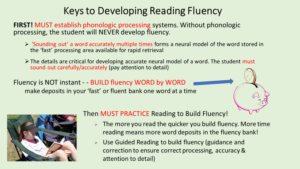
Effective reading instruction can directly help a student develop these fluent or ‘fast’ neural pathways. First, intentionally establish correct phonologic processing of print. Then provide guided practice so the student repeatedly sounds out individual words consequently expanding their storehouse of rapid retrieval neural models, allowing them to read more and more words quickly and effortlessly. Fluency is developed word-by-word and is dependent on repeated accurate print to sound (phonologic) processing.
For additional information see Reading Fluency Explained: What Reading Fluency Is, How Fluent Reading is Developed and How to Help Your Child or Student Become a Fluent Reader
3. Vocabulary
As can be expected, vocabulary knowledge is important to reading development. Vocabulary is beyond correct decoding. It is understanding the meaning of the word. Expanding the student’s knowledge bank of vocabulary words is important to comprehension. The greater the student’s vocabulary the easier it is to make sense of and understand text. Vocabulary is generally related to understanding individual words where ‘comprehension’ generally refers to understanding larger parts of the text. Vocabulary and overall comprehension are related.
Vocabulary knowledge is distinct from the skill of decoding print. A student can fully understand words he is not able to read/decode. For example, a five-year-old has a much larger speaking and understanding vocabulary than a printed reading vocabulary. He may not be able to decode the printed words ‘gorilla’, ‘vacation’, ‘Christmas’ or ‘chocolate’ but has the vocabulary knowledge to understand exactly what these words mean. In contrast a student may be able to correctly decode a strange word perfectly and still now know what it means. The student may correctly decode the word ‘placid’, ‘leviathan’ or ‘mizzen’ but have no idea what these words mean. This would be a vocabulary knowledge issue. Of course, for comprehension, the student needs to both accurately decode the word and know what the word means. Expanding a student’s vocabulary knowledge is important to reading development
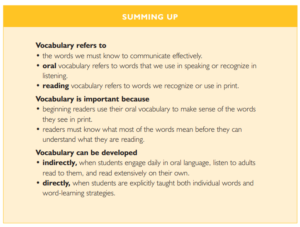
Summary from National Institute of Literacy – Put Reading First The Research Building Blocks for Teaching Children to Read page 39
For additional information and specific techniques for helping your student develop vocabulary, see the article Expanding Vocabulary Knowledge: How to Help Your Child or Student Expand Their Vocabulary Knowledge
4. Comprehension
Comprehension is deriving meaning from the text. Obviously, comprehension is critically important to the development of skilled reading. Comprehension is an active process that requires thoughtful interaction between the reader and the text. Vocabulary development is critical to comprehension. Comprehension, or reading for meaning, obviously is the goal of reading instruction.
Remember, to achieve comprehension, the student must first develop accurate phonological decoding skills and build fluency. Fluency and accuracy are critical to reading comprehension. If the student struggles with accurate fluent decoding this inability to easily convert print into language will continue to limit reading comprehension. If decoding takes significant effort, the student has little energy left to devote to thinking about what they are reading. When the student can easily, accurately and fluently decode the printed text, he then is able to focus energy on higher level comprehension skills.
Reading comprehension is a skill that needs to be developed. Comprehension is a complex higher level skill that is much greater than decoding. It is important for students to develop comprehension strategies. Comprehension strategies focus on teaching students to understand what they read not on building skills on how to read/decode. While readers acquire some comprehension strategies informally, explicit or formal instruction in the application of comprehension strategies has been shown to be highly effective in enhancing understanding (from the Report of the National Reading Panel). In other words, you can take specific actions to help students develop comprehension skills.
For additional information see Developing and Improving Reading Comprehension Skills: Overview of Reading Comprehension & Specific Actions to Help Students Develop & Improve Reading Comprehension
CLICK To Learn More About Reading Comprehension
D) Summary of Skills Necessary for Proficient Reading
Skilled reading requires the mastery, integration and application of numerous skills and knowledge. The most effective and efficient method of ensuring your student becomes a skilled reader is to intentionally and directly teach all skills necessary for proficient reading in a complete and systematic manner. Parents and teachers can use targeted activities to directly teach skills necessary for proficient reading, intentionally build correct phonologic processing pathways, and develop higher level advanced skills. An effective direct-systematic-phonics program explicitly teaches students to convert letters into sounds and then blend the sounds into words develops proficient phonologic processing of print. However, it does not constitute a complete curriculum or entire reading program. A direct-systematic-phonics program provides the essential foundation of accurate effortless decoding so the student can begin to achieve the higher goals of reading. In addition to requiring practice to build proficiency, a comprehensive reading program needs to include vocabulary, fluency and comprehension development. Other essential language curriculum areas in spelling, grammar, creative and technical writing, exposure to literature, appreciation and enjoyment of writing and ability to extract and research information from multiple sources are absolutely essential to education. The importance of these educational elements is WHY you must first get all students on the right track to reading proficiency.
Reading printed English is a complex learned skill, it is not a natural biologic development. For details Important Background Facts About Written English Language Essential to Effective Reading Instruction
The most effective and efficient way to ensure a student learns all the skills necessary for proficient reading is to directly teach them to the individual in an explicit and systematic manner. A highly effective direct systematic phonics reading instruction program helps your child or student build necessary skills and establish the essential foundation for proficient reading so they will be able to obtain the higher skills and greater objectives. For additional information see the article Direct Systematic Phonics Instruction Proven Effective – Why Parents & Teachers Should Use Direct Systematic Phonics
This list of essential skills necessary for proficient reading was compiled from the validated scientific research found in the National Reading Panel’s “Teaching Children to Read” Summary Report, the University of Oregon “BIG IDEAS in Beginning Reading”, and various research articles on the amazing neruoscientific research on how the brain functions in proficient reading. For details see Key Reading Research Findings on Teaching Reading & the Neuroscience of Proficient Reading). In addition, this list is supplemented by the author’s observations and experiences from carefully observing students who struggle with reading, evaluating the specific errors these struggling students made and learning the specific techniques that were successful in helping students overcome their reading difficulties.
Additional information how to build all skills necessary for proficient reading is located on the Free Reading Information page
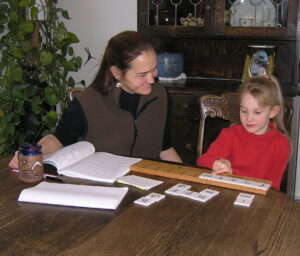
This information was provided by Miscese Gagen, a mother with a passion for teaching children to read proficiently by using effective methods. She is the author of the effective reading instructional programs Right Track Reading Lessons and Back on the Right Track Reading Lessons as well as a reading tutor with over 20 years’ experience successfully building proficient reading skills in her students. Right Track Reading empowers parents and teachers with information and resources to help their children or students achieve reading success. We CAN improve reading proficiency, one student at a time! More information at www.righttrackreading.com