Blending Explained: Why Smoothly Blending Sounds (Phonemes) When Sounding Out is Critical to Proficient Reading
& How to Help Students Develop Skills in Smoothly Blending Sounds
What is ‘Smoothly Blending Sounds’ in Reading?
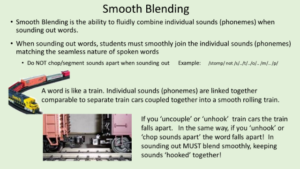
In reading, blending sounds is the ability to smoothly and fluidly combine individual sounds together into words as we read. For example, smooth blending is sounding out the word ‘mast’ as /mmaasst/ instead of a choppy or segmented /m/…./a/…./s/…./t/. In simple terms, blending is smoothly ‘hooking the sounds together’ when sounding out words. In normal speech, we smoothly and seamlessly join phonemes together into a word. In reading, the essential skill of ‘blending sounds’ is the ability to smoothly join the sounds (phonemes) together when sounding out words.
Why is Smoothly Blending Sounds Important to Reading?
To read proficiently, the student needs to learn to blend individual sounds smoothly together into words without choppy pauses between the sounds. The ability to seamlessly combine individual sounds together into the fluid word is not only vital for developing correct phonologic processing, it is also critical for developing eventual fluency. Smoothly blending sounds is one of the subskills vital to developing correct phonologic processing, the foundation for proficient reading. For additional information on correct phonologic processing and skills needed for proficient reading see Overview and Visual Representation of Skills Needed and Process of Proficient Reading
Why do you need to directly teach students skill in smoothly blending sounds together?
While many students pick up smooth blending easily and automatically, others do not acquire this vital skill on their own and need specific work to master blending sounds as they read. Difficulties smoothly blending sounds are usually evident as ‘choppy sounding out’. When a child separates the individual sounds this inability to blend smoothly can create a hurdle that blocks reading development. If the student is chopping sounds apart, they often are not able to put all the sounds together and ‘smoothly’ say the word. The student either forgets the individual sounds by the time they get to the end of the word or is unable to combine the segmented sounds into a word. Students who struggle with smoothly blending sounds often know the sounds in isolation but are unable to ‘hook’ the sounds together. An example, is the student may sound out ‘strap’ as /ss/…/t/…./r/…/a/…/p/ and then say ‘step’. They know the individual sounds but because they do not ‘hook them together’ they forget all the sounds and are unable to read the fluid word. Students who lack blending skills may initially get by with short words but quickly run into trouble with longer words containing four or more sounds. When a student has not developed the ability for smoothly blending sounds together, they make numerous errors and face difficulty with reading. Correct phonologic processing requires smooth blending.
Blending sounds is a skill easily overlooked. As proficient readers we already ‘know’ the entire word and can easily break sounds apart and effortlessly put the word together again. Since it is effortless for us, we often fail to recognize the difficulty beginners face in combining individual sounds to form words. Beginner readers do not ‘know’ the end result (the word). Therefore, choppy segmenting of sounds can prevent them from being able to combine sounds together and form the word.
To avoid potential difficulty, it is important to directly teach smooth blending skills from the beginning. The student needs to automatically engrain the skill of smooth blending. Also remember, it is always easier to develop correct techniques in the initial stages then try to ‘undo’ engrained bad habits of ‘choppy’ ‘segmented’ sounding out. Take the time to develop skills in smoothly blending sounds from the very beginning.
For additional information and details on difficulties faced when students lack smooth blending see the article Actual Errors Made by Students Who Lack Smooth Blending Skills How to Identify Skill Gaps in Smooth Blending & The Critical Importance of Developing Smooth Blending
How do I teach students to blend sounds smoothly? How to directly develop essential skill in smooth blending
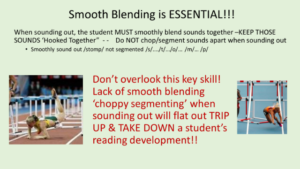
From the very beginning, directly teach the child or student to smoothly combine sounds. Do not let the child ‘chop’ sounds apart. Have the child practice smoothly blending sounds. For example, have the child sound out ‘test’ as /test/ instead of the choppy /t/…/e/…/s/…/t/. When sounding out it is essential the parent or teacher demonstrates the correct blending skills of not stopping between the sounds. Never pause between individual sounds. Teach skills in smoothly blending sounds from the beginning and specifically work on this skill with any student that has difficulty blending sounds smoothly. Smooth blending can be directly taught to with several simple techniques:
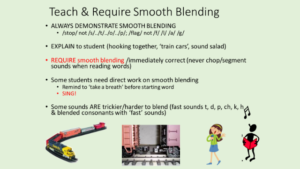
- First, the parent or teacher needs to always demonstrate correct blending skills! Never demonstrate choppy segmenting. Pay attention to how you demonstrate sounding out! Many parents and teachers inadvertently demonstrate choppy or segmented sounding out without realizing the child may be picking up incorrect techniques. Always keep sounds hooked together smoothly. If the child does not remember an individual ‘sound’ you can point to the individual sound and say the sound in isolation. However, instead of chopping all the sounds in the word apart go back and have the child ‘hook all the sounds together’ when they sound out.
- Explain blending to the student in understandable terms. Using age-appropriate terminology to explain ‘smooth blending’ of sounds. Blending can be explained as ‘keeping sounds hooked together’ or not ‘chopping up’ the sounds. For younger children who like trains, you can make an analogy to train cars coupled together. When the train cars come ‘unhooked’ the train falls apart. Words are the same way, when we ‘unhook’ the sounds the word ‘falls apart’. For older students, the straightforward explanation of ‘smooth blending’ is generally adequate. Use whatever terms you wish; just be sure the student understands they need to keep sounds hooked together so the word does not ‘fall apart’.
- Have the student ‘take a breath’ before starting to sound out a word. This intentional inhaling before starting a word helps the child get through the word before they have to pause and take a breath. This conscious reminder and effort to ‘take a breath’ before starting to sound out a word is a temporary step to help the child develop blending. After they develop smooth blending skills, this deliberate breath is no longer necessary.
- Make sure the student pronounces the sounds correctly. When ‘slowing’ down and ‘stretching out’ the word when sounding out be sure the child does not distort any sounds. Some sounds can be stretched out (such as m, f, s, a, i, o, e, l, n, r, v). Other sounds cannot be slowed down (the ‘fast’ sounds b, d, t, k, g, p, ch) and must be hooked quickly to the next sound. If you slow these sounds down you end up distorting the sound (for example /t/ as /tuh/ or /k/ as /kuh/. A few sounds are harder to say (h can be tricky) and need to be practiced.
- If a student is having trouble blending sounds, have them SING as they sound out the word. When you sing the sounds (carry a tune) it is impossible to segment sounds. I would like to thank my friend Sally for sharing this highly effective technique with me. This ‘singing’ the word is fabulously effective with the students who struggle with blending. The singing helps the child learn to smoothly ‘hook sounds together’. Once the child has developed blending skills, they no longer need to ‘sing’ the words. However, the technique of singing is one of the most effective tools for teaching smooth blending.
- If the child is separating sounds instead of smoothly blending sounds together, stop the student immediately. Don’t let the student practice incorrect skills! Remind him to keep the sounds together and have him take a breath and sound out the word again or sing as he sounds out. If needed explain and demonstrate; say something similar to “listen to how we keep the sounds together without stopping when we sound out”. If the child cannot blend STOP and work on oral blending activities until he acquires this essential skill. It is essential to develop smooth blending in the beginning. Remember, habits are harder to break. Stop, teach and build necessary skills. Always help the student learn and practice correctly!
- If the child is separating sounds instead of smoothly blending sounds together, stop the student immediately. Don’t let the student practice incorrect skills! Remind him to keep the sounds together and have him take a breath and sound out the word again or sing as he sounds out. If needed explain and demonstrate; say something similar to “listen to how we keep the sounds together without stopping when we sound out”. If the child cannot blend STOP and work on oral blending activities until he acquires this essential skill. It is essential to develop smooth blending in the beginning. Remember, habits are harder to break. Stop, teach and build necessary skills. Always help the student learn and practice correctly!
- Also, remember reading skills are not isolated tasks. The fundamental skills are interrelated. Smooth blending is related to automatic knowledge of the code. If knowledge of the phonemic code is not automatic and direct, the student often has to pause before they recall the sound resulting in ‘choppy’ sounding out. If the student is pausing because they don’t automatically know the sound, they need to do some direct practice of the print=sound code in isolation. This provides additional support for systematic presentation where the child practices reading decodable text. If the child is trying to sound out words that contain sounds they do not know, they will have to pause and think and this may hamper the development of smooth blending skills.
- If needed, use oral sound blending activities to practice and develop smooth blending skills. Use as a warm up and training drill before initial sounding out decoding when a child struggles with blending. If a child lacks blending skills, tell your child you are going to warm up by playing some fun sound games. Say “First I will say some sounds slowly. Then you say the same sounds slowly by yourself and then say them at regular speed. Let me show you how we are going to do this”. (Always DEMONSTRATE, as instructions are often not understood by children.) Say “mmmooommm” (‘mom’ stretched out); You would also say ‘mmmoooomm’ slowly and then when I ask you to say it regular you would say /mom/. Now it is your turn”
The format is:
Parent or Teacher: Say “ (the word) ” the parent slowly stretches out the word
Child: The child repeats the word slowly
Parent or Teacher: “Now say it regular”
Child: The child says the sounds at regular speed.
For Example:
Parent or Teacher: “Say ‘sssuuunn’ (the word ‘sun’ stretched out slowly)
Child: repeats “sssuuunn”
Parent: “Now say it regular”
Child: “sun”
For this blending skill development activity, use simple single syllable words. Begin with sounds that can be ‘stretched’ out and avoid the ‘fast’ blended consonant combinations until the child first masters basic blending. Some appropriate words include: me, am, if, we, in, is, at, see, same, sun, fan, fun, run, rim, ram, this, mom, his, math, slam, swim, not, nut, seed, road, that, seat, team, meat, lap, flip, top, bus, flag, vest, wish, mast, last, was.
Start simple and build skills. If the child has difficulty with these oral exercises, practice with the child. Demonstrate how to stretch out sounds keeping the sounds hooked together. Have the child practice stretching words out (saying words slowly) and then saying the words at regular speed. Once again, demonstration and practice are highly effective in helping the child learn. If necessary, the child can also ‘sing’ the words in these exercises to help develop blending. The objective is helping the child develop to the skill of smoothly blending sounds. These oral drills create awareness and build skills in smoothly blending sounds.
Concluding Information on the Importance of Smoothly Blending Sounds (phonemes) & Making sure we help children directly develop all necessary skills:
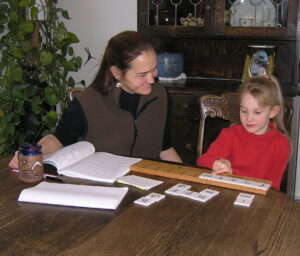
Final comments from the author based on actual experience: Do not underestimate the importance of smooth blending. It is a critical subskill of correct phonologic processing. Unfortunately, the importance of smooth blending is often not recognized. Choppy segmented sounding out alone will block students from developing necessary phonological processing skills. For example, I tutored a 2nd grade student who was struggling significantly with reading. She was a bright energetic child who had terrific phonemic awareness, knew her sounds (phonemic code) in isolation, and tracked correctly from left-to-right but still stumbled through simple words and was unable to read words longer than 4 sounds. She was in the habit of chopping sounds apart and her inability to smoothly combine sounds significantly restricted her reading. As soon as she learned to smoothly ‘hook the sounds together’ she had a rapid and dramatic improvement in her reading. This young girl, who had previously been identified as a ‘slow learner’ and recommended for retention and special education services for reading disability, quickly became a proficient reader. Years later the grandfather flagged me down to tell me his granddaughter had just graduated in the top of her high school class and received scholarships to pursue nursing degree at Montana State University. This example is another classic illustration of a child struggling with reading because she lacked a specific necessary skill and the ability of the child to succeed when acquiring the necessary skill. We can improve reading proficiency!
How do identify the lack of smooth blending in my child or student?
The inability to smoothly blend sounds together when sounding out is typically evident by listening to the student read. See the article Reading Errors Made by Students Who Lack Essential Skill of Smoothly Blending Sounds: The Critical Importance of Fluidly Blending Sounds (Phonemes) Together When Reading & How to Recognize Skill Gaps in Smoothly Blending Sounds
Reminder! Smoothly Blending Sounds is only one skill necessary for proficient reading
Remember smooth blending is only one of the skills necessary for proficient reading. See the articles Overview of Teaching Children to Read and Skills Necessary for Proficient Reading for additional information on the process of proficient reading.
Reading is complex and requires mastering and integrating many different essential skills. For additional free information, useful articles and effective resources on teaching students to read proficiently CLICK TO EXPLORE FREE READING INFORMATION
To learn more about easy-to-use and affordable tools to directly help your child or student achieve reading success PREVIEW Right Track Reading Lessons (designed for younger children) and Back on the Right Track Reading Lessons (specifically targeted for older struggling readers 3rd/4th grade to adult). Translating the science and evidence-based research into actions YOU can use with your student!
Right Track Reading ~ Empowering parents & teachers with information and resources to lead their students to reading success!
This article was written by Miscese Gagen, a mother with a passion for teaching children to read proficiently by using effective methods. She is the author of the effective reading instructional programs Right Track Reading Lessons and Back on the Right Track Reading Lessons as well as a reading tutor with over 20 years’ experience successfully building proficient reading skills in her students. The purpose of this article is to empower parents and teachers with information to help their children achieve reading success. We CAN improve reading proficiency, one student at a time! More information located at www.righttrackreading.com ~ Copyright 2004-2021 Miscese R. Gagen