Reading Errors Made by Students Who Lack Essential Skill of Smoothly Blending Sounds
The Critical Importance of Fluidly Blending Sounds (Phonemes) Together When Reading & How to Recognize Skill Gaps in Smoothly Blending Sounds
Smoothly Blending Sounds (Phonemes) is an Essential Skill for Proficient Reading
The ability to smoothly blend sounds (phonemes) together when sounding out words is an absolutely essential subskill for proficient phonologic processing. In normal speech, we smoothly and seamlessly join phonemes together into a word. To develop proficient reading, the student must learn the skill of smoothly blending sounds (phonemes) together when sounding out words. In other words, the student must blend individual sounds smoothly together into words without choppy pauses between the sounds. The ability to seamlessly combine individual phonemes together into the fluid word when sounding out is not only vital for developing correct phonologic processing, it is also critical for developing eventual fluency.
For additional information on this essential skill see Blending Explained: Why Smooth Blending Is Important to Reading Development
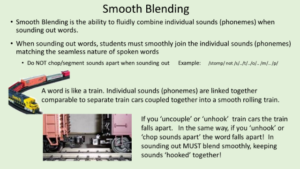
Unfortunately, the critical importance of smooth blending to proficient reading development is often overlooked or not recognized.
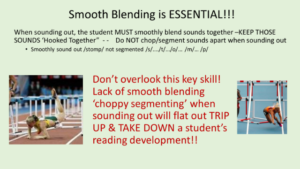
Even if a child has acquired other skills, lack of smooth blending alone will prevent the development of proficient reading. A track athlete tripping on a hurdle and falling down illustrates how lack of smooth blending flat out takes down a student’s development of proficient reading. Students who lack smooth blending make reading errors and face great difficulty in developing correct proficient phonologic processing.
Important to Recognize Skill Deficit in Smoothly Blending Sounds ⇒ How to Identify Blending Problems with Examples of Actual Reading Errors Caused by Lack of Smooth Blending
Lack of smooth blending is where a student incorrectly chops apart/segments sounds when sounding out words instead of smoothly blending sounds together. It is important to identify students who lack this essential skill of smoothly blending sounds together and provide direct instruction/practice to build this skill necessary for proficient phonologic processing.
Identify skill gaps in smoothly blending sounds by simply listening to how the student reads words. Typically, you hear the student sounding out individual sounds in a segmented/choppy manner instead of smoothly combining sounds in their first pass through word. (Evaluate reading performance by having student read random word list and also short passage.) Students who demonstrate choppy sounding out /segmenting sounds when they read words lack the essential smooth blending skill. Not only does lack of smooth blending make reading slow/laborious it alone will cause reading errors and block development of proficient processing. The following examples are all actual reading errors from students who had classic difficulty with smooth blending. (‘…’ indicate a pause)
- cap – sound out choppy /kuh/…/a/…./p/… and then go back and read cap
- net – sound out choppy /n/…/e/…./t/.. and then go back and read net
- swim – sound out choppy /s/…/w/…/i/…/m/.. and then go back and read swim
- splint – sound out choppy /s/…./p/…/lu/…/i/…/n/…/t/ & then pause to combine and say splint
Not only is choppy sounding out audibly recognizable, you can visually observe the student using an inefficient 2 step process. The student makes first pass through word saying all sounds separately and then has to go back in a second pass or separate step to say sounds together to read the word. This slow and laborious segmented sounding out can both be heard and seen when watching the student read. (BE AWARE: While not as frequent, also watch for ‘silent chopping’ where a student chops/segments sounds silently to themselves before attempting to put sounds together into a word. This weakness in blending is not as obvious as the classic, easy to identify, out loud choppy sounding out. When choppy/segmented sounding out is inaudible, watch the student and you often can ‘see’ the child mouth individual sounds silently as they use the inefficient 2 step process. While you don’t ‘hear’ the chopping, you can ‘see’ the use of the slow, laborious process of sounding out segmented and then struggling to go back and put the word together in their head before verbalizing the word. This is a strong indicator they are segmenting sounds. If you suspect this, tell the student you can tell they are working hard to figure out the word and ask them to sound words out loud for you.)
Students who lack smooth blending may ‘get by’ with reading ‘short words’ (3&4 sounds) but often run into significant issues… the high hurdle that trips them up when they try reading any words with 5 or more sounds. Notice in the following actual errors, these students sounded out all letters in the word correctly. However, with choppy/segmented sounding out they could not combine sounds into the word.
- plant – choppy sounding out all letters correctly /p/…/l/…/a/…./n/…/t/ ⇒ then said pal
- swift – choppy sounding out all letters correctly /s/…./w/…/i/…./f/…./t/ ⇒ then said fit
- splint – choppy sounding out all letters correctly /s/../p/…/l/…./i/…/n/…/t/ ⇒ then said sip
- snap – choppy sounding out all letters correctly /s/…/n/…/a/…./p/ ⇒ then said sap
- shot – choppy sounding out all letters correctly /s/…/h/…/o/…/t/ ⇒ then said stop
- wilts – choppy sounding out all letters correctly /w/… /i/…./l/…/t/…/s/ ⇒ then said quit
- plant – choppy sounding out all letters correctly /p/…/l/…/a/…/n/…/t/ ⇒ then said plan
- sprint – choppy sounding out all letters correctly /s/../p/../r/../i/../n/../t/ ⇒ then said present
- twist – choppy sounding out all letters correctly /t/…/w/…/i/…/s/../t/ ⇒ then said sent
If student demonstrates choppy/segmenting as they read. Immediately STOP them and teach smooth blending. Learning and mastering smooth blending is a critical skill and alone will have immediate and significant positive impact on reading performance! When a student learns to smoothly blend sounds together it replaces the inefficient choppy 2 step process with the correct quick/efficient smooth blending of sounds in first pass through word that is essential for building proficient reading and developing fluency.
It is incredibly exciting to help a student overcome this hurdle that blocked their reading development and watch them continue the race to proficient reading. In my tutoring cases when I evaluate a struggling reader and the student knows the sounds, is using sounding out as their approach to reading and only lacks smooth blending, I can help that student double (sometimes triple) their reading speed in only 1 or 2 reading sessions by just teaching them to blend smoothly. It is amazing – Lots of fun for me and incredibly motivating for the student! The critical skill deficit in smoothly blending sounds is a commonly encountered problem in struggling readers.
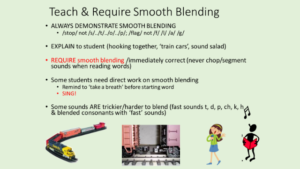
For more complete information on the essential reading skill of smoothly blending sounds and instructions on how to develop smooth blending in your child or student, see the article Blending Explained: Why Smooth Blending is Important to Reading Development & How to Help Children Develop Smooth Blending
Note: This article summarized lack of smooth blending skills. Remember skills are not isolated. Proficient reading requires the mastery, integration and application of numerous skills. Slow/choppy sounding out or slow/laborious sounding out can also be caused by gaps in code knowledge. If a student has to stop and think or try and figure out what a sound is before they apply it also will result in pauses/choppy/slow laborious sounding out. It is important to evaluate a struggling reader to determine where the student is missing skills. If a car has a broken fuel pump, replacing the transmission will not fix it… Evaluating & identifying missing skills is critical for effective intervention!
For additional information see the articles
Reading is complex and requires mastering and integrating many different essential skills. For additional free information, useful articles and effective resources on teaching students to read CLICK TO EXPLORE FREE READING INFORMATION
To learn more about effective, easy-to-use, and affordable tools to help your child or student achieve reading success, CLICK TO PREVIEW EFFECTIVE RIGHT TRACK READING PROGRAMS. Right Track Reading Lessons (designed for younger children) and Back on the Right Track Reading Lessons (specifically targeted for older struggling readers 3rd/4th grade to adult).
Translating the science and evidence-based research into actions YOU can use with your student!
Empowering parents & teachers with information & effective resources to lead their student to reading success!
This information was written by Miscese Gagen, a mother with a passion for teaching children to read proficiently by using effective methods. She is the author of the effective reading instructional programs Right Track Reading Lessons and Back on the Right Track Reading Lessons as well as a reading tutor with over 20 years’ experience successfully building proficient reading skills in her students. The purpose of this article is to empower parents and teachers with information to help their children achieve reading success. We CAN improve reading proficiency, one student at a time! More information located at www.righttrackreading.com ~ Copyright 2004-2021 Miscese R. Gagen