Reading Multisyllable Words: Helping Students Learn How to Handle Multisyllable Words
Reading Multisyllable Words – General Information
Multisyllable words are harder to read than short words. To read multisyllable words the student needs to apply a more advanced strategy. Some students automatically develop the proper strategies for reading multisyllable words but many do not and struggle with these longer words. Direct instruction and guided practice help the student learn how to handle these ‘long’ words. The majority of English words are multisyllable so it is critical to read them effectively and efficiently.
The following example illustrates why students must be able to easily handle multisyllable words. Multisyllabic words are found everywhere! Students need to be able to easily read longer words.
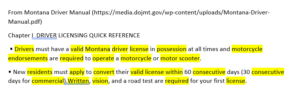
“The majority of words are multisyllabic so it is critical for students to easily read these longer words. You can directly help your student develop skills to handle multisyllable words”

Syllables are simply the hunks of sound within a spoken word that are said with a single puff of air. Every syllable has at least one vowel sound with or without the surrounding consonant sounds. Multisyllable words are made up of a combination of these distinct sound hunks. In these multisyllable words it is impossible to combine all the sounds together in one puff. To read multisyllable words the student has to not only process the print phonetically but he needs to learn how to distinguish and group the appropriate sounds together to form the correct syllables and then smoothly combine these correct sound hunks with all the adjacent syllables into one fluid word. The student needs to capture all the appropriate sound hunks in the word without missing one or without adding one that should not be there. The syllables need to be smoothly and quickly joined into one fluid word that is accented and pronounced correctly. Reading multisyllable words is a more complex process and absolutely takes practice.
Students benefit from direct instruction and practice in this complex skill of reading multisyllable words. The instruction described below is effective with students who have already established correct phonologic processing. If the student is not able to decode words applying correct phonologic processing, they will first need to establish this necessary foundation for proficient reading. For additional information see Overview & Visual Representation of Overall Process Required for Proficient Reading
Many struggling readers have difficulty with multisyllable words. Also, some students who have a strong reading base run into problems with higher reading levels as they begin to face many multisyllable words. These students need to learn strategies for handling multisyllable words. The general rule of thumb is 1st graders should easily read 1 syllable words, 2nd graders should easily handle 2 syllable words, 3rd graders 3-syllable words and 4th grade 4 or more syllables. It is also important to realize, this advanced skill of reading multisyllable words cannot be proficiently mastered until after the student is able to automatically decode and blend the individual sounds.
If your student struggles with reading you must build the foundation BEFORE working on handling multisyllable words – see articles
1) Students Who Face Difficulty Learning to Read and
2) Information on Effective Intervention to Help Struggling Readers Achieve Reading Success
You can help a student develop proficiency in reading multisyllable words by directly teaching strategies to handle these longer words and by providing guided practice in reading multisyllable words. Direct instruction in reading multisyllable words is important when helping beginner readers learn how to read, in helping novice readers advance and when remediating struggling readers.
YOU Can Directly Help Your Student Develop Skills in Reading Multisyllable Words
This remainder of this article overviews strategies to develop skills in handling multisyllable words. Activities are designed to help the student learn how to break words down into appropriate syllables, pay attention to detail, pick up all sounds and smoothly blend sound hunks. Students should practice common patterns, including the most frequently encountered affixes. Direct guided instruction in reading multisyllable words helps the student develop necessary skills so they can easily handle the ‘big’ words.
Explain to the Student:
- We will learn and practice techniques for reading longer multisyllable words or ‘tackling the big guys’.
- Syllables are hunks of sound within a word that we say in a single puff of air. ***If the student does not yet understand syllables, you MUST spend time with some oral exercises where the student says longer words and learns to hear and orally break the word into syllables. Make sure the student can orally distinguish syllables.
- To handle reading these “long” words you need to learn how to distinguish, or “see”, the appropriate syllables or sound chunks within a word and then rapidly capture all sounds and smoothly put these sound chunks together. It is a more advanced skill than simply knowing and blending the individual sounds of single syllable words together. You need to combine the sounds into appropriate ‘hunks’, capture all these syllables which usually do not have a meaning on their own and join them rapidly and smoothly with the adjacent syllables to form the word. It is almost like reading 3, 4 or more separate nonsense words and smoothly combining them into one fluid word. Plus, to top it off, you need to get the correct pronunciation and accent. This direct practice will help you learn how to easily handle these longer words.
Activities for Developing Skills in Reading Multisyllable Words
Directly Teach the Student How to Handle Multisyllable Words as part of effective direct systematic phonics instruction
When first teaching young students how to handle ‘big words’, explain they need to learn the proper technique for ‘tackling the big guys’. Once they learn how to tackle, they can easily take out the big words! This appropriate football analogy transpired when I was working with a couple of 1st graders who were extremely enthusiastic about football! Teaching students how to handle multisyllable words needs to be part of the direct systematic phonics instruction. Introduce and directly teach decodable 2 syllable words as soon as the student has mastered foundational skills and is applying correct phonologic processing (knows basic code, is tracking, blending and is sounding out single syllable words correctly). Start with 2 syllable words and then after the student easily handles 2 syllable words and has acquired knowledge of code complexities begin to incorporate some 3 syllable words.
The example below is from initial direct instruction lesson for young students on handling 2 syllable words.
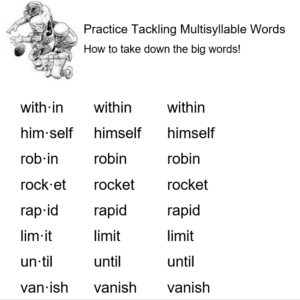
For older students, the direct instruction and practice with multisyllable words typically progresses at a faster pace. With students 3rd grade and up, I teach significantly more 2 and 3 syllable words as part of the direct systematic phonics instruction. Students who already have established correct phonologic foundation and just need to acquire the advanced skill of handling multisyllable words progress rapidly with the guided practice described in next section.
Build Skills with Guided Practice Reading Multisyllable Words – Mark syllable breaks when necessary, as the student reads
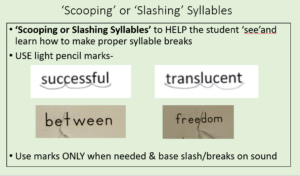
Have the student practice reading multisyllable words by reading both text containing multisyllable words and lists of multisyllable words. This needs to be guided reading with correction/feedback. As the student reads the words to you, have your pencil ready. If the student has problems with breaking words into appropriate syllables help the student by placing little light pencil mark scoops or slashes in the appropriate syllable breaks so he can better ‘see’ the syllables. For example:
inconsistent – add light pencil marks to indicate ⇒ in/con/sis/tent
protective – add light pencil marks to indicate ⇒ pro/tec/tive
This light pencil scoop or slash through the appropriate breaks and maybe a comment such as ‘take another look’ helps the student learn how to break words. Before long the student begins to ‘see’ the appropriate breaks on his own. Remember to only make the scoop or slash marks when the student needs help. The scoop or slash marks help the student learn how to handle these longer words. While both techniques work, I tend to prefer the quick and fluid motion of scooping over slashing.
Once again, as with all guided reading, make sure the student reads each word accurately. Often when students tackle multisyllable words they leave out parts, add sounds that are not there or change sounds. Stop any of these errors and have the student take another look. Make immediate corrections for any error. The correction technique of tapping the pencil on the word to signal ‘stop and look again’ is often all that is necessary. Correction is critical to developing the attention to detail and ability to pick up all sounds within a multisyllable word that is important to accurate fluent reading. Help the student by making slash marks when needed. Direct instruction with correction helps the student learn how to capture all the hunks and smoothly combine them into a fluid word.
In addition, you may need to help the student with pronunciation. When reading multisyllable words placing the accent on the correct syllable adds another level of complexity to correctly pronouncing the word. Not only does the student need to accurately sound out the word but they need to accent it correctly. If the word is familiar to the student, they usually ‘get’ the correct accenting and pronunciation. If the word is unfamiliar you may need to provide the correct pronunciation. Help the student with correct pronunciation whenever they need assistance. With improper pronunciation, you can just say something similar to “Close, but we actually pronounce the word this way _____”. Then always make sure the student re-reads the word pronouncing it correctly. This correct pronunciation is part of the ‘fluent’ neural model of the word so by all means help the student learn and practice correct pronunciation of new vocabulary.
When distinguishing appropriate syllable breaks for reading instruction, base the split on the sound structure of the word. In other words, base ‘sound hunks’ on how you say the word. This is NOT always the official dictionary syllable splits. For example, in the word “effect” you can split based on how we say the word is e-fect not the ef-fect official dictionary split. Don’t get too picky about where the word is exactly split. This is the quick sound breaks – Base it on sound! Sometimes we say words differently. (i.e. for puppy you can say either pup-ee or pup-pee…either split is fine for handling the multisyllable reading of the word). This is not learning the rules and making the official correct written syllable splits found in a dictionary but rather quickly hearing and handling sound hunks within a word for reading.
Writing Words Phonetically by Syllable
Have the student write multisyllable words by syllable based on sound. Printing orally presented multisyllable words effectively helps students learn how to tackle and proficiently read multisyllable words. Not only does printing words phonetically by syllable directly establish and develop necessary phonologic processing but it also builds understanding of the syllable structure of words. The student learns how long words break apart into smaller sound ‘chunks’ and gains knowledge of common patterns and affixes. Writing spoken multisyllable words by syllable directly strengthens the converse skill of breaking words into appropriate syllables for reading. (Note: this is based on writing the word by saying sounds of the syllables not by letter name)
Select some multisyllable words and read the words out-loud to the student. Have the student write the word by syllable as they say the sound hunk or syllable. In the beginning, they can leave a small gap between the syllables to help them ‘see’ the syllable splits. The word writing should be given to the student with specific affix or spelling patterns grouped together to help him learn and recognize common patterns in our language.
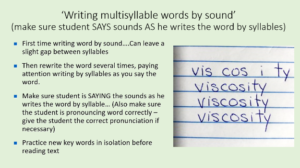
The word writing activity is an exercise in handling and processing multisyllable words NOT a spelling test. However, you do not want a student to practice spelling a word incorrectly. Help the student learn the correct spelling patterns. Help the student build skills by grouping common patterns and providing direction. Help teach correct spelling by saying “these next words are going to use the ___spelling for the ___ sound”. As they write, help with spelling hints such as the /ow/ sound in this word is spelled with “ou”, or “in this word the /s/ sound is spelled with ‘c’” . If you give a word with a ‘tricky’ spelling, teach the ‘unexpected’ portion so the student learns correctly. The following are some examples of spelling/word writing lists designed to help the student develop skills:
List 1: Please write these multisyllable words: finishing, respected, positive, reminded, inspecting, defrosting, vanishing
List 2: “These words have the -ment ending (remind the student that the e in ment sounds like an i but we spell it -ment)” and give…. placement, pavement, statement, refreshment, equipment, banishment, enjoyment, employment
Remember fluency is built by practice. If a specific word is difficult for the student, have them write that word several times saying the sounds as they print the word. This repetition of correct phonologic processing in ‘word writing’ is an excellent tool for developing fluency on a specific word.
 Learning Common Affixes
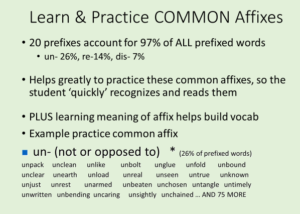
Learning and practicing common affixes helps build skills in reading multisyllable words. Although most of the common prefixes and suffixes are phonetic it helps to quickly identify the appropriate ‘chunks’ of these common affixes. Direct practice in reading common affixes helps the student quickly identify, group, and process appropriate sounds. The repeated practice builds fluency in these common affixes and greatly improves reading fluency of other words that contain the same common affixes. In addition, knowing the meaning of the common prefixes and suffixes helps students understand the word and expand their vocabulary knowledge.
There are hundreds of possible prefixes and suffixes the student will eventually need to learn. However, it is best to first focus efforts on those prefixes and suffixes that are most commonly encountered. Twenty prefixes account for approximately 97% of the prefixed words. Guided lessons working through common affixes help build skills. Have the student work through reading and writing one prefix group at a time. (*As the student reads, have a pencil ready and make slash marks to indicate syllable breaks only if and when the student needs assistance with a word. If necessary, help with pronunciation and then have the student re-read the word with correct pronunciation.)
Example of an suffix lesson: “These words have the -able ending” and give her…..washable, bendable, moveable, readable, fixable, comfortable, agreeable, employable, changeable, punishable, questionable (don’t mix -ible endings in the list when the student is practicing the -able ending). Have the student write these words phonetically by syllable and then read the words.
Example of a prefix lesson: “These words all start with the re- prefix” and give him…renew, replace, return, recheck, review, repay, refill, reflect, reprint, revisit, remind, restore. Have the student write these words phonetically by syllable and then read the words.
 Review New Multisyllable Words Before Reading a Passage
Another technique to help a student improve reading multisyllable words, is to preview the new multisyllable words in isolation before reading the passage. This is beneficial when text contains new multisyllable words/vocabulary the student is unfamiliar with. Before the student reads a new chapter, go through the text and list the new vocabulary and more difficult multisyllable words. Have the student practice reading and writing these words in isolation before he tackles the entire passage. By practicing the new words in isolation ahead of time, the student will be better prepared to read and comprehend the chapter. In addition to building fluency in reading multisyllable words, this method of previewing new words before reading text is also a terrific tool for improving vocabulary and enhancing reading comprehension.
Practice Reading Multisyllable Words
Direct guided practice with multisyllable words can be conducted with Guided Reading or with direct structured lessons. While guided reading helps develop this skill in individual instruction (such as parent reading with their child at home), structured lessons which provide targeted & direct practice in handling multisyllable words are advantageous to quickly helping a student develop this essential skill. Structured Lessons are helpful when teaching a group or class as instruction can be better organized. (Example practicing a list with a particular prefix or suffix together with an overhead presentation). Structured lessons are also important for students who face difficulty handling multisyllable words and for remediation with struggling readers. Structured lessons help students learn as they allow systematic skill development (example begin practice with 2 syllable words, then 3 syllable words, then lists with 4 syllable words). Expected patterns of the common affixes are also efficiently taught and effectively learned using pre-planned lessons/word lists. In addition, once students have acquired skills to handle multisyllable words, their proficiency continues to advance as they spend time independently reading text containing multisyllable words.
Tools to Effectively Build Skills in Handling Multisyllable Words
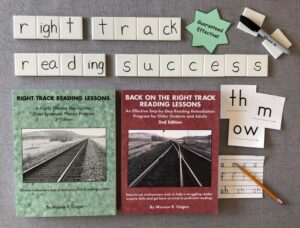
Right Track Reading Lessons (designed for younger students k-2nd or 3rd) incorporates explicit instruction on handling multisyllable words as part of the structured direct systematic phonics lessons. The program also contains an entire advanced section Reading Multisyllable Words (Multisyllable Lessons 1-12): with lessons on handling longer multisyllable words. It provides reading lists of multisyllable words including direct practice with common prefixes and suffixes. For a preview see Reading Multisyllable Words Lesson 4: Common Prefixes
Back on the Right Track Reading Lessons (targeted for older students and adults 3rd grade & older who struggle with reading) includes direct instruction to teach the student how to master the more complex skill of handling multisyllable words. The program also includes an entire advanced section Reading Multisyllable Words. These lessons o include practice of the most common prefixes and suffixes. To preview multisyllable lessons see sample lessons from Multisyllable Words Lessons 4 and 5 with Common Prefixes & Suffixes and sample from Multisyllable Words Practice Lesson 10
Empowering parents & teachers with information & effective resources to lead their student to reading success!
Reading is complex and requires mastering and integrating many different essential skills. For additional informative articles and resources on teaching students to read CLICK TO EXPLORE FREE READING INFORMATION
If you are ready to learn more about the effective, easy-to-use, and affordable tools to help your child or student achieve reading success, CLICK TO PREVIEW EFFECTIVE RIGHT TRACK READING PROGRAMS. Translating the science and evidence based research into actions YOU can use with your student!
This information was written by Miscese Gagen, a mother with a passion for teaching children to read proficiently by using effective methods. She is the author of the effective reading instructional programs Right Track Reading Lessons and Back on the Right Track Reading Lessons as well as a reading tutor with over 20 years’ experience successfully building proficient reading skills in her students. The purpose of this article is to empower parents and teachers with information to help their children achieve reading success. We CAN improve reading proficiency, one student at a time! More information located at www.righttrackreading.com ~ Copyright 2004-2021 Miscese R. Gagen