Directional Tracking Explained
Why Proper Directional Tracking (left-to-right processing) Is Essential for Reading Development & How to Effectively Teach Directional Tracking to Your Child or Student
What is directional tracking in reading?
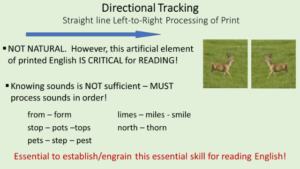
We read and write English from left-to-right. This left-to-right horizontal arrangement of print is an essential component of the written English language. Proper directional tracking is looking at and processing all the letters in order from left-to-right. Proper directional tracking is essential for reading success.
Why is directional tracking important to proficient reading?
For accurate reading, the student must process sounds in order from left-to-right. Knowing the individual sounds is not sufficient. The following words demonstrate order of the letters is important: (stop-pots-tops) (thorn-north) (no-on) (miles-limes-smile) (step-pets-pest) (every-very) (felt-left).
To read proficiently the student must not only know the individual sound but must process the letters in order left-to-right. Correct phonologic processing requires proper directional tracking. Poor readers have frequent tracking errors where they improperly process letters out of order. Poor readers often exhibit erratic eye movement as they look around for ‘whole words’ or jump around searching for familiar hunks or word families. These incorrect tracking strategies contribute to reading difficulty.
Correct phonologic processing requires sounding out all graphemes (phonograms) in order left to right, processing ALL sounds in order. To read proficiently, you can’t look at word as a whole and can’t process the printed squiggles (graphemes/phonograms) out of order. The correct detailed left-to-right processing of print is essential to skilled reading.
Why do you need to teach directional tracking?
You need to directly teach directional tracking because scanning left-to-right in a straight line manner is not a natural biologic process. Instinctively and biologically, looking all over for important elements and filtering out background non-essential details is a superior way to gather and process information. Straight line, left-to-right processing is one of the arbitrary artificial components of our man made written English language that the student must learn and automatically apply. Many children apply the natural instincts of looking all over and fail to develop the artificial straight line left-to-right tracking skills that are essential to proficient reading. Although this simple sub-skill may appear self-evident to adults who are proficient readers, many students do not recognize and apply this essential element. Remember, young children do not instinctively understand how reading print and our printed language works. (To learn more details, see Important Background Facts About Written English)
The goal is for the child or student to establish the essential left-to-right straight line processing of print when they read. The most effective way to ensure the student acquires this essential skill is to directly teach and require proper directional tracking from the beginning.
How do I teach directional tracking to my child or student? How do I help my student establish correct left-to-right tracking when reading?
The skill objective is for the child or student to acquire and automatically apply proper left-to-right straight line processing of print when they read. Effective instruction to teach directional tracking explicitly targets and build and establish this essential component of proficient phonologic processing. You can teach directional tracking with the following simple, no cost, highly effective techniques.
Effective Techniques to Directly Teach Directional Tracking – Proper Left-to-Right Processing when Reading
1) Demonstrate Proper Tracking:
Demonstrate proper tracking whenever possible by pointing and sliding your finger under the words as you read. By applying this simple act of showing left-to-right processing anytime you read to your child or students you teach directional tracking. Children learn from observation. Remember, you are teaching a fundamental component of English that is not only artificial but is also difficult for children to understand. A child cannot see how you process print left-to-right when you read. If you read without pointing, it ‘looks’ like you are just telling a great story. By sliding your finger under words as you read you visually demonstrate the proper directional tracking. The child learns from this concrete demonstration that we process print left-to-right. By demonstrating finger tracking, parents and teachers can help children engrain this necessary skill.
- Start demonstrating to your child when they are young (babies, toddlers, preschoolers). Start demonstrating this essential skill from the very beginning when you first sit your baby or toddler on your lap and read to them. Simply USE YOUR FINGER and follow under the words you are reading. By observing your physical motion, the child learns the essential left to right processing of print. Toddlers and preschoolers can even ‘help’ you read by moving their finger with yours. This is not formal lessons. This is the highly enjoyable snuggling on the couch with your child on your lap reading books together. Just add in the simple finger motion and from a very young age the child will acquire this necessary subskill of proficient reading. Children whose parents have read to them with finger tracking, acquire this proper tracking skill long before formal reading instruction begins.
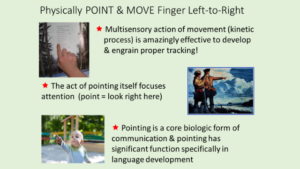
2) Require Physical Tracking:
Require the child or student to physically point and slide their finger or other pointer under the letters as they are reading/sounding out words. This simple ‘point & slide’ technique is a highly effective multisensory method to teach directional tracking. The kinetic process of physical finger motion is highly beneficial in developing and engraining this essential left-to-right processing component of English. In addition, the physical pointing is also helpful in directing and focusing the student’s attention on individual sounds/details within the word. It teaches proper left to right processing, helps them ‘keep their place’ and builds essential attention to detail.
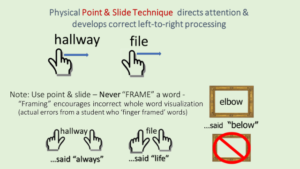
Important reminder! When pointing, make sure student is sliding finger directly under the word … (not blocking out vision with finger or hand!
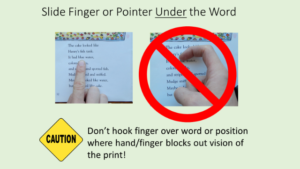
- The physical tracking (point and slide technique) is necessary in beginner readers. The physical ‘point and slide’ technique is highly effective in ensuring the child is correctly processing print left-to-right as they sound out. To effectively teach directional tracking, require physical tracking throughout the learning stages of establishing strong phonologic processing skills.
- The physical tracking (point & slide technique) is absolutely essential for students in remediation & reading intervention situations. Struggling readers often have not acquired this essential left-to-right detailed phonologic processing and frequently make errors in processing order. The physical tracking is necessary to help the student both extinguish incorrect processing of looking all over and also to build correct left-to-right processing skills. In remediation, it is essential to directly teach directional tracking and always require the student to physically move their finger or a pointer under the letters from left to right in all their reading.
- Age adaptations: Have younger children (k-1st grade) use their ‘reading finger’. For older students (2nd grade & up) have the student use a fine pointer such as toothpick, mechanical pencil or mini-screwdriver. I recommend using a fine tip pointer for all but the youngest students. As soon as they are mature enough to not be distracted by a pointer (or sword fight with the toothpick), I use a toothpick or other pointer. The ‘fine point’ is beneficial for the attention to details. Older students’ fingers are too large to achieve a point focused on individual letters. They really need to use a smaller pointer. In addition, the older students generally prefer to point with an object instead of their finger.
- Materials Needed: You don’t have to buy anything to teach directional tracking. Effective NOT expensive! All you need is your finger to demonstrate tracking and the child’s finger for them to physically track as they read. For older students, I recommend using a fine pointer such as toothpick, mechanical pencil (able to retract lead), mini-screwdriver or another thin pointer. Many commonly available items make terrific pointers! Toothpicks and mechanical pencils are my go items, but I’ve had tutoring students use mini-screwdrivers, little Lego swords, a nail, a piece of wire, a straightened paperclip, a plastic stir-stick, etc.
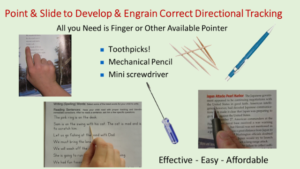

The most effective method (blue ribbon winning technique) to teach directional tracking and attention to detail essential for proficient phonologic processing is to use the “point & slide technique” where the student physically slides their finger or other pointer under the sounds of the words as they are reading. Simple! Effective! Point your way to reading success!
3) Design Activities to Teach & Reinforce Proper Directional Tracking:
Design and conduct reading activities to teach directional tracking and reinforce the necessary left to right directional tracking. Have students read word lists across the page left-to-right instead of up and down columns. Have student write across the page. Avoid activities that encourage or allow the child to ‘hop’ around the page when reading. For example, avoid the ‘letter scramble’ activities, ‘words written backwards/vertically/diagonally word worksheets, and searching for ‘hidden words’ haphazardly scattered on a page’. These type of activities in young learning stages just confuse and are contrary to developing proper tracking skills and should be avoided in reading and spelling instruction!
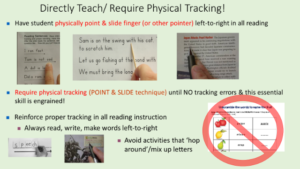
Is it necessary to have the child actually point with their finger or a pointer as they read?
Yes, it is! The importance of the physical movement (kinetic process) in tracking cannot be emphasized enough. Require the child or student to use ‘point & slide’ physical tracking in the learning stage and in the remediation stages. Not only does this motion help engrain necessary left-to-right processing but pointing at sounds also helps the child focus on and correctly process individual sounds within the word. It improves attention to detail as well as proper left-to-right tracking. It IS necessary to require physical tracking motion when teaching beginners and when remediating struggling readers.
Warning: There is significant misinformation around the act of ‘finger pointing’ in reading instruction. Recommendations that promote eliminating finger pointing are NOT based on the science of proficient reading and fail to consider the complex set of skills needed for reading. They were entirely based on invalid interpretation of correlational observations. While we do see beginning readers point and skilled readers reading fluently without pointing, correlation does NOT imply causation. (look up ‘correlation vs causation’ for information on making this false assumption). Widely spread misinformation promoting eliminating and prohibiting finger pointing originated primarily from a popular commercial curriculum program based on invalid interpretation that correlation equated to causation. Unfortunately, this popular commercial program and system promoted the incorrect assumption that the act of pointing causes slow reading and somehow skilled reading develops if you eliminate finger pointing. If preventing children from using their finger created good readers, then all those kids who have been told to ‘sit on their hands’ or to ‘not point’ or ‘pointing is just for kindergarteners’ would have become fluent readers. Although this is obviously not the case, this misinformation spread throughout the education system.
Physically pointing IS a highly effective technique to teach the necessary skills of correct left to right careful phonologic processing necessary for developing proficient reading.
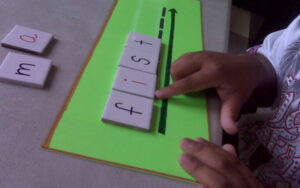
How long does the student need to point and physically track with their finger or pointer? When should you discontinue the requirement for physical pointing in reading?
As the student’s reading ability advances, they will eventually ‘outgrow’ the need to physically point at the letters and track under words as they read. As students advance in skills from developing initial phonologic processing to fluency they tend to appropriately outgrow and drop finger movement on their own.
When the student is automatically applying the left-to-right processing of all sounds, has established strong phonologic processing of print and no longer makes tracking or attention to detail errors, you can discontinue the requirement for physical tracking. If the student still needs to strengthen phonologic processing, is making tracking errors or missing details, continue to require the physical “point & slide technique”.
The goal is not pointing at print or eliminating pointing, the goal is acquiring and applying correct left to right detailed phonologic processing when reading. ‘Physical point & slide’ is just the highly effective technique to build this essential skill in correct directional processing. Once the student has mastered the necessary skills, the technique no longer needs to be used.
How is directional tracking related to vision and erratic eye movement when scanning text and reading?
If you have any concerns with your child’s vision you need to take your child to an eye doctor. Physical vision has tremendous impacts on reading (the child must be able to see the print in order to convert print to sound). However, if your child’s physical vision is fine (checked by an eye doctor) often erratic eye movement and improper tracking when reading are not the cause of reading difficulties but likely the symptoms of incorrect reading skills. Remember, reading is an artificial complex learned skill. If the child is has not learned to process print in a straight line left-to-right manner and instead is looking all over their eye movement will be erratic. Looking back and forth, trying to visually recognize ‘whole’ words, hopping around looking for known parts and word families, and other incorrect reading strategies create symptoms of erratic eye movement. Proper directional tracking is closely related to eye movement. If the child learns to process all the letters in order from left-to-right they develop straight-line smooth eye-tracking when reading.
Summary/ Key points for establishing correct left to right directional tracking in reading
- The necessary left-to-right straight-line processing of printed English is not natural. To ensure your child or student acquires this essential skill, left to right directional tracking needs to be explicitly taught.
- Demonstrate correct left-to-right straight line tracking by simply using your finger to slide under words when you read to your child or student.
- Require the student physical tracks using “point and slide” technique with finger or pointer.
- Design activities to encourage/require proper tracking. Avoid activities that could inadvertently confuse proper tracking.
Remember proper directional tracking is only one of the skills necessary for proficient reading
Directional tracking is just one skill necessary for proficient reading. Reading is complex and requires mastering and integrating many different essential skills.
- For a visual representation outlining of necessary skills and integration of skills necessary for proficient reading See Overview and Visual Representation of Overall Processes Required for Proficient Reading
- For additional details on the multiple skills needed for proficient reading, see the article Skills Necessary for Proficient Reading: Explanation of Foundational Skills for Phonologic Processing and Higher-Level Skills to Advance to Proficient Reading
Empowering parents & teachers with information & effective resources to lead their student to reading success!
Reading is complex and requires mastering and integrating many different essential skills. For additional free information, useful articles and effective resources on teaching students to read CLICK TO EXPLORE FREE READING INFORMATION
If you are ready to learn more about the effective tools to help your child or student achieve reading success, CLICK TO PREVIEW EFFECTIVE RIGHT TRACK READING PROGRAMS.
————————————————————————————-
This information was written by Miscese Gagen, a mother with a passion for teaching children to read proficiently by using effective methods. She is the author of the effective reading instructional programs Right Track Reading Lessons and Back on the Right Track Reading Lessons as well as a reading tutor with over 20 years’ experience successfully building proficient reading skills in her students. The purpose of this article is to empower parents and teachers with information to help their children achieve reading success. We CAN improve reading proficiency, one student at a time! More information located at www.righttrackreading.com ~ Copyright 2004-2021 Miscese R. Gagen