Students Who Face Difficulty Reading ~ Information on Reading Problems & Dyslexia: Why Children Face Challenges Learning to Read
Difficulty Reading: Many Children and Adults Have Problems Reading
Many individuals struggle with reading. Difficulty reading is a significant and common problem. If your child or student struggles with reading he or she is not alone. Unfortunately, many students in this country fail to learn how to read proficiently. The 2019 National Assessment of Educational Progress (NAEP) Reading Report Card reveals, 65% of the 4th graders in this country were NOT at the proficient level with an alarming 34% below the basic level. The 8th grade reports show similar rates. Even the more optimistic individual state testing results routinely show 40% failure rates. The adult literacy data shows 50% of the adults in this country are in the lowest literacy levels that limit the ability to find and keep decent jobs. The bottom line is reading IS difficult for many people.

If you suspect your child or student is having difficulty reading or is not learning to reading proficiently, you are correct to be concerned. Don’t let an explanation of “he’s coming along” or “she’s average” dissuade you from your observations and desire to take action to help them succeed at reading. Remember because difficulty reading is prevalent, ‘average’ does NOT equate to proficient. Your child can very well be facing difficulty reading even though they are considered within average performance. If you think your son or daughter or student is having difficulty reading and needs help learning to read proficiently you are likely correct.
Keep reading to learn more about reading difficulty and how you can help your child or student overcome reading challenges, learn to read proficiently and achieve reading success.
The information is organized into the following sections: (Scroll down the page OR Click to navigate directly to each section)
- What is Dyslexia?
- What Science Reveals about Difficulty Reading: Why individuals face difficulty reading (dyslexia)
- Reading Problems Start Early and Do Not Go Away
- Are Reading Problems Inherited? Does Difficulty Reading (Dyslexia) Run in Families?
- Reminder! Reading is Not a Natural Biologic Process
- How to help struggling readers develop proficient reading skills
- Learn More About Difficulty Reading
- You CAN Help YOUR Child or Student Achieve Reading Success ~ Summary & Concluding Statement
“If your bright child or student struggles with reading grade level text, they are not alone. Reading difficulty is prevalent.”
Thanks to amazing neuroscience, we now know WHY these students struggle and importantly, we know HOW TO directly help these students achieve reading success.“
What is Dyslexia?
Dyslexia was previously defined as a problem learning to read or difficulty reading age level material despite normal intelligence and physical abilities (vision, hearing). In other words, dyslexia is when an individual who has no specific physical or mental limitations had significant difficulty reading. Thanks to scientific advances we are learning much more about dyslexia and reading difficulty. We have learned this difficulty reading has nothing to do with intelligence or ability but rather with how the person processes the print. The next section explains what we have learned from the neuroscience reading difficulty and dyslexia.
Whether or not you get an official diagnosis of ‘dyslexia’ or simply realize reading is not easy for your child, it is important to recognize when a student faces difficulties reading. If your child is unable to read grade level material or can only do so with great effort or frequent errors the student is likely facing difficulties translating the black print to language. Students struggle with reading because they lack necessary skills. It is imperative to take direct action to help your struggling child or student overcome reading difficulty and achieve success.
What Science Reveals about Reading Difficulties: Why Individuals Face Difficulty Reading or Dyslexia?
Thanks to the scientific advances, we are learning much about the distinct neural processes involved with both proficient reading and difficulty reading. We now have neurobiologic evidence of why individuals have difficulty reading. These reading problems have nothing to do with intelligence or ability but rather with how the person processes the print. Scientific advances allow neuroscientists to view images of the brain as it reads and actually map out these neural functioning pathways. Scientists have mapped out neural functioning pathways involved in both proficient reading and in dyslexic reading. Researchers found proficient readers convert print to sound using phonologic processing pathways. In contrast, struggling readers have difficulty turning print to sound and fail to use or develop phonologic processing pathways. We have biologic proof the key to proficient reading is phonologic processing.
Dyslexia was previously defined as a problem learning to read despite normal abilities and intelligence. Now, thanks to amazing scientific advances, we have neurobiologic evidence of why perfectly intelligent individuals have difficulty reading. Neuroscientist discovered, Dyslexic individuals have an inherent phonologic weakness and deficit in the phonological processing component of language and therefore problems turning print into sound. The researchers discovered struggling readers use different neural pathways than proficient readers and these improper neural pathways form because the individual does not recognize the sound structure of words and process print phonetically. Struggling and dyslexic readers are NOT processing print into sound. The neurobiological research indicates there are likely two types of reading difficulties, one a genetic basis (which may impact approximately 10-15% of the population) and the other and much more common caused by environmental influence. In both cases, struggling readers fail to use phonologic processing pathways when they read. This brain imaging shows struggling readers have failed to develop the necessary phonologic neural pathways. The struggling readers are literally reading the ‘wrong way’.
Research reveals neural processing pathways first form in beginning readers. Therefore, individuals who fail to develop correct phonologic ‘proficient’ reading pathways continue to face serious and persistent difficulties. This helps explain the evidence most students who fall behind in reading skills never catch up. We now know difficulty reading persists because they are not processing the print correctly using proficient phonologic processors. Instead, they use less efficient and effective neural processing areas. These dyslexic or struggling readers have not developed the phonologic processing skills necessary for proficient reading.
This information from neuroscience is incredibly exciting. We now know why students struggle with reading and what we need to do to help students achieve reading success!
Reading Problems Start Early and Difficulty Reading Does NOT Go Away!
Children who struggle with reading difficulties early on often continue to struggle with reading. If appropriate direct intervention does not occur, most these students do not ‘catch up’ with their peers. The frequent and risky misconceptions the child or student “will pick it up later”, “will grow into reading” and “just needs a little more time” are false. The exact opposite is the documented truth. Students who are behind at the end of first grade usually remain behind. The statistics prove the vast majority of the children who were poor readers in first grade were poor readers in fourth grade. (Chart below from ‘The Scope of Reading Difficulties in America’ – University of Oregon’s Big Ideas in Beginning Reading
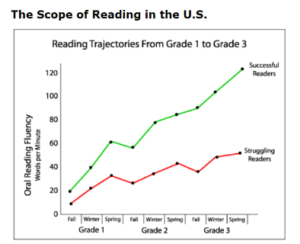
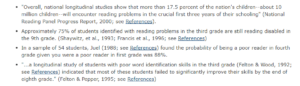
The neuroscientific neural research explains WHY we documented students who struggled with reading early on rarely caught up. We have neurobiologic proof reading difficulties do not ‘go away’. The brain imaging research shows the ‘incorrect’ dyslexic neural pathways first develop in beginning readers. Reading problems persist because struggling readers lack necessary phonologic processing pathways. They are literally reading the wrong way. To correct reading problems, it is critical to directly intervene and teach your child with an effective direct systematic phonics program that intentionally develops necessary phonologic processing pathways. Effective intervention to build correct phonologic pathways is critical and the earlier the better. Do not wait!
Sometimes students ‘get by’ with incorrect processing in the lowest grades (K, 1st). The easy reading material, illustrations, context clues, oral directions and limited depth of content can disguise their difficulty decoding print. For example, if the child looks at the picture or memorizes repetitive text it appears he can ‘read’. However, students who have not developed necessary phonologic processing rapidly run into problems as vocabulary expands and text complexity advances. The incorrect strategies of ‘whole word’ visual memorization, word guessing, context clues and predictable text fail as reading level advances. This is often why ‘reading problems’ often become evident in 2nd or 3rd grade. In reality, the ‘difficulty’ processing print already existed. To read proficiently, the student must process print phonetically. Students who don’t develop phonologic processing pathways face persistent difficulty reading.
Are Reading Problems Inherited? Does Difficulty Reading (dyslexia) Run in Families?
Dyslexic tendencies (difficulties reading) definitely do appear to run in families. However, since you cannot inherit the ability to perform an artificial learned skill, the ability to read itself is not inherited. Rather, from the research these observed and well documented ‘family dyslexic tendencies’ result from an inherited phonologic weakness. The phonologic weakness that is the hallmark of dyslexic readers definitely can be inherited. The neural research shows dyslexic individuals have an inherent phonologic weakness and deficit in the phonological processing component of language. Some people inherently have a harder time recognizing the sound structure of language. It is more difficult for individuals with poor phonemic awareness to develop the phonologic processing pathways necessary for proficient reading. Also remember poor phonemic awareness is not related to intelligence. Very bright individuals can have phonologic weaknesses. In summary, it is the inherited phonologic weakness that leads to a higher risk of developing reading problems that causes reading difficulties & dyslexia to run in families.
While inherent phonological weakness appears to predispose some children to develop reading problems, family genetic traits are NOT the only influence in reading success. The neurobiological research indicates there are likely two types of reading difficulties, one a genetic basis (these are the classic ‘dyslexic’ students with definite genetic phonologic processing weakness impacting approximately 10-15% of the population) and the other and much more common difficulty reading caused by environmental influence (not genetic weakness but rather an environment that failed to build phonologic processing and proficient reading skills). In both cases, struggling readers fail to develop and use the necessary phonologic neural processing pathways when they read.
The effectiveness of reading instruction has significant impact on reading success. You can’t control the genetic influence BUT you CAN directly develop phonemic awareness and use reading instruction that intentionally and directly develops phonologic processing pathways. Research shows direct phonemic awareness training as significant positive impacts on reading and spelling success! Not only can you help a child develop phonemic awareness, you can also help your child develop ‘proficient reader’ phonologic processing pathways. A direct systematic phonics program teaches the reader to convert print to sound and intentionally develops phonologic pathways which are essential to overcoming difficulty reading and building proficient reading.
Students with inherent phonologic weakness are at higher risk for reading difficulties because they are unlikely to develop necessary proficient reader phonologic processing pathways on their own. To ensure these students learn to read it is particularly important to use directly develop phonemic awareness and intentionally establish proficient phonologic processing of print. You don’t need to worry if your child inherited poor phonemic awareness; you just need to be sure and use effective instruction to directly develop phonemic awareness and establish (force) essential phonologic processing of print.
Reminder ~ Reading is NOT a Natural Biologic Process!
Reading is not a natural biological process. Reading is a complex learned skill. Consequently, children do not naturally develop reading skills. See the articles Overview of Teaching Children to Read and Important Background Facts about the Written English Language. Everyone has to learn how to read. (The fictional Tarzan character was the only kid who successfully learned to read with no instruction.) To effectively and efficiently perform this artificial task of turning man-made black squiggles into language, the student needs to tap into the existing brain functioning areas naturally designed to efficiently process spoken language. While some students pick up necessary skills many do not. By directly teaching the student to convert print to sound you intentionally develop the necessary proficient processing pathways.
How to help struggling readers develop proficient reading skills
We can absolutely help struggling readers develop proficient reading skills. Thanks to the incredibly exciting information from neuroscience we know why students struggle with reading and what we need to do to help students achieve reading success! We need to develop phonologic processing pathways.
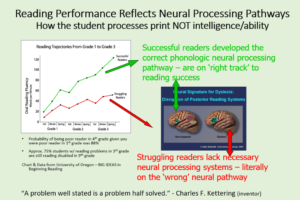
The terrific news is not only do we know what we need to do (help students develop phonologic processing pathways) but we also know exactly how to accomplish this goal. We use effective targeted reading instruction to intentionally and directly build necessary skills and phonologic processing pathways. Years of valid evidence based research has proven that direct systematic phonics is the most effective way to help struggling students develop proficient reader skills.
Now, we have definite neurobiologic proof (neural mapping) that instruction with direct phonologic based reading programs can actually ‘re-wire’ the brain and develop necessary phonologic processing pathways in both children and adults. Effective programs that specifically taught letter-sound correspondence not only noticeably improved reading skills in struggling readers, but actually changed neural activity from incorrect neural pathways to the “correct” pathway that good readers use. The phonologic processing seen in dyslexia was reversed with intense phonologic based intervention. Neural imaging showed reading intervention that enabled children to improve phonologic decoding skills successfully changed activation to normal patterns. Phonologically targeted intervention builds proficient phonologic pathways. The proven ability of direct systematic phonologic based reading instruction to actually develop correct proficient reader phonologic pathways in dyslexic individuals is the most exciting element of the neurobiologic reading research
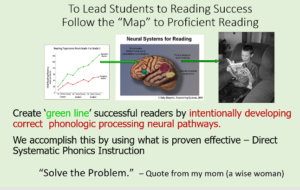
Brain imaging research on dyslexia and phonologic based intervention validates and supports the existing results-based evidence. For decades, valid results-based research has shown direct systematic phonics programs are the most effective approach for teaching children to read. The recent neural functioning research shows us why the direct systematic phonics programs work. Strong direct systematic phonics programs ‘work’ because they intentionally help the student develop correct phonologic processing pathways and build proficient reader skills. See the article Direct Systematic Phonics Instruction Proven Effective Why Parents & Teachers Should Use Direct Systematic Phonics
Learn More About Difficulty Reading
If your child has been labeled ‘dyslexic’ or you suspect your child is facing difficulties reading, I highly recommend learning more about the incredible neuroscientific research and valid evidence-based effectiveness of direct systematic phonics. This research provides solid scientific information on dyslexia (not theory, opinions, or marketing propaganda but solid science). Many books on dyslexia simply give ways to ‘manage’ the symptoms of poor reading. In contrast, the research gives scientific neural-biologic basis for dyslexia and provides information on how to actually develop proficient reading skills to overcome reading difficulties. I also highly recommend reading the research that specifically address the effectiveness of direct systematic phonics intervention in improving reading and in developing correct neural pathways. A listing of key research and links can be found in the detailed article Key Research Findings on Teaching Reading & the Neuroscience of Proficient Reading.
You CAN Help Your Struggling Child or Student Achieve Reading Success!
You can help your child or student overcome their struggles and develop proficient reading by direct intervention with an effective direct systematic phonics program. The neural imaging research clearly shows effective phonemic based instruction not only improves reading skills but actually develops correct proficient reader neural pathways. The earlier you intervene, the better. Be sure the program you select meets the criteria of effective direct, systematic phonics based reading instructional program. For more information read the articles:
- How to Help a Student Overcome Reading Difficulties & Develop Necessary Proficient Reader Skills
- Effective Reading Intervention to Help Struggling Students Achieve Reading Success
The bottom line is students struggle with reading because they lack specific skills and have not developed correct processing pathways. You can absolutely help your struggling child or student achieve reading success by ‘following the map’ and intentionally developing phonologic processing pathways. We accomplish this by directly teaching the complex set of skills needed for reading by using proven effective tools, direct systematic phonics programs.
Concluding Personal Statement from Miscese Gagen
If you child or student is struggling with reading or dyslexic, you can definitely help them build necessary skills and achieve reading success. This is not an empty promise based on wishful intentions. I have successfully tutored students for over 20 years. The vast majority of my tutoring students significantly struggled with reading as parents call me for help when their child is having challenges. (I don’t get calls to tutor successful readers). When I first sit down with a student, I always promise them “I will make reading easier for you”. I have NEVER broken this personal promise and am always successful in helping students build reading skills because I use explicit instruction with my effective direct systematic phonics programs. While the science and research clearly validate the effectiveness of direct systematic phonics, it is my personal experience time after time, watching previously struggling students achieve success that convinces me beyond a doubt, we can help all students overcome reading difficulty and learn to read.
A very important point understand about the individuals who are classic ‘dyslexic’ with strong biologic characteristic of phonologic weakness. These ‘dyslexic individuals who represent approximately 10-15% of the population, do face additional challenges in learning to read proficiently. It takes a more effort to build skills because with their definite phonologic weakness, they do not naturally and easily tap into phonologic processing pathways. Ongoing neuroscientific research is expanding knowledge on dyslexic individuals. As frequently noted, dyslexic individuals have a phonologic weakness but they often are bright, creative, exhibit amazing visual processing abilities, and possess strong reasoning skills. It is extremely important to realize when you have a dyslexic student with these impressive skills, teaching them to read with a strong direct systematic phonics program absolutely will not change or eliminate their strong assets or diminish these natural strengths. Working with targeted effective direct systematic phonics program simply forces them to develop phonologic processing for converting print to sound to use when they read print. I have successfully tutored numerous classic ‘red flag’ phonemic weakness dyslexic students, including my youngest daughter. All of them learned to read proficiently.
Empowering parents & teachers with information & effective resources to lead their student to reading success!
Reading is complex and requires mastering and integrating many different essential skills. For additional informative articles and resources on teaching students to read CLICK TO EXPLORE FREE READING INFORMATION
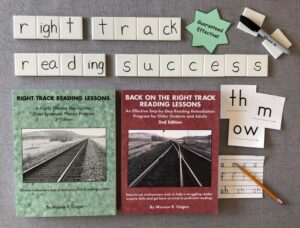
If you are ready to learn more about the effective, easy-to-use and affordable tools to directly help your child or student achieve reading success CLICK TO PREVIEW Right Track Reading Lessons (designed for younger children) and Back on the Right Track Reading Lessons (specifically targeted for older struggling readers 3rd/4th grade to adult). Translating the science and evidence-based research into actions YOU can use with your student!
This information was written by Miscese Gagen, a mother with a passion for teaching children to read proficiently by using effective methods. She is the author of the effective reading instructional programs Right Track Reading Lessons and Back on the Right Track Reading Lessons as well as a reading tutor with over 20 years’ experience successfully building proficient reading skills in her students. The purpose of this article is to empower parents and teachers with information to help their children achieve reading success. We CAN improve reading proficiency, one student at a time! More information located at www.righttrackreading.com ~ Copyright 2004-2021 Miscese R. Gagen