Overview Children Learning to Read & Developing Proficient Reading
Why Reading Is Difficult for Many Children and What You Need to Do to Make Sure Your Child Develops Proficient Reading
We all want our children and students to learn to read proficiently!
Obviously, we all want our children to read proficiently! They need to be able to look at black squiggly marks on a page and translate this written code into our English language. Proficient reading is the key that unlocks the door to the vast wealth of information and literature and is critical to a successful education. When a child or adult, struggles with reading, they suffer in other areas of education because they cannot easily access the information contained in our written language. We strive for all our children and students to achieve reading success.
Many Children & Students Face Difficulty Achieving Proficient Reading
Unfortunately, difficulty reading is a significant and serious problem throughout our country. If your student struggles with reading he or she is not alone. In 2019, 65% of the 4th graders in this country were NOT at the proficient level. Even more alarming 34% of the 4th graders were below basic level. The 8th grade reports show similar rates. (From the 2019 National Assessment of Educational Progress (NAEP) Reading Report Card www.nces.ed.gov/nationsreportcard/reading)
While the accuracy of various testing measures can be debated, proof of prevalent reading difficulty is reflected in adult literacy rates. Difficulty reading is far greater than the limited scope of a student’s ability to read stories, complete classroom assignments or pass standardized tests. The end result is limited literacy skills that handicap the individual’s educational potential, future employment opportunities, earning potential, and ability to access opportunities. The National Institute for Literacy (NIFL) states “Literacy experts believe adults with skills at Levels 1 and 2 lack a sufficient foundation of basic skills to function successfully in our society.” Approximately 50% of adults have significantly limited literacy skills. (From NIFL: The State of Literacy in America, 1992 National Adult Literacy Survey www.nifl.gov)
The purpose of this article is not to debate problems and challenges with the education system or to discuss the serious consequences of poor literacy rates, but rather to empower parents and teachers with information and effective tools to help individual students acquire necessary skills to read proficiently. Our children cannot afford to wait for long term solutions. Parents, teachers and other caring adults have the immediate power to make a significant impact on individual children. By taking direct action with individual children, we can begin to solve this country’s significant reading proficiency problem from the bottom up. We can improve reading proficiency rates… one child, one parent, one teacher, one classroom at a time!
The bottom line is reading is difficult for many students. It is critical to directly help students acquire skills necessary for reading success. When a student struggles, we need to intervene and take direct, effective action to develop the exact skills necessary for proficient reading. We can effectively help a student learn to read proficiently by intentionally teaching exact necessary skills in a direct, systematic and complete manner.
Brief Background on Reading Printed English Language
To read, an individual needs to be able to look at black squiggly marks on a page and translate this written code into our English language. While ‘reading’ obviously is more than decoding, this decoding or changing print into words of our language is a necessary foundational skill. The decoding needs to be effortless so the student has mental energy left over for the higher process of what and why they are reading. The student must master accurate and effortless decoding in order to achieve comprehension, enjoyment, content learning, critical analysis and the other higher level objectives of proficient reading. Although proficient decoding is not the reason why we read, it is a foundational skill essential to reading success.
First, we need to understand English is a phonetic language. That means words are made up of sounds blended together. The alphabetic characters, the artificial black squiggly marks, are the way we show our phonetic language on paper. In English, written letters and combinations of letters represent specific sounds. To read, we need to translate or decode these black squiggly marks back into the sounds that blend to form specific words. Although it is not perfect and there are numerous complexities, written English absolutely IS a phonetic alphabetic code. In linguistic history written phonetic alphabets replaced pictograph alphabets precisely because there were too many words to represent with pictures.
- For details and additional information, see the article Important Background Facts on the Written English Language Essential for Reading Instruction.
Reading Print Can Be Challenging for Children
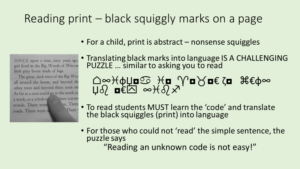
It is important to realize reading, translating the man-made black squiggles of our written English language, is NOT an innate natural biological process. Not only is reading an artificial complex learned skill, but children are often naïve about written language. Many don’t have a clue how our written language works. Many do not understand how letters represent sounds blended into words that make up our oral phonetic language. Even basic components of our written language, such as left-to-right tracking are not always evident to the child.
The reality is, children face a challenging puzzle when they first try to read written words. Think about it! Try to read a simple sentence, where known letters are replaced with some alternate squiggles. See if you can read the following simple sentence…

This is the exact type of challenging puzzle children face with reading print! Our alphabet presents a similar system of artificial nonsense squiggles. To solve the puzzle, the child needs to learn the code. By the way, the answer to the puzzle is “Reading an unknown code is not easy!”
Because you are teaching a complex and artificial process to a naïve child, it is important to teach them in an explicit, systematic and complete manner. It should not be left to chance for the child to figure it out on their own. While some children do figure out and acquire the skills to read, no matter how you teach them, many do not learn. If the child fails to acquire necessary skills or knowledge, they face serious and persistent difficulty reading.
What is Involved in Reading Proficiently? We are Learning How Proficient Reading Actually Works!
Scientists are learning how the brain functions as it reads proficiently. Scientific advances allow neuroscientist to view images of the brain as it reads and actually map out these neural functioning pathways. We are learning much about the distinct neural processes involved with both proficient reading and difficulty reading. Neuroscientist discovered proficient readers convert print to sound using phonologic processing pathways. In contrast, struggling or dyslexic readers process print using different neural pathways. Struggling readers do not recognize the sound structure of words and fail to develop necessary phonologic processing pathways. We now have biologic proof the key to proficient reading is phonologic processing. The neural research is providing valuable information how the correct phonologic processing pathways are first formed in beginning readers and also details on how the more advanced fast reading pathways of fluent readers are formed. The brain imaging studies reveal students must convert print to sound and develop correct phonologic processing pathways. Remember reading is an artificial learned skill. When students convert print to sound, they tap into the brains phonologic processors designed for effortlessly processing spoken sound.
- For additional information and details please see the article: How Reading Works: The Neurobiologic Process of Proficient Reading & Proof WE CAN Help Students Learn to Read Proficiently
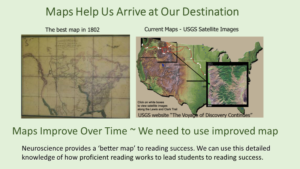
We have the “Map” to Proficient Reading – – We Can Use this ‘Map’ to Lead Students to Reading Success!
The neuroscience, literally provides us with a ‘map’ to proficient reading. It reveals the neural phonologic processing pathways are vital for reading success. We have not only learned the actual processing pathways essential for reading proficiently but we discovered phonologic based instruction can intentionally develop these correct phonologic neural pathways. It is time to use these improved maps to make sure we lead all students to the desired destination of reading success!
Direct Systematic Phonics Builds Proficient Reading – Proven to Work by Neuroscience and Valid Evidence Based Research
Importantly, the brain imaging studies actually show intensive phonologic programs actually developed correct neural pathways in struggling readers. In other words, effective direct systematic phonics programs that specifically taught letter-sound correspondence not only improved reading skills but also changed brain activity to the ‘correct’ neural pathways that good readers use. For years validated research has shown direct systematic phonics programs are the most effective way to teach children to read. This brain imaging research shows us why these phonologic based programs work. They intentionally develop the phonologic processing pathways that are necessary to read proficiently.
Parents and teachers can use a strong direct systematic phonics program to intentionally and explicitly build the neural pathways necessary for proficient reading and to directly develop all necessary skills. Direct systematic phonics directly teaches the student to convert print to sound so they can tap into the brains phonologic processors designed for effortlessly processing spoken sound.
A highly effective direct systematic phonics reading instruction program helps your child or student build necessary skills and establish the essential foundation for proficient reading so they will be able to obtain the higher skills and greater objectives.
- For details and additional information see the article: Direct Systematic Phonics Instruction Proven Effective – Why Parents & Teachers Should Use Direct Systematic Phonics
Use Direct Instruction to Explicitly Teach and Develop ALL Skills Necessary for Proficient Reading
Proficient reading is a complex learned skill requiring the mastery, integration and application of numerous sub-skills and knowledge. Skilled reading involves both 1) establishing a foundation of phonologic processing of print and then 2) developing higher level or advanced skills. To become a skilled reader, the student must first convert print to sound and establish ‘proficient reader’ neural processing pathways. To do this efficiently the student must recognize the sound structure of language (phonemic awareness), directly and automatically know the phonemic code including the complexities (knowledge of the complete code). They must process print from left-to-right (tracking), smoothly combine sounds (blending) and pay close attention to all the letters in the words (attention to detail). Learning the individual components in isolation is not sufficient. The student must not only master these individual skills but also integrate and automatically apply these skills when they read. In addition, as with all learned skills, practice with correct phonologic processing is essential to developing proficiency. After the essential foundation of phonologic processing is established, it is equally important for the student to develop the advanced or higher level skills including handling multisyllable word, building fluency, expanding vocabulary and developing comprehension skills and strategies. These interrelated skills necessary for proficient reading must be acquired, mastered, integrated, applied and PRACTICED for the student to become a skilled reader!
The most effective and efficient way to ensure a student learns all necessary skills is to directly teach them to the individual in an explicit and systematic manner. Never leave it to chance for a child or student to acquire reading skills on their own!
- For a visual overview of the skills needed see Visual Representation & Overview of Key Skills and the Process of Proficient Reading
- For a more detailed explanation of skills see the article: Skills Necessary for Proficient Reading: Explanation of Foundational & Higher Level Skills Needed to Read Proficiently
You CAN Ensure YOUR Child or Student Develops Proficient Reading & Achieves Reading Success!
To sum it up, reading is not a natural biologic process. Speech is a natural process. Our brain is biologically wired to process speech and sound. To effectively and efficiently perform the artificial task of turning man-made black squiggles into our language, the child needs to tap into the existing brain functioning neurological pathways naturally designed to process sound. The brain imaging research shows us to read proficiently your child must be using the phonologic processors. If he fails to use phonologic processors, he faces persistent difficulty reading proficiently. The scientific evidence clearly shows us the specific program of reading instruction has a significant effect on rates of reading success. Direct systematic phonics programs are the most effective way to teach children to read. We can intentionally help children develop specific skills necessary for proficient reading. It is like railroad tracks leading from a beginning point, if the child accidentally gets on the wrong track, they will never make it to the proficient reader station unless direct appropriate intervention occurs. In contrast, an effective direct systematic phonics program helps ensure the child is on the right track to reading success.
In Conclusion:
- Reading IS difficult for many individuals. Converting artificial black squiggles to language is not a natural biologic process. It is a complex learned skill many children fail to acquire. If your child or student struggles with reading, direct effective intervention is essential. For additional information, please see the article Students Who Face Difficulties Learning to Read: Information on Difficulty Reading and Dyslexia
- We have neurobiologic proof: To read proficiently, individuals need to convert print to sound using highly efficient phonologic neural processing pathways. The neuroscience has provided a ‘map’ to reading success!
- To develop the foundation of correct phonologic processing of print the student must acquire, master, integrate and apply skills and knowledge in phonemic awareness, knowledge of the complete phonemic code, smooth blending, proper directional tracking and attention to detail. As with any complex learned skill, the most effective way to ensure your child acquires skills is to directly and systematically teach each necessary skill to the child.
- Teaching methods do matter! The validated research clearly shows that most effective way to teach reading is with a direct systematic phonics program. We need to directly and systematically develop phonemic awareness, teach the necessary printed letter= sound relationships, and skills in blending, tracking and attention to detail. The brain imaging research shows direct phonologic based programs effectively develop phonologic processing pathways necessary for proficient reading. Use direct systematic phonics to build proficient reader neural processing pathways!
- Reading is more complex than decoding. After the student develops the necessary foundation of phonologic processing of print the student needs to develop the higher level skills in handling multisyllable words, building fluency, expanding vocabulary and developing comprehension. These advanced skills are all enhanced by direct instruction.
- Most importantly, with an effective direct systematic phonics program followed by direct instruction in higher level skills you can intentionally help your child develop skills necessary to read proficiently. Teaching a child or student to read proficiently is a wonderful and rewarding experience! We can achieve success, one child at a time.
Parents, teachers and other caring individuals empowered with accurate information and effective resources can have immediate impact on reading proficiency by 1) teaching their own children or students with effective direct systematic phonics programs, 2) encouraging schools to adopt effective direct systematic phonics programs, and 3) after successfully teaching your own child, finding the time to teach at least one other child how to read. We can improve reading proficiency rates in this country… one child, one student at a time!
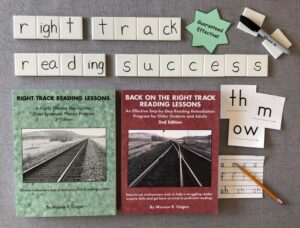
If you are ready to learn more about the effective tools to help your child or student achieve reading success… CLICK TO PREVIEW EFFECTIVE RIGHT TRACK READING PROGRAMS.
Empowering parents and teachers with information & resources to lead their students to reading success! Access additional informative articles and resources on teaching students to read… CLICK TO EXPLORE FREE READING INFORMATION
This article was written by Miscese Gagen a mother with a passion for teaching children to read proficiently by using effective methods. She is the author of the effective reading instructional programs Right Track Reading Lessons and Back on the Right Track Reading Lessons. and a reading tutor with over 20 years’ experience successfully building reading skills in her students. The purpose of this article is to empower parents and teachers with information to help their children achieve reading success. We CAN improve reading proficiency, one student at a time! More information is located at www.righttrackreading.com ~ Copyright 2005-2021 Miscese R. Gagen (article originally written in 2005 and updated 2007 and 2021