Explaining Effective Reading Intervention or Remediation Program to a Student
Help the Struggling Reader Understand Effective Reading Intervention
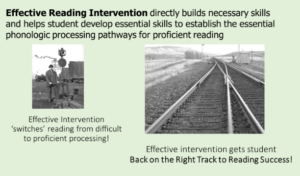
Before starting an effective reading intervention or remediation program with a struggling reader, it is important to explain the program to the student. You need the student to understand effective reading intervention directly teaches and develops essential skills to raise the student to the proficient level. Make sure the student understands the effective reading intervention and program of instruction you are going to do with them is NOT teaching down at lower level but rather building necessary skills to help bring the student up to proficient level. The intervention is designed to build skills so the student gets on the ‘green line’ to reading success!
The student’s effort and attitude impact how quickly they learn. Motivated students progress faster than students with a poor attitude. Help the student develop positive attitude toward the effective reading intervention program. Some older students are frustrated with their failure and have developed a negative attitude towards reading. Remember, this ‘dislike’ of reading is human nature. We tend to ‘dislike’ and avoid activities we find difficult or fail at frequently. Make sure they understand this is not just ‘more of the same’ but rather targeted instruction that will directly develop missing skills and help them achieve success.
“Effective reading intervention directly builds skills so the student can achieve reading success.“

Key Points the Struggling Reader Needs to Understand About the Reading Intervention or Remediation Program
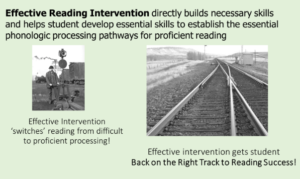
Before beginning an intensive reading remediation program, help the student understand the effective reading intervention or remediation program. Explain the effective remediation plan to the student. The student needs to realize
1) Reading is a complex learned skill.
2) Reading problems are common.
3) Reading problems have nothing to do with intelligence or ability but rather how the student is processing print.
4) Students struggle with reading because they lack specific necessary skills such as weakness in phonologic processing or other fundamental skills (use results from the evaluation to pinpoint and share the specific skills the student needs to strengthen).
5) Effective reading intervention targets instruction to directly strengthen or build the weak or missing skills so their reading improves.
6) Because they are older and have significant background knowledge and higher-level skills they can advance rapidly.
7) With some direct work you are confident they will develop proficient reader skills.
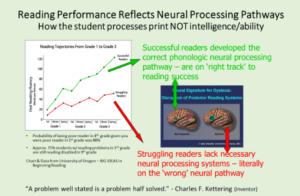
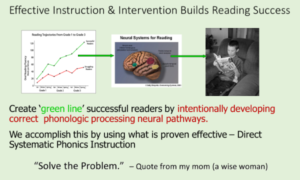
Explain Key Points of Reading Difficulty & Effective Reading Intervention to the Student
Before beginning the structured reading remediation program give the student a quick summary of what you are doing with the instruction program and why this will help them become a successful reader. Use your own words with individualized explanations to help the student understand. The explanation should include the following information:
- Reading is a complex learned skill. Think about some of the other learned skills you enjoy (Give an analogy to an activity the student enjoys and can relate to: softball, soccer, basketball, piano, dance). If someone hadn’t taught you the essential subskills in the beginning you would probably have difficulties performing the advanced skills. For example, think about trying to make a home run if you were holding the bat incorrectly, or playing a song on the piano if you never learned the basic notes, or playing varsity in a basketball game if you never learned how to dribble or learned the plays. You have had problems reading and spelling because you are missing some essential skills. Share appropriate information from Background Facts about Written English
- Reading print is not a natural biologic process. Reading is complex. It requires looking at man-made, arbitrary black squiggly lines and changing that written code into our spoken language. To read proficiently you need to use the brains natural system for processing sound. These sound or phonologic processing pathways are essential to proficient reading. If you use other processes, reading will require much effort and remain difficult. Most problems with reading have nothing to do with intelligence or ability but rather by incorrect processing. Many very intelligent people face difficulty reading. You are likely having problems reading because you are not using these proficient phonologic processors. You probably were never specifically taught the necessary steps for reading proficiently or were taught in a way that accidentally allowed you to learn incorrectly. Share information from How Reading Works, Show the skills needed to read from Overview and Visual Representation of the Process of Proficient Reading and Share appropriate additional information from Students Who Face Difficulties Learning to Read.
- You are not alone in your problems reading. Approximately 65% of the students in this country can NOT read proficiently and 35% can not read at even a basic level. (If it helps show your student the actual statistics from your state located in the Reading Report Card on NAEP website. Direct links to this site can be found at the linkspage of the Right Track Reading website.)
- The good news is effective reading intervention and targeted instruction improves reading. Even adults who have struggled for years can have dramatic success when they are taught with direct systematic phonics programs. Effective direct systematic phonics instruction is proven to not only improve reading skills but to actually develop the neural pathways necessary for proficient reading. With an effective reading intervention with direct instruction and work and practice on your part, you can develop the skills necessary for proficient reading. Show the student some of the research studies where direct intensive phonics instruction improved reading skills and developed phonologic processing pathways in struggling readers. Links to several studies can be found at Key Reading Research Findings on Teaching Reading & the Neuroscience of Proficient Reading
- Explain the intent and purpose of effective reading intervention. Make sure they understand, this intervention program will help them achieve reading success. (I tell students, by doing this work, they will build skills and reading will become easier for them.) – For additional information see Effective Reading Intervention to Help Struggling Students Achieve Reading Success
- Because you are older, your experience and background knowledge will help you learn quickly and progress at a much faster pace than a young child just learning to read. Older students can progress as a very rapid rate.
- It is my job to specifically teach you all the necessary steps to read our complex language. Before starting, I want you to know that I will stop you if you start to perform a skill incorrectly. It’s my job to make sure you learn the right way and practice correctly. Remember correction is not negative. It helps you learn correctly and develop proficient reader pathways.
- Don’t worry if the first lessons seem too easy. These are the ‘warm up drills’. To develop proficiency, it is important to learn and practice correct technique. Repeated drill in fundamental skills is necessary. The initial reading lessons make sure you master the correct techniques and basic fundamentals. Compare these initial reading lessons to the fundamental skills and drills that the student practices with their favorite sport or activity. For example, to be a skilled basketball player you must first learn to dribble and shoot free throws. Repeated drills in basic skills help you become a better player. Even the elite professional players drill fundamental skills. Like any complex skill, mastery of individual components and then repeated practice is necessary to develop proficiency. The initial lessons develop the following fundamental skills that are essential for proficient reading: phonemic awareness, direct automatic knowledge of the phonemic code, smooth blending, proper tracking, attention to detail and proper phonologic processing.
- The harder you work the quicker you develop the necessary skills and become a proficient reader. I am confident you will excel and learn to read proficiently. Let’s get started!
Conclusion
In summary, share information and help the student understand the effective reading intervention or remediation program. Help them develop a positive attitude towards the remediation program. If they are still negative, don’t back off requiring them to roll up their sleeves and work hard. Keep working hard and attitude will improve as they gain skills (human nature!).
For additional information see the articles:
- How to Help a Student Who Struggles With Reading Overcome Difficulties and Achieve Reading Success
- Elements of an Effective Reading Remediation Program
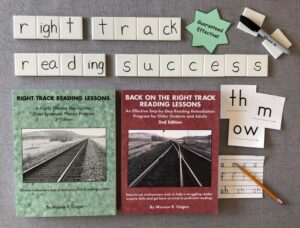
To learn more about the effective, easy-to-use and affordable tools to directly help your child or student achieve reading success PREVIEW Right Track Reading Lessons (designed for younger children) and Back on the Right Track Reading Lessons (specifically targeted for older struggling readers 3rd/4th grade to adult). Translating the science and evidence-based research into actions YOU can use with your student!
Empowering parents & teachers with information & effective resources to lead their student to reading success!
Reading is complex and requires mastering and integrating many different essential skills. For additional informative articles and resources on teaching students to read CLICK TO EXPLORE FREE READING INFORMATION
This information was written by Miscese Gagen, a mother with a passion for teaching children to read proficiently by using effective methods. She is the author of the effective reading instructional programs Right Track Reading Lessons and Back on the Right Track Reading Lessons as well as a reading tutor with over 20 years’ experience successfully building proficient reading skills in her students. The purpose of this article is to empower parents and teachers with information to help their children achieve reading success. We CAN improve reading proficiency, one student at a time! More information located at www.righttrackreading.com ~ Copyright 2004-2021 Miscese R. Gagen