How Reading Works: Biologic Process of Proficient Reading & Exciting Scientific Proof – We CAN Help Students Learn to Read Proficiently
We Are Learning How Proficient Reading Works!
The scientific research on neurological processes involved in proficient reading is fascinating. Scientific advances allow neuroscientists to view images of the brain as it reads and actually map out these neural functioning pathways. Amazingly, researchers can actually see how the brain reads! We have learned much about the distinct neural processes involved with both proficient reading and difficulty reading. I highly recommend reviewing specific research summaries and articles on neural imaging/phonologic processing, dyslexia and phonologic based reading. A selection of these informative research findings can be found in the detailed article:
Key Reading Research Findings on Teaching Reading & the Neuroscience of Proficient Reading
“The scientific research provides a ‘map’ we can use to lead children and students to reading success.“

Neuroscientists Have Learned Proficient Readers Use Phonologic Processing Pathways
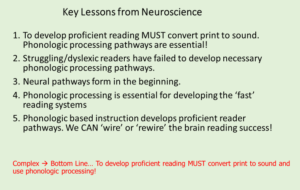
Neuroscientists have learned proficient readers use phonologic pathways: Scientist have mapped out neural functioning pathways involved in proficient reading. Researchers found proficient readers convert print to sound using phonologic processing pathways. In contrast, struggling readers have difficulty turning print to sound and aren’t using phonologic processing pathways. We now have biologic proof the key to proficient reading is phonologic processing. Scientists learned these neural phonologic processing pathways necessary for proficient reading first form in beginning readers. Scientists are learning how ‘fast’ fluent reading develops word by word and is dependent on accurate phonologic processing. While actual neural processing is complex and involves multiple areas of the brain, the bottom line is proficient reading requires phonologic processing of the print. By converting print to sound the student taps into the brain’s natural systems for efficiently processing spoken language. Phonologic processing is literally the pathway to proficient reading. To read proficiently, the student must use the brain’s phonologic processing pathways and turn print into sound.
Difficulty Reading is a Common & Significant Problem
Reading Difficulties: Difficulty reading is a significant problem throughout our country. If your student struggles with reading he or she is not alone. Unfortunately, most students in this country fail to learn how to read proficiently. In 2019, 65% of the 4th graders in this country were NOT at the proficient level with an alarming 34% below the basic level.[1] The 8th grade reports show similar rates

[1] The 2019 National Assessment of Educational Progress (NAEP) Reading Report Card www.nces.ed.gov/nationsreportcard/reading.
Neuroscience Reveals WHY Students Struggle with Proficient Reading
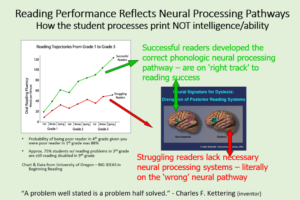
These reading problems have nothing to do with intelligence or ability but rather with how the person processes the print. Thanks to the scientific advances, we now have neurobiologic evidence of why individuals have difficulty reading. The researchers discovered struggling readers use different neural pathways than proficient readers and these improper neural pathways form because the individual does not recognize the sound structure of words and process print phonetically. Struggling readers don’t turn print into sound. Dyslexia is defined as a problem learning to read despite normal abilities and intelligence. Dyslexic individuals have an inherent phonologic weakness and deficit in the phonologic component of language and therefore problems turning print into sound and consequently do not develop proficient phonologic processing pathways. This brain imaging shows struggling readers have failed to develop the phonologic neural pathways.
Research reveals neural processing pathways first form in beginning readers. Therefore, individuals who fail to develop correct phonologic ‘proficient’ reading pathways continue to face serious and persistent difficulties. This helps explain the evidence most students who fall behind in reading skills never catch up. We now know difficulty reading persists because they are not processing the print correctly using proficient phonologic processors. Instead, they use less efficient and effective neural processing areas.
Sometimes students ‘get by’ with incorrect processing in the lowest grades (K, 1st). The easy reading material, illustrations, context clues, oral directions and limited depth of content can disguise their difficulty decoding print. For example, if the child looks at the picture or memorizes repetitive text it appears he can ‘read’. However, students who have not developed necessary phonologic processing rapidly run into problems as vocabulary expands. The incorrect strategies of ‘whole word’ visual memorization, word guessing, context clues and predictable text fail as reading level advances. This is often why ‘reading problems’ often become evident in 2nd or 3rd grade. In reality, the ‘difficulty’ processing print already existed. To read proficiently, the student must process print phonetically. Students who don’t develop phonologic processing pathways face persistent difficulty reading. For additional information see the article Students Who Face Difficulties Learning to Read: Information on Reading Problems and Dyslexia
Effective Phonologic Based Reading Programs Can Develop Proficient Reading
Very importantly, research provides neurobiological proof effective instruction using direct-phonological-based reading programs can develop neural pathways for proficient reading in both children and adults. Effective programs that specifically taught letter-sound correspondence not only noticeably improved reading skills in struggling readers, but actually changed neural activity from incorrect neural pathways to the “correct” pathway that good readers use. The proven ability of direct systematic phonics-based reading instruction to actually develop correct proficient reader phonologic pathways in dyslexic individuals is the most exciting element of the fascinating neurobiologic reading research.
This brain imaging research on dyslexia further validates and supports the existing results-based evidence. Valid results based research shows direct systematic phonics programs are the most effective approach for teaching children to read. This brain research shows us why the direct systematic phonics programs work. The neurobiologic details on proficient reading neural pathways provide a wealth of information on how best to design effective reading programs. Remember, reading is not a natural biologic process. To effectively and efficiently perform this artificial task of turning man-made black squiggles into language, the student needs to tap into the existing brain functioning areas naturally designed to efficiently process spoken language. By directly teaching the student to convert print to sound you intentionally develop these proficient processing pathways.
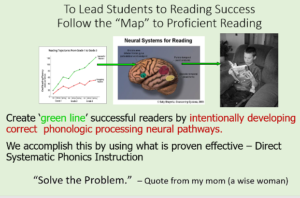
The terrific news is we now know a highly effective direct systematic phonics program of reading instruction can help children and adults develop correct phonologic processing pathways and build proficient reading skills. Scientific evidence clearly shows the specific program of reading instruction has significant effect on rates of reading success. There is a “right way” to teach reading and to ensure the correct ‘good reader’ neural pathways are activated. The brain research reveals why many children fail to learn to read with the popular methods of reading instruction such as ‘whole language’, ‘literature based’ and ‘balanced’ approaches. These well-intentioned methods allow and often encourage development of incorrect neural pathways or at best fail to intentionally develop correct pathways. It is like a railroad track leading from a beginning point, if the student accidentally gets on the ‘wrong track’ they most likely will never make it to the proficient reader station, unless direct appropriate intervention occurs. In contrast, an effective phonologic based program helps ensure the student is on the “right track” to reading proficiency.
Summary on How to Develop Proficient Reading Phonologic Neural Processing Pathways
To read proficiently, the student must develop phonologic neural processing pathways. If students fail to convert print to sound and develop phonologic processing pathways, they face difficulty learning to read. Effective complete direct systematic phonics reading programs intentionally help children acquire specific necessary skills and develop these proficient reader neural pathways. We have proof, both validated results-based evidence and findings from the neural imaging studies, direct systematic phonics programs are effective in both helping young children learn to read proficiently and in helping struggling students overcome reading difficulty. We have the map (the science) and the tools (direct systematic phonics) to help children achieve reading success!
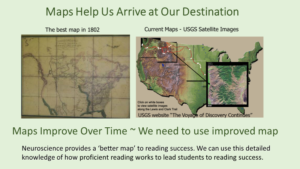
We Have the Map & Tools to Lead Students to Reading Success! The neuroscience provides us with an improved detailed map on how to lead individuals to the destination of proficient reading. The valid evidence based research proves what tools work best to make that journey. We can use this improved map and effective direct systematic phonics instruction to make sure our children and students arrive at the destination of reading success.
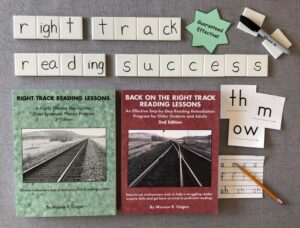
Right Track Reading translates this science of proficient reading and valid evidence based research into concrete actions parents and teachers can use to ensure their children or students achieves reading success.
To learn additional details on how to build necessary skills so your child or student learns to read see the articles:
Empowering parents & teachers with information & effective resources to lead their student to reading success!
Reading is complex and requires mastering and integrating many different essential skills. For additional informative articles and resources on teaching students to read CLICK TO EXPLORE FREE READING INFORMATION
If you are ready to learn more about the effective tools to help your child or student achieve reading success, CLICK TO PREVIEW EFFECTIVE RIGHT TRACK READING PROGRAMS.
This information was written by Miscese Gagen, a mother with a passion for teaching children to read proficiently by using effective methods. She is the author of the effective reading instructional programs Right Track Reading Lessons and Back on the Right Track Reading Lessons as well as a reading tutor with over 20 years’ experience successfully building proficient reading skills in her students. The purpose of this article is to empower parents and teachers with information to help their children achieve reading success. We CAN improve reading proficiency, one student at a time! More information located at www.righttrackreading.com ~ Copyright 2004-2021 Miscese R. Gagen