Fun Phonemic Awareness Activities to Help Young Children Develop Phonemic Awareness
Also Known As ‘Fun Sound Games’ You Can Play with Your Child to Help Them Develop Phonemic Awareness
Phonemic Awareness is Critical to Reading Success
We have learned that phonemic awareness, the ability to hear, distinguish, recognize and manipulate sounds within words, is critical to reading success. We also know that phonemic awareness training has a significant positive effect on reading and spelling. In other words, we can directly teach children how to hear, recognize and manipulate sounds within words. For additional information and details on phonemic awareness see the article: Phonemic Awareness Explained
This page shares a variety of fun phonemic awareness activities you can do with your young child to help them build phonemic awareness, a subskill that is necessary for proficient reading. Use these free, fun phonemic awareness activities to help your child build skills. There is no need to purchase any materials to build phonemic awareness skills! Sounds and opportunities to help your child build skills are everywhere!
Note: Throughout this article, sounds are indicated between slashes /_/. For example, the letter ‘m’ has the sound /m/.
*Important Reminder: If you suspect a child has any hearing difficulty, it is critical to get them evaluated by an appropriate medical professional. Children with unmitigated physical hearing limitations may be challenged or unable to develop PA because they cannot physically hear well enough.
Helping Your Young Child Develop Phonemic Awareness
You can help your young child develop phonemic awareness with simple and fun oral activities. These fun phonemic awareness activities or ‘sound games’ include listening, sound identification, sound discrimination, word play and rhyming activities. These fun activities help your child learn how to hear, recognize and manipulate sounds in words. These oral sound activities can easily be played with preschool and young children for 5 or 10 minutes while you are driving in the car, making dinner or playing outside.
Always demonstrate the activity, showing the child exactly what you want him to do. Be sure to walk the child through several examples to make sure they understand. Showing young children how to do something is more effective than telling them instructions.
Also, especially in the beginning, help the young child learn how to listen to and recognize sounds by saying the words slowly and clearly. “Slowing down” the word makes it easier to hear the individual sounds (example stretch out /sssssiiiiiit/ instead of quick /sit/). Pay attention to correct pronunciation and be sure you are not distorting sounds. Some sounds can be stretched out others cannot.
When conducting your fun phonemic awareness activities, use a wide variety of words so the child actually has to listen to sounds. For example, if you always use the word ‘sun’ for practice distinguishing the beginning /s/ sound the child may just have /s/ memorized. By constantly mixing up and using different words (sit, Sam, sob, sap, sink, snake, snail, slide..etc), the child must actually must listen to sounds.
Start Simple and Build Skills
Start simple and then increase complexity as the child develops skills. Start with beginning sounds. Once children get the hang of beginning sounds (the easiest to hear and distinguish), you can move on to ending sounds and rhyming and finally to manipulating middle sounds. Avoid the blended consonants in the beginning, particularly blends with the ‘fast’ sounds of /d/, /t/, /k/, /g/, /b/ that are much harder to segment. Younger children often have a hard time manipulating middle sounds and some of the blended consonants. The following outline shows the simpler skills progressing to the more complex.
Simple (easier to distinguish) ⇒ More Complex (harder to distinguish)
- beginning sounds ⇒ ending sounds ⇒ middle sounds
example: /s/ in sit ⇒ /s/ in miss ⇒ /s/ in mistake
- single consonants ⇒ blended consonants with ‘slow/stretchy’ sounds ⇒ blended consonants with ‘fast’ sounds
example: /s/ in sit ⇒ /s/ in slip ⇒ /s/ in stop
- sounds that can ‘stretch out’ ⇒ the ‘fast’ or ‘quick’ sounds
(/m/ /s/ /f/ /a/ /r/ /l/ /n/ /o/ /sh/ ) ⇒ ⇒ (/t/ /d/ /b/ /k/ /g/ /p/ )
Note: Sounds that are more difficult to distinguish include: the sounds /f/ and the soft /th/ (as in bath), the sounds /f/ and /v/, the sounds /t/ and /d/, the sounds /k/ and /g/. Speech wise these sounds are very similar and are harder for some children, particularly young preschoolers, to differentiate.
Fun Phonemic Awareness Activities ~ Also Known As… “Fun Sound Games”
These initial fun phonemic awareness activities should be conducted as “fun sound games”. The ‘sound games’ are designed to help your young child learn how to hear, recognize and manipulate sounds within words. Create and adapt sound games to help the child build specific phonemic awareness skills. The 7 specific phonemic awareness skills you need to develop are listed in the article Phonemic Awareness Explained.
Have fun with your child using age and developmentally appropriate games designed to help child recognize the sound structure of words. At first, start with the beginning sounds that can be stretched out (such as m, s, f, l, n, r) and avoid the blended consonants that are much more difficult to segment (for example give the word ‘big’ not ‘broom’). Start simple and then add complexities later as the child’s skills develop. Because these initial fun phonemic awareness activities are oral/auditory you can conduct these ‘games’ while running around outside, eating lunch, playing or while driving in the car. You do not need to purchase any materials to conduct these effective fun phonemic awareness activities. A few of the many possible activities include:
- Give the child a word and see if he can tell you the sound the word starts with. “What sound does the word _____ start with? For example, ask What sound does the word “Sam” start with? /ss/. What sound does the word ‘fast’ start with?
- See if the child can come up with words starting with a specific sound. Say “the word ___ starts with the sound ___. Let’s see what else we can think of other words that start with the ___sound.” If necessary, give the child the starting sound to get them started. For example, “milk” starts with the sound /m/. What else can you think of that starts with the sound /m/…. and to help him out say /mmmmmm/ while the child is thinking of a word. If needed, help out at first with some words…/mmmm/ … mud…./mmmm/ mom…” If the child says a word like ‘cat’ simply say oops that word starts with the /k/ sound…listen /c//a//t/. What starts with /mmm/?
- These ‘finding sounds’ games can be played anywhere. The ‘sounds at the park’ example below shows how you can build essential skills with fun phonemic awareness activities that can be conducted in any location. There is no need to purchase any materials to build phonemic awareness skills! Opportunities to play with sounds are everywhere!
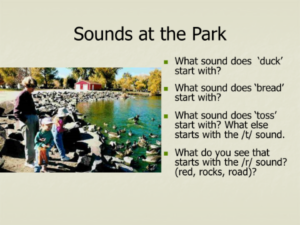
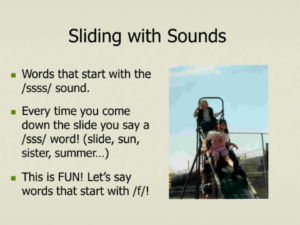
- Remember these sound games should be fun and active (preschool appropriate!) If you are at the park and your child is coming down the slide../sss/ have them say a word that starts with /sss/ every time they come down the slide (slide, swing, sun, sister, sing, ..etc)
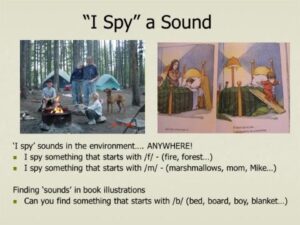
- Play “I spy” with beginning sounds. Format: “I spy something that starts with the /__/ sound, what do I spy?” Example: I spy something that starts with /mmm/. What do I see? Have the child say the sound /mm/ as they look around and spot their dog ‘Milo’, a glass of ‘milk’, a ‘magazine’ on the table, a ‘marker’, ‘mud’ on the floor, ‘mom’, a coffee ‘mug’..etc..
- Play Let’s go ‘shopping for sounds’ – You can easily incorporate fun sound games into daily routine activities.
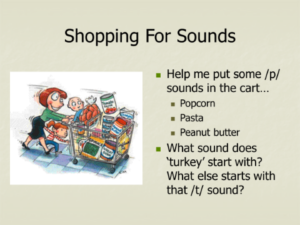
- Play “silly word” games with changing beginning sounds. Have the child modify the first sound in a word. For example, use the child’s name and make silly words. For example, “Jess, if your name started with /mmm/ what would it be?… Mess; How about /t/?.. Tess; How about /b/? Bess. Silly ‘animal names are also fun. If ‘fox’ started with /s/.. sox, /l/ ..lox..etc.
- Work on rhyming activities. Rhyming is terrific for developing phonemic awareness. Help the child learn how to rhyme. Say a word like ‘cat’ and see how many rhyming words the child can say. (At first this rhyming needs to be demonstrated as kids will often just say a word that starts with the same sound.) For example “What would rhyme with cat? hat, mat, pat, sat.. See if you can come up with any “silly” rhyming words…zat.. dat..
- Sing little songs (or adapted versions of songs with a specific sound). Have the child help you make a ‘silly sound song’ of a specific sound. For example sing twinkle, twinkle little star with all the words starting with the /sss/ sound (swinkle, swinkle, sittle star ).
- Practice orally segmenting sounds within a word. Have the child tell you the sounds he hears within a word. Remember this is an auditory skill based on sound, not letter names or spelling correctly. For example: Tell me the sounds in the word ‘shut’: the child should say /sh/ /u/ /t/ or tell me the sounds in the word ‘plane’: the child should say /p/ /l/ /ay/ n/
- Play ‘sound changing’ games where you tell the child a word and give him some instructions on how to change it. “Say _____ without the ____ sound”. (For example, say ‘milk’ without the /m/…. and the kid should say ‘ilk’). Or “how would you say ____ if the /__/ sound was change to /__/? (For example, how would you say sing if the /s/ was changed to /r/? (the child should say ring)
Have fun with it! Make up your own sound activities/games. Create and adapt sound games to fit your child. Keep activities age appropriate and fun. The focus is for your child to learn how to hear, recognize and manipulate sounds in words. As the child’s skills develop begin linking oral phonemic awareness to print.
Additional Information & Activities To Build Phonemic Awareness
The fun phonemic awareness activities listed above are designed for preschoolers and young children. For further details and additional activities to directly build phonemic awareness skills please see the detailed article:
Additional information is also located at:
Reminder – Phonemic Awareness is only one of the many skills needed for reading success
Phonemic awareness is only one critical skill for reading success. Phonemic awareness training teaches your child to hear, recognize and distinguish sounds with a word. It is primarily an auditory skill and alone does not teach kids to read. An effective direct-systematic-phonics program is still the most effective way to ensure your child learns the other skills that are necessary for proficient reading. To Learn more about the effective reading instruction see Direct Systematic Phonics Instruction Proven Effective – Why Parents & Teachers Should Use Direct Systematic Phonics
Proficient reading is complex and requires mastering and integrating many different essential skills. For a visual representation outlining of necessary skills and integration of skills for correct phonologic processing of print and development of advanced skills that lead to proficient reading see Overview and Visual Representation of Overall Processes Required for Proficient Reading.
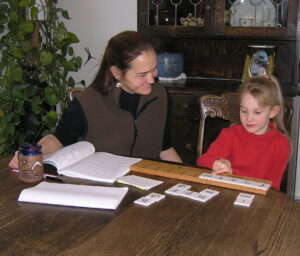
Right Track Reading Empowering Parents & Teachers with information and resources to help their children and students achieve reading success!
Reading is complex and requires mastering and integrating many different essential skills. For additional free information, useful articles and effective resources on teaching students to read CLICK TO EXPLORE FREE READING INFORMATION
This article was written by Miscese Gagen, a mother with a passion for teaching children to read proficiently by using effective methods. She is the author of the effective reading instructional programs Right Track Reading Lessons and Back on the Right Track Reading Lessons as well as a reading tutor with over 20 years’ experience successfully building proficient reading skills in her students. The purpose of this article is to empower parents and teachers with information to help their children achieve reading success. We CAN improve reading proficiency, one student at a time! More information located at www.righttrackreading.com ~ Copyright 2004-2021 Miscese R. Gagen