Important Background Facts on Written English Language Essential to Effective Reading Instruction
Linguistic Facts on Written English & Background for Reading Printed English
For effective reading instruction, it is vitally important to be aware of and understand the background facts on written English language. These critical components that are inherent to our wonderful written English language have significant bearing on effective reading instruction. Before teaching reading, we need to learn “the nature of the beast” that we are dealing with.
1. English is a phonetic language with a written phonetic alphabet/code:
One of the most important background facts on written English is that English is a phonetic language, meaning words are made up of sounds blended together. English words consist of various combinations of 44 sounds. The alphabetic characters, the 26 different artificial black squiggly marks, are the way we show this phonetic language on paper. The printed letters and combinations of letters represent specific sounds. The linguistic fact is written English is a phonetic alphabet, not a pictograph or other symbolic writing system. In linguistic history, written phonetic alphabets replaced pictographs precisely because there were too many words to represent by pictures. Written English is a phonemic code. When the complete code is known, the vast majority of English words are decodable. In addition, even irregular words are mostly decodable. To read, we need to translate or decode these black squiggly marks back into the sounds that blend to form specific words. Decoding the sounds is the essential foundation for proficient reading. The more advanced skills in fluency and comprehension are dependent on first mastering phonetic decoding.
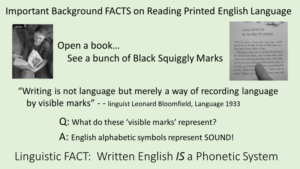
To read, students need to learn the phonemic code. That is, they need to learn the print=sound relationships that are the basis for our written English Language (Or for those who prefer technical terms, the grapheme (phonogram) = phoneme relationships.) This phonemic code is the basis for writing and reading our printed English language.
Print ⇒ The grapheme (or alternate term phonogram) is the distinct written symbol either an individual letter (s, m, a) or combination of letters (th, sh, ch, oy) that are used to represent a single phoneme.
Sound ⇒ A phoneme is the smallest speech sound example the sound /s/ or /ch/.
For example: The spoken word ‘chain’ consists of 3 phonemes (sounds) /ch/ /ay/ /n/ & is written with 3 graphemes/phonograms ‘ch’ ‘ai’ ‘n’. The spoken word ‘shack’ consists of 3 phonemes /sh/ /a/ /k/ & is written with 3 phonograms/graphemes ‘sh’ ‘a’ ‘ck’. To read, students need to learn the phonemic code relationships between print & sound (graphemes and phonemes). This is one of the essential background facts on written English.
2. Written English is NOT a Simple Phonemic Code – It is a COMPLEX Phonemic Code:
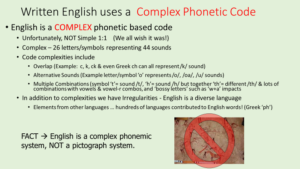
Another of the significant background facts on written English, is that printed English is based on a complex phonemic code. Unfortunately, English phonetic writing is not restricted to a simple one-to-one relationship between one specific printed symbol and one unique sound. English contains numerous complexities. The 26 written symbols and combinations of these symbols represent 44 sounds. There is overlap where a sound is represented by more than one symbol (/k/ can be written ‘c’, ‘k’, ‘ck’ and in a few words the Greek ‘ch’). Specific symbols often represent more than one sound (c=/k/ & /s/; o= /o/, /oa/ & /u/). Symbols combine to represent different sounds than the individual components (t=/t/ h=/h/ but th=/th/). Many combinations of symbols, especially in the numerous vowel combinations, represent multiple sounds (ow=/ow/ & /oa/; ea = /ee/, /e/ & sometimes the unexpected /ay/). Some symbols influence and modify other symbols creating new sounds (w+a; a+l; the r-controlled vowel combinations). English also contains some irregular words that at least partially do not follow the phonemic code. And finally, to top it off, English language has incorporated and assimilated components of Greek, Latin, German, French, Spanish, Native American and other languages. While these contributions add to the richness of English, they do complicate reading. To read proficiently the student needs to learn these complexities. (Note: Obviously, it would have been far easier to teach a simple code to children learning to read. However, like it or not, the bottom line is these code complexities are one of the vital background facts on the English language that we must deal with in effective reading instruction).
To learn more about our complex phonemic code, see the article The Building Blocks of Written English – The Complete Phonemic Code: Why Knowledge of Complete Phonetic Code is Important to Proficient Reading & How to Help Children Learn the Complete Accurate Phonemic Code
3. Reading is a Complex Artificial Skill:
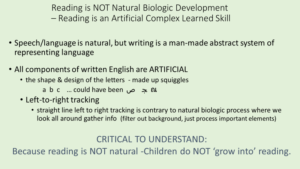
Reading our complex artificial system of recording the English language on paper is absolutely NOT a part of natural biologic development. While speech is a natural biologic process, reading our man-made arbitrary system of artificial black squiggles is not innate. All components of writing and reading our language are contrived. For example, even the basic left-to-right directional processing of print is not natural. Think about it. In the natural world, the best way to gather information is to look all over. In contrast, to read English you must process the alphabetic symbols in an artificial, straight-line, left-to-right manner. Other languages apply up-to-down or right-to-left processing rules. While we obviously use our biologic functions of vision and hearing to read, there is nothing natural about learning to read. Because reading is not a biological developmental process, children do not necessarily acquire these skills. Like all complex learned skills, reading it is best taught step-by-step with practice and mastery of individual steps before moving on to advanced skills. The background facts on written English are this complex artificial system and contrived process of converting black squiggles into language is absolutely NOT a natural biologic function!
4. Children are Naïve About How Reading Works & Can Easily End Missing Key Elements:
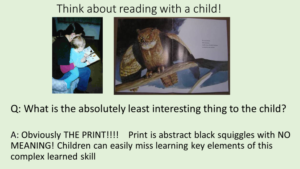
It is important to realize not only is reading unnatural but children are often naïve about written language. Much of what skilled readers take for granted is NOT evident to children. This reality that naïve children are often clueless on components of written language, is a vital a fact on written English language. Think about it from a child’s point of view! Printed letters are simply black abstract squiggles. Usually, the least interesting thing on the page of a children’s book is the print. Adults glance at a page and come up with a terrific story. Many are not aware of how our reading system functions with printed letters representing sounds blended into the words of our language. Therefore, children easily adopt incorrect strategies which lead to reading difficulty. Reading instructional programs that are incomplete, include incorrect reading strategies, contain potentially misleading information, fail to teach all necessary skills or teach skills using analytical, embedded, implicit and other indirect instruction methods are ineffective with many children. It is true that some children figure out the necessary process and become good readers under any reading program. However, many do not learn and develop serious reading difficulties. If the child gets on the “wrong track” on their approach to reading, they face serious and persistent difficulties. The reason some children fail while others succeed has nothing to do with intelligence or ability, but rather with how different children learn and process information. Many children struggle with reading simply because they miss acquiring necessary skills. It is risky to leave it to chance for students to acquire the complex skills necessary for proficient reading on their own.
These important background facts on written English are just part of the knowledge base that helps us effectively teach children and students to read. Discover more about why learning to read our wonderful but ‘crazy English language’ is challenging, how proficient reading actually works and what you can to help ensure your child or student learns to read by exploring the articles:
These articles and numerous other information and resources are available on the Right Track Reading website. Empowering parents and teachers with information and resources to lead their children or students to reading success!
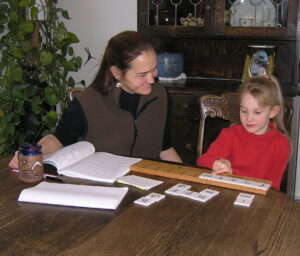
Empowering parents & teachers with information & effective resources to lead their student to reading success!
This information was written by Miscese Gagen, a mother with a passion for teaching children to read proficiently by using effective methods. She is the author of the effective reading instructional programs Right Track Reading Lessons and Back on the Right Track Reading Lessons as well as a reading tutor with over 20 years’ experience successfully building proficient reading skills in her students. The purpose of this article is to empower parents and teachers with information to help their children achieve reading success. We CAN improve reading proficiency, one student at a time! More information located at www.righttrackreading.com ~ Copyright 2004-2021 Miscese R. Gagen