The Building Blocks of Written English ~ The Complete Phonemic Code
Why Knowledge of Complete Phonetic Code is Important to Proficient Reading & How to Help Children Learn the Complete Accurate Phonemic Code
Why is it necessary to learn the complete phonemic code?
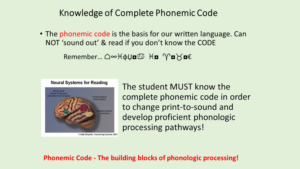
Students need to learn the complete phonemic code because this phonemic code is the basis for written English and the foundation for proficient reading. The linguistic fact IS English is a phonetic based system. The black squiggles represent sound. While English contains complexities it is a phonetic based system and must be approached as such. Thanks to the advances in neuroscience, we know proficient reading requires the conversion of print to sound and development of phonologic neural processing pathways. See the articleHow Reading Works for more detailed information.
The development of these proficient reader pathways requires the child to convert print to sound. Learning the phonemic code (sound the print represents) is an essential subskill for developing these proficient reader pathways. While the knowledge of phonemic code alone does not ‘teach’ a child to read, this knowledge of the complete phonemic code provides essential building blocks for developing the foundation of proficient phonologic processing. To view how knowledge of the phonemic code fits into the overall process of proficient reading, see Overview and Visual Representation of Overall Process Required for Proficient Reading.
“You have to know the phonemic code to ‘sound out’ words. The complete phonemic code are the building blocks for proficient reader phonologic processing!“
What is the complete phonemic code?
The complete phonemic code is the specific print=sound relationships written English is based on. To read, students need to learn the phonemic code. That is, they need to learn the print=sound relationships that are the basis for our written English Language (Or for those who prefer technical terms, the grapheme (phonogram) = phoneme relationships.) This phonemic code is the basis for writing and reading printed English.
Print ⇒ The grapheme (or alternate term phonogram) is the distinct written symbol either an individual letter (s, m, a) or combination of letters (th, sh, ch, oy) that are used to represent a single phoneme.
Sound ⇒ A phoneme is the smallest speech sound example the sound /s/ or /ch/.
For example: The spoken word ‘chain’ consists of 3 phonemes (sounds) /ch/ /ay/ /n/ & is written with 3 graphemes/phonograms ‘ch’ ‘ai’ ‘n’. The spoken word ‘shack’ consists of 3 phonemes /sh/ /a/ /k/ & is written with 3 phonograms/graphemes ‘sh’ ‘a’ ‘ck’. To read, students need to learn the phonemic code relationships between print & sound (graphemes and phonemes).
The English phonemic code (print=sound or grapheme=phoneme) is complex. Unfortunately, letters and sounds do not have a one-to-one correspondence. There are 26 different symbols (letters) combined into many different phonograms/graphemes representing 44 sounds(phonemes). Some letters represent more than one sound. Many sounds are made from a combination of letters. There is overlap where a single phoneme/sound can be written multiple ways. Then to top it off, our language includes spellings from other languages and some irregular words. Although it is complex, English is not complete random chaos. English is mostly phonetic or follows predictable patterns. If all sounds are learned and patterns practiced, most words can be phonetically decoded. For additional information, see Important Background Facts on Written English Essential to Reading Instruction.
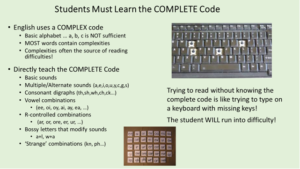
The student needs to acquire knowledge of the complete phonetic code. An effective reading program directly and systematically teaches all necessary phonograms. The phonograms are the alphabetic letters or groups of letters that symbolize the smallest speech sounds of English. Knowledge of the basic alphabet is not sufficient. The student needs to know the multiple vowel sounds, consonant digraphs, vowel-combinations, r-controlled vowels, and other complexities that comprise the vast majority of printed words. Phonograms are the distinct printed letters or combinations of letters that symbolize specific sounds within written English words. Depending on exactly how they are classified, there are between 70 to 80 phonograms. In addition to the 26 single letters of the alphabet, the student needs to learn consonant digraphs (th, sh, ch, wh, ck, ph, wr…), vowel combinations (ee, oa, oe, ai, ay, oi, oy, ea, ow, ou, ue, au….), r-controlled vowels (ar, or, ore, er, ur, ir, ear, eer, air…) and other combinations (a+l, w+a, c+e, igh, ough…).
It is no surprise the vowel combinations and other complexities are frequently the source of reading and spelling difficulties. Many students lack necessary knowledge of the complete phonetic code. Instruction often fails to teach these complexities or teaches them in an indirect, incomplete or haphazard manner. The most effective way to ensure students acquire complete and accurate knowledge of the complex phonemic code is to directly teach all phonograms to the student.
How Do I Help My Child or Student Learn the Complete Phonemic Code?
To read proficiently, the student must process print phonetically. Phonetic processing requires converting and linking printed letter(s) directly to correct sound. To maximize effectiveness (phonologically correct processing) and efficiency (faster with less effort) several components should be incorporated into the direct phonics instruction. It is important to realize exactly how the ‘phonics’ knowledge is taught to the child has tremendous impacts on success. Careful attention to the following elements helps children acquire necessary knowledge preventing potential difficulties and improving reading success.
In order to help students learn:
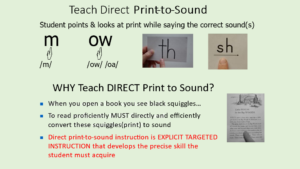
- Teach the DIRECT print=sound relationship: For efficient processing knowledge of the printed code needs to be direct. The student must be able to quickly glace at black squiggles and automatically convert this print directly to sound. Indirect processing such as relating print to a known object or word and then extracting the sound from that word, is much less efficient than automatically knowing the direct print=sound. An example of indirect processing is when a child relates the sight of printed letters to a word/object (‘b’ = book), or link letters to a picture ‘b’ = &. In these indirect processing relationships, the child has to recognize and split out the beginning sound of the object before processing the /b/ sound. Another indirect example is relating sound to other words, such as when the child sees ‘oy’ in ‘destroy’ and has to think ‘oy’ is in the word ‘boy’ and therefore the ‘oy’ must have the /oy/ sound. These indirect processing pathways take significantly more effort than directly and automatically processing print = sound. Avoid all these inefficient ‘middle man’ processing pathways. Always teach direct print=sound. Have the child or student look directly at the printed letter or letters (accurate printed phonogram) and say the correctly pronounced sound. Learn and practice the direct print=sound until this knowledge is automatic. Be sure activities establish this direct accurate print=sound efficient processing.
- Teach the COMPLETE phonemic code: The importance of learning the complete code is explained in the previous section. Our language is not simple. The child must learn the complexities and gain direct knowledge of all the phonograms. The phonograms are the alphabetic letters or groups of letters that symbolize the smallest speech sounds of English. The most effective way to ensure the child acquires necessary knowledge is to directly and systematically teach them the complete phonemic code. In addition to the 26 single letters of the alphabet, directly teach the consonant digraphs (th, sh, ch, wh, ck, ph, wr…), vowel combinations (ee, oa, oe, ai, ay, oi, oy, ea, ow, ou, ue, au….), r-controlled vowels (ar, or, ore, er, ur, ir, ear, eer, air…) and other combinations (a+l, w+a, c+e, igh, ough…). An effective reading program directly and systematically teaches all necessary phonograms. Trying to read without knowing the complete code is like trying to type on a keyboard with missing keys. The student will run into difficulty!
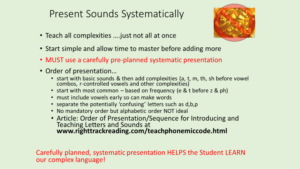
- Teach the code SYSTEMATICALLY: Our language is complex. If you toss the entire complex code at a young child at once it creates confusion. Systematic presentation should be used to manage the complexities. By controlled presentation you allow the child time to learn, practice and master the code in manageable. Start a few at a time. Present the simple and common phonograms before adding the complex and infrequent. Systematically present phonograms to the child and allow the child time to practice so the sound knowledge becomes automatic. For additional information on order of presentation see the article: Teaching and Learning the Phonemic Code: Order of Presentation or Sequence for Introducing and Teaching Letters & Sounds
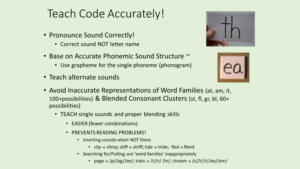
- Teach the CORRECT PRONUNCIATION: The child or student needs to learn the sound the letter (or phonogram) represents in our language. This correct sound pronunciation is not the same as the letter name. Many students can tell you the letter name but do not know the sound the letter represents. For example, for the letter ‘h’ the sound is /h/ not the letter name /aych/. Correct pronunciation is important. For example the letter‘d’ has a quick sharp /d/ sound not a long /duh/.
- Teach PHONETICALLY ACCURATE PRINT: Teach the child using phonetically accurate representations of print. In other words, the phonograms (printed code) you teach the child needs to be phonetically accurate. Examples of phonetically accurate phonograms are ‘m’= /m/, ‘c’= /k/ & /s/, ‘th’=/th/, ‘ch’=/ch/, ‘oi’=/oy/ ‘e’=/e/ and /ee/. Avoid inaccurate representations such as ‘word families’ and ‘blended consonant clusters’. Not only can these inaccurate representations create confusion and reading difficulties in some children they add hundreds of unnecessary possible combinations for the child to learn.
- Require direct PRACTICE UNTIL AUTOMATIC: The goal is for the student to automatically know the printed alphabetic character equals sound association (printed letter(s)=sound) of the complete phonemic code. The student effectively learns this ‘printed letter=sound’ association through direct instruction and repeated practice. Practice and drill the direct print=sound until the student has mastered automatic knowledge. When the sound is automatic, the student does not have to spend any effort consciously think about what it is. He can then concentrate on higher reading skills. It is comparable to learning how to type. In keyboarding, you learn the association of finger movement for a specific letter. At first, a beginner has to look at both the keyboard and their hands. After a little drill, he can type without looking by concentrating on what finger to move where. With additional direct practice, the typist improves in proficiency to the point where the keyboarding is automatic. When you are no longer spending mental energy on figuring out where to put your fingers, all your concentration can focus on the actual writing/typing. The same concept applies to reading. The objective is for the student to establish direct automatic print=sound code knowledge. Practice Builds Proficiency!
For additional details on specific actions and effective multisensory activities you can use to help your child or student build knowledge of the complete phonemic code, please see the article Free & Highly Effective Multisensory Activities (Fun Sound Games) to Successfully Help Your Child or Student Learn the Complete Phonemic Code (Direct Print=Sound),
For additional details effective order of presentation for teaching the complete phonemic code see the article, Effective Order of Presentation for Teaching the Phonemic Code, Sequence for Introducing Letters and Sounds of the Phonemic Code to Help Students Learn.
Summary of Learning the Complete Phonemic Code
Remember, learning the phonemic code (print=sound relationship) in isolation will not teach your child to read. Although knowledge of the complete phonemic code is essential, it is only one skill necessary for proficient reading. Reading is complex and requires mastering and integrating many different essential skills. The student must learn the complete phonemic code and then importantly must learn how to integrate and apply this code knowledge in in process of sounding out words (phonologic processing print). For a visual representation outlining of necessary skills and integration of skills necessary for proficient reading See Overview and Visual Representation of Overall Processes Required for Proficient Reading
The isolated practice and drill of direct print=sound knowledge is a learning step to acquire one of the skills necessary to develop correct phonologic processing of print. After the child has acquired this knowledge and is automatically applying it in correct phonologic processing, he no longer needs to practice the sounds in isolation. Just as skilled typist does not need to go back and type rows of “ffff dddd ssss”. Direct instruction of the phonemic code using a strong direct systematic phonics program is not the end goal but rather the highly effective tool to help children acquire direct automatic knowledge of the complete phonemic code so they develop proficient reader processing pathways! see Direct Systematic Phonics Instruction Proven Effective – Why Parents & Teachers Should Use Direct Systematic Phonics
Concluding Example Demonstrating the Importance of Directly Teaching and Learning the Complete Phonemic Code:
One of the significant weaknesses in many reading programs is they do NOT directly and systematically teach the complete code. Most often the basic code is taught and students are left to figure out the most complex part of our code on their own. It is important to realize many students, especially those with phonemic weakness, do NOT learn code complexities indirectly (as most complexities are internal to words) and require direct systematic instruction on these confusing elements of our complex English code! Students cannot sound out and fail to develop correct phonologic processing if they do not know the complete code.
The vast majority of my struggling readers have significant gaps in their knowledge of the complete code. They had never been directly taught the complexities that are essential component of the phonemic code. Without this code knowledge, they were unable to develop efficient phonologic processing and often adopted incorrect strategies (whole word visualization, word guessing etc).
The following are copied from my evaluation notes from one of my many struggling readers (Remember, parents call me for help when their child is having significant struggles). This particular girl “M” is typical of many struggling readers.
From Evaluation Summary Report for 2nd grade girl “M”:
Knowledge of the Phonemic Code: I checked if M knew the complete phonemic code in isolation. M knew most sounds for the basic code (alphabet and common digraphs such as ‘th’ ‘ch’ ‘sh’) and this knowledge was automatic as she quickly said the sounds (VERY FAST!). With basic code, she only had a few gaps with alternate sounds (long sounds for vowels, and s=/z/, o=/u/ or y=/ee/ or /ie/,). However, she had significant gaps in automatic knowledge of the vast majority of the code complexities (vowel combinations, r-controlled combinations, and other complexities). In addition to the errors and unknown sounds, her response time was much slower (pauses & think before responding). This evaluation indicated while she knows the basic code, she lacks automatic knowledge of the majority of the code complexities (vowel & r-controlled combinations, other complexities). She needs to build knowledge of the complete phonemic code so she can decode/sound out words
Reading Performance: I listened to M read a list with progressively increasing difficulty. I had her read 50 single syllable words containing only basic code (ask, pug, trip, crust, print…); 25 single syllable words containing vowel combinations (heap, starve, hoist, wood). I also evaluated M performance reading a short passage (standard 2nd oral fluency passage from DIBELS/ U of Oregon). M worked hard but had significant difficulty reading the word list accurately. Her reading was slow with noticeable errors. In the basic code list, she had a 20% error rate. Her error rate jumped to 80% in the single syllable words containing complexities. She had difficulty reading the 2nd grade oral reading passage. She had to work hard at it. Her reading was slow (oral fluency rate was 17wpm) and she had significant error rate (25% error rate). This is well below the middle of 2nd grade benchmark of 100+ wpm/99% accuracy.
As you can see from the evaluation notes, her significant gaps in knowledge of the complete phonemic code were reflected in both code check and in reading performance (jump from 20% to 80% error rate in single syllable words as soon as words included code complexities). The vast majority of words contain complexities and without this code knowledge, she could not sound out words so resorted to adopting other incorrect strategies (whole word visualization/guessing etc).
The good news, is in approximately 15 hours of direct instruction time tutoring with Right Track Reading Lessons effective direct systematic phonics, “M” quickly developed essential skills and was reading at the 2nd grade benchmark (100+wpm). Direct, systematic instruction of the complete phonemic code as part of a strong phonologic based reading instructional program that explicitly teaches all skills and explicitly builds phonologic processing works!
Empowering parents & teachers with information & effective resources to lead their student to reading success!
Reading is complex and requires mastering and integrating many different essential skills. For additional informative articles and resources on teaching students to read CLICK TO EXPLORE FREE READING INFORMATION
If you are ready to learn more about the effective tools to help your child or student achieve reading success, CLICK TO PREVIEW EFFECTIVE RIGHT TRACK READING PROGRAMS.
This information was written by Miscese Gagen, a mother with a passion for teaching children to read proficiently by using effective methods. She is the author of the effective reading instructional programs Right Track Reading Lessons and Back on the Right Track Reading Lessons as well as a reading tutor with over 20 years’ experience successfully building proficient reading skills in her students. The purpose of this article is to empower parents and teachers with information to help their children achieve reading success. We CAN improve reading proficiency, one student at a time! More information located at www.righttrackreading.com ~ Copyright 2004-2021 Miscese R. Gagen