Key Strategies for Effective Reading Instruction
Overview of Elements Essential to Effective Reading Instruction
This article briefly overviews key concepts and components that should be utilized throughout reading instruction to maximize effectiveness. Apply these general effective reading instruction strategies to individual, small group and class reading instructional activities.
The reason we apply these strategies, is it improves the effectiveness of reading instruction. By incorporating these components, we help children and students learn necessary skills and achieve reading success.
“By applying these key strategies, we help students learn to read!“

Explicitly Teach the Complete Set of Skills
Proficient reading is a complex learned skill requiring the mastery, integration and application of numerous sub-skills and knowledge. Never leave it to chance for children or students to acquire skills on their own. Effective reading instruction explicitly teaches all necessary skills. To become a skilled reader, the student must first convert print to sound and establish ‘proficient reader’ neural processing pathways. To correctly process print phonologically, the student needs to master, integrate and apply skills and knowledge in phonemic awareness, knowledge of the complete phonemic code, smooth blending, proper directional tracking and attention to detail. After the essential foundation of phonologic processing is established, it is equally important for the student develop advanced or higher level skills including handling multisyllable word, building fluency, expanding vocabulary and developing comprehension skills and strategies.
For a visual representation outlining of skills necessary for proficient reading see Overview and Visual Representation of Overall Processes Required for Proficient Reading
Use Effective Direct Systematic Phonics Instruction
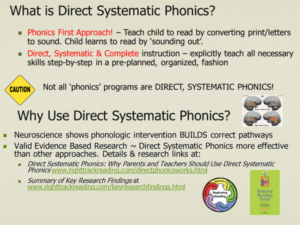
The research clearly demonstrates “systematic and explicit instruction in phonics produces significant benefits for children from kindergarten through sixth grade and for children having difficulty learning to read.” To achieve effectiveness, phonics instruction needs to be systematic, explicit and importantly provide opportunity for the student to practice applying the phonics knowledge to reading of words, sentences and stories. In addition to the results based research, we now have neurobiological proof phonologic based reading programs that specifically teach letter-sound correspondence can actually develop neural pathways necessary for proficient reading in both children and adults. Effective reading instruction needs to use direct systematic phonics. All reading instructional approaches are NOT equal in effectiveness. Direct systematic phonologic based instruction is more effective than other approaches to reading instruction.
See the article Proven Effective! Direct Systematic Phonics Instruction; Why Parents & Teachers Should Use Direct Systematic Phonics.
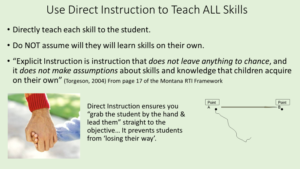
Direct/Explicit Instruction
Effective reading instruction explicitly teaches each skill. Directly teach students exactly what they need to know. Direct instruction prevents the situation where students fail to learn simply because they inadvertently missed essential information or skills. Many students do not learn with indirect, embedded, analytical or incidental approaches. While some students ‘find their way’ without direct instruction, many will fail to learn. Explicit instruction is most effective and efficient approach. Direct instruction helps the student learn.
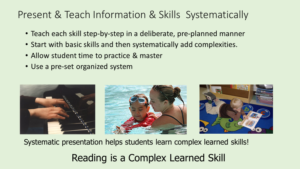
Systematic Presentation
A step-by-step, pre-planned, carefully controlled presentation helps students learn the complex process of reading. Systematic presentation allows the student time to practice and master individual skills before additional complexities are added. Start simple, teach foundational skills, and add complexities slowly. Systematic presentation breaks the complex process of reading into manageable ‘bite-sized’ skills allowing the student to achieve success one step at a time as they build their way toward proficient reading. Reading is a complex learned skill. Systematic presentation helps students learn and succeed.
Direct & Systematic Instruction HELPS Students Learn to Read
Include Targeted Multisensory Activities
Multisensory processes (visual, kinetic, auditory, oral) can help the student learn. To achieve effectiveness in reading, these multisensory processes must be carefully targeted to directly establish the skills necessary for proficient reading. It is not the sensory process itself but the targeted application of these multisensory processes to the development of specific skills that is key to enhanced learning in reading. Effective reading instruction designs and targets multisensory activities to directly build necessary skills
Apply the K.I.S.S. Principle – Keep it Straightforward & Simple!
Effective reading instruction is laser focused on building the exact skills needed for proficient reading. Design and target instruction in a straightforward manner. Eliminate irrelevant program elements and ‘clutter’ that add unnecessary complexity or include side elements that can distract and send kids off in the wrong direction. The straightforward approach improves effectiveness and efficiency of instruction!
Age-Appropriate Presentation
Presentation of instructional activities needs to be appropriate for the age/level of the students. Younger children and older students have very different needs and considerations. While the science of proficient reading and core elements of effective reading instruction applies to all age levels, presentation is different for young beginners than it is for older remedial students. Adjust and adapt presentation to the appropriate age/level/needs of the individual student.
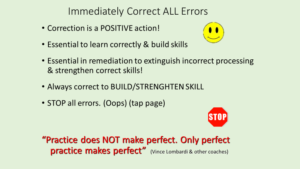
Immediate and Effective Correction
Correction is not negative; it is a positive opportunity to help the student learn. To be effective correction must 1) stop the incorrect process and 2) teach and build correct skill. With beginning readers correction prevents learning wrong. In remediation, correction is essential to extinguish the improper processing and build correct skills. It is a disservice to let a student learn incorrectly or continue to perform and practice incorrectly. Correction is a necessary element of effective reading instruction.
Monitor and Adjust
Teaching and learning are different. Monitor continuously to ensure the student has actually learned/acquired the skills. Make appropriate individual adjustments. Monitoring is important in beginning reading to insure the child has actually acquired necessary skills. In remediation, struggling readers lack specific skills and at times face a particular challenge acquiring a specific skill. Monitor carefully to ensure they have actually acquired the necessary skill. Monitoring is linked closely with effective correction. The goal is to make sure the student acquires specific skills (not just run through a lesson or program). Some students require extra instruction or practice to master a skill. Monitoring and making appropriate adjustments is an essential component of effective reading instruction, as it allows you to provide extra support and practice when necessary.
Provide Sufficient Practice – Practice Builds Proficiency!
Practice is essential to build proficiency. Simply teaching a skill is not sufficient. It is vital to provide sufficient practice to ensure the student masters the skill. Some students require additional practice (monitor and adjust)! Direct and repeated practice is absolutely necessary not just to acquiring the individual skills but importantly the student must practice integrating and applying these skills in correct phonologic processing. Sufficient guided practice is an essential component of effective reading instruction. Ask any of my tutoring students! One of my favorite lines, is “Practice Builds Proficiency!”
Struggling Readers (dyslexic students) Require Direct Effective Phonologic Based Intervention
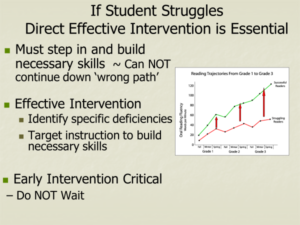
When a student struggles with reading, intervene immediately and directly with effective phonologic based intervention program. The earlier the better. The evidence proves struggling students do not ‘grow into reading’ or ‘catch up later’. Persisting with more of the same, additional practice of reading the wrong way, continuing along with status quo, or waiting for the child to ‘grow into reading’ result in a struggling reader getting farther and farther behind. Direct effective intervention is absolutely necessary.
For additional information see the articles: How to Help a Child or Student Who Struggles With Reading Overcome Their Reading Difficulties and Achieve Reading Success and the article Effective Reading Intervention to Help Struggling Students Achieve Reading Success & How Reading Evaluations Target Effective Instruction
Concluding Statement on Effective Reading Instruction
The key strategies listed above are essential components of effective reading instruction. By incorporating these elements into reading instruction, we can help children and students learn to read. These key strategies of effective reading instruction are all incorporated into Right Track Reading’s effective direct systematic phonics programs and all resources and instructional materials found on the Right Track Reading website.
For specific elements of effective beginning reading programs and effective reading remediation/reading intervention programs see the articles:
- Elements of an Effective Beginning Reading Program: How to Help Children Establish a Strong Foundation of Correct Phonologic Processing
- Elements of an Effective Reading Remediation Program to Improve Reading Skills in Struggling Readers
For additional background information on WHY these strategies are effective see the articles:
- How Reading Works: The Biologic Process of Proficient Reading and Exciting Scientific Proof – We Can Help Students Learn to Read Proficiently!
- Important Background Facts on Written English Language Essential to Effective Reading Instruction
- Overview of Teaching Children to Read: Why Reading is Difficult and What You Need to Do to Make Sure Your Child Learns to Read Proficiently
- Proven Effective! Direct Systematic Phonics Instruction; Why Parents & Teachers Should Use Direct Systematic Phonics.
- Summary of Key Research Findings and Links to Research
Reading is complex and requires mastering and integrating many different essential skills. For additional informative articles and resources on effectively teaching students to read CLICK TO EXPLORE FREE READING INFORMATION
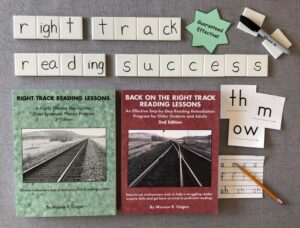
Empowering parents & teachers with information & effective resources to lead their student to reading success!
If you are ready to learn more about the effective tools to help your child or student achieve reading success, CLICK TO PREVIEW EFFECTIVE RIGHT TRACK READING PROGRAMS.
This information was written by Miscese Gagen, a mother with a passion for teaching children to read proficiently by using effective methods. She is the author of the effective reading instructional programs Right Track Reading Lessons and Back on the Right Track Reading Lessons as well as a reading tutor with over 20 years’ experience successfully building proficient reading skills in her students. The purpose of this article is to empower parents and teachers with information to help their children achieve reading success. We CAN improve reading proficiency, one student at a time! More information located atwww.righttrackreading.com ~ Copyright 2004-2021 Miscese R. Gagen