Effective Order of Presentation for Teaching the Phonemic Code
How to Manage Effective Order of Presentation for Teaching the Phonemic Code or Sequence for Introducing Letters & Sounds of the Phonemic Code to Help Student Learn to Read
When getting ready to teach the phonemic code to students, important and commonly asked questions include:
“What is the most effective order of presentation for teaching the phonemic code to students?”
“What is the best sequence for introducing the letters and sounds of the phonemic code?”
“Which letters do I teach first?”
Read this article to discover important considerations in setting order or sequence for introducing and teaching the complete phonemic code. These elements are designed to help the student learn our complex phonemic code and to increase the effectiveness of reading instruction.
Q: What order is most effective when teaching the phonemic code
A: Read this article to learn about order of introducing sounds & letters of the phonemic code to help students learn!

Knowledge of the Phonemic Code is Essential to Proficient Reading
Knowledge of the complete phonemic code is one of the essential foundational skills for reading success. Automatic knowledge of the phonemic code is not the end goal for reading instruction but rather an essential skill the students must acquire so they have the ability to process print phonetically and develop the proficient reading pathways that lead to skilled reading. For additional information please see the article The Building Blocks of English: The Phonemic Code Explained.
To read, students need to learn the phonemic code. That is, they need to learn the print=sound relationships that are the basis for our written English Language (Or for those who prefer technical terms, the grapheme (phonogram) = phoneme relationships.) This phonemic code is the basis for writing and reading printed English.
Print ⇒ The grapheme (or alternate term phonogram) is the distinct written symbol either an individual letter (s, m, a) or combination of letters (th, sh, ch, oy) that are used to represent a single phoneme.
Sound ⇒ A phoneme is the smallest speech sound example the sound /s/ or /ch/.
For example: The spoken word ‘chain’ consists of 3 phonemes (sounds) /ch/ /ay/ /n/ & is written with 3 graphemes/phonograms ‘ch’ ‘ai’ ‘n’. The spoken word ‘shack’ consists of 3 phonemes /sh/ /a/ /k/ & is written with 3 phonograms/graphemes ‘sh’ ‘a’ ‘ck’. To read, students need to learn the phonemic code relationships between print & sound (graphemes and phonemes).
How we teach this phonemic code to our children makes a significant difference in student achievement
How we teach this phonemic code to our children makes a significant difference in student achievement. A carefully preplanned, well organized, direct, systematic and complete presentation of the phonemic code is critically important to effective reading instruction. The effective order of presentation for teaching the phonemic code or sequence we should use for introducing and teaching the letter(s) and their sounds is a key component of effective reading instruction. A preplanned systematic presentation of the phonemic code (letter(s)=sounds is critically important for two essential reasons:
- A preplanned, direct, and systematic presentation of the ‘letters and sounds’ or phonemic code is a crucial component of designing an effective direct systematic phonologic based reading program (SEE the article Direct Systematic Phonics Proven Effective – Why Parents and Teachers Need to Use Direct Systematic Phonics). To develop proficient phonologic processing, students MUST practice reading decodable text. You must have a planned systematic sequencing of the letter(s)/phonemic code in order to develop decodable text. Please the article Decodable Text Explained.
- Our English phonemic code is complex and confusing. If you toss the entire alphabet soup at a child at one time or introduce it in a haphazard manner they will likely be confused and face difficulties. A carefully planned systematic sequence allows us to manage the complexities. By controlling presentation, you can start simple, add a few sounds a time, provide practice and allow the child to master knowledge and essential foundational skills before adding additional code complexities. Bottom line, a carefully planned, systematic presentation helps the child learn our complex phonemic code so they can develop the skills that lead to proficient reading!
Even when we recognize the importance of planned systematic instruction of the phonemic code, the questions remain: What is the most effective order of presentation for teaching the phonemic code to my child or students? What is the best sequence to teach letters and sounds to children?
Important Considerations to achieve effective order of presentation for teaching the phonemic code – The Sequencing Strategies for Successfully Helping Students Learn Letters and Sounds of the Phonemic Code
While there is not an absolute mandatory sequence for teaching the phonemic code, there are some important sequencing strategies and considerations when determining order of presentation for effective reading programs. The following considerations are important in ensuring effective phonologic based reading instruction and importantly helping the child learn. Effective order of presentation for teaching the phonemic code incorporates these considerations.
- A pre-planned sequence of letter=sound code presentation coordinated with the reading material: You must have a known order of presentation coordinated with your reading instruction so you can have the child practice reading decodable text. The reading material, word lists, short decodable sentences and stories and other text the child is reading must be decodable and match the letters/phonemic code that has been directly taught to the child. This is essential for ensuring the child develops proficient reader phonologic processing pathways. While you have flexibility in exact order of introduction, you must use a preset, complete, deliberate and known order of presentation coordinated directly to your reading instruction. Carefully pre-planned sequencing helps the child learn our complex code and develop correct phonologic processing pathways.
- Introduce sounds simple to complex: Begin with the simple sounds and the basic code This is important because it allows the child to master and learn other essential beginning skills such as blending and tracking with ‘easier’ sounds. The simple continuous sounds that can be ‘stretched out’ are easier to blend (/m/, /s/, /f/, /r/, /n/, /l/). In general, the ‘basic code’ of the primary letters and short vowel sounds and common digraphs such as th, ch and sh should be introduced and taught before the ‘advanced code’ of vowel combinations, r-controlled vowel combinations and other complexities. For example, teach m, t, s & short vowels before adding in the vowel combinations, r-controlled vowel combinations and complexities such as ‘igh’ and ‘ph’. Not only does this systematic simple to complex strategy help the child learn, it makes teaching easier!
The importance of introducing the simple and basic code first before adding in complexities is essential, not just for helping students learn the phonemic code but for effectiveness in establishing phonologic processing. It is significantly easier and more effective to work on establishing the complex set of skills needed for proficient phonologic processing using only the basic code. To establish the correct phonologic processing pathways, students need to acquire, integrate, and apply a complex set of skills (See Overview & Visual Representation of Skills Needed for Proficient Reading). Trying to build foundational skills in phonemic awareness, smooth blending, attention to detail and proper directional tracking with code complexities increases challenges, and adds confusion and difficulty. After the student has acquired and is correctly integrating and applying foundational skills then you systematically add in the necessary complexities.
- Introduce a few letters/sounds at a time: Teach new sounds in small sets. Allow time for practice before adding new sounds. Be sure and include review of previous sounds until code knowledge is automatic. The timeworn analogy of successfully eating a large loaf of bread a few slices at time applies to teaching our phonemic code.
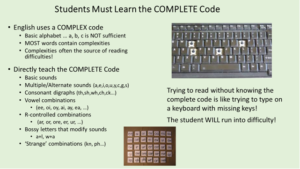
- Teach the complete code! Include direct instruction of all the code complexities. Start with the basic sounds but be sure and also include the alternate sounds, the vowel combinations, the r-controlled vowel combination, and other complexities. Don’t stop at the basic sounds and leave the most confusing part of our English language for the child to figure out on their own. You must teach the complete phonemic code that is the foundation of our written English language! A pre-planned systematic presentation ensures you cover the entire phonemic code. Don’t toss the entire alphabet soup of 70 to 80 phonograms at the child in one day but rather manage these complexities by planned, systematic and complete instruction.
- Consider frequency of occurrence – Introduce commonly encountered sounds before the infrequent sounds: When determining order of presentation, consider the frequency of occurrence in English words and introduce the most commonly encountered letters/sounds before the infrequent letters. For example, the letter ‘e’ and ‘t’ occur significantly more often than the letters ‘q’ or ‘v’. You want to teach the frequent letters early on so you can make more decodable words. Frequency lists vary depending on if they are derived from common words or all words. In general, the highest frequency letters include e, t, a, i, n, o, s, h, r, d, l, c. (For example, a Cornell University study of frequency of occurrence in forty thousand words found ‘e’ occurred in 12% of words compared to ‘j’ in only 0.10%)
- MUST Introduce vowels early: Vowels are necessary to form words, therefore you need to include the vowels early on. Your first reading lesson needs to include at least one vowel and then quickly bring in all other vowels. Including vowels early is an essential component in effective order of presentation for teaching the phonemic code.
- Include some of the ‘buddy letters’ or ‘partner letters’ (digraphs) early: The common digraphs ‘th’, ‘sh’ and ‘ch’ should be taught early in your sequence. This is important so the student learns and understands the important concept that 2 letters make 1 sound. In addition, these combinations are extremely common and you need them to make words for decodable text (You need to teach the ‘th’ sound early in your sequence so you can include the words “the”, “this” or “that” in your decodable sentences and stories).

- Separate similar letters and similar sounds that are easily confused by children: Separate instruction of similar looking letters that can be visually confused (b, d and p) and sounds that are phonemically similar (such as /i/ and /e/, /f/&/v/). In other words, don’t introduce b and d on the same day! Separate these letters/sounds in your preplanned sequence to maximize effective order of presentation for teaching the phonemic code.
- Group certain letters together: Sometimes it helps to group certain letters or graphemes together. For example, pairing ‘k’ and ‘ck’ together in the same lesson, or pairing ‘ch’ and ‘tch’ together. This grouping allows you to design instruction to help the child learn. For example, by teaching both representations of the /ch/ sound together, I can directly show and teach the relationship of when ‘ch’ is used compared to the far less common ‘tch’.
- Alphabetic order i
 s NOT ideal: The alphabetic order sequencing of letter presentation is not advised for teaching the phonemic code. Alphabetic order creates challenges for effective reading instruction because it fails to incorporate many of the key components listed above. Teaching letters by alphabetic order is one of the least effective sequences to use for teaching the phonemic code for reading as it fails to address most of the necessary components listed above.
- Additional information on sequence for introducing letters: The University of Oregon’s Big Ideas in Reading also has some information on the sequence for presenting phonemic code at http://reading.uoregon.edu/big_ideas/au/au_programs.php
It is important to remember the effective order of presentation for teaching the phonemic code or sequence in which you introduce the letters/code is just one part of effective instruction of the phonemic code. Additional key points essential to effective instruction of this phonemic code are summarized in the next section.
Review Additional Key Points Essential to Effective Instruction of the Complete Phonemic Code
- Explicitly teach the direct print=sound relationship. The student must look at the printed letter(s) and say the correct sound. Use direct print to sound. Avoid using indirect instruction methods such as picture=sound (picture of train = /t/) or printed letter = object (letter ‘d’= dinosaur).
- Introduce and teach sounds systematically. Use a pre-planned organized system sequenced simple to complex.
- Explicitly teach the complete phonemic code. Start with the basic code but also directly teach the complete code including digraphs, vowel combinations, r-controlled vowels and other complexities.
- Teach correct pronunciation. Remember this is the phoneme or sound the letter represents in our language NOT the letter name. (example ‘h’ = the sound /h/ not the letter name /aych/, ‘m’= the sound /mmm/ not the letter name /im/)
- The printed code needs to be phonetically accurate. Base printed code instruction on single phonemes. Avoid word families and blended consonants that are not phonetically accurate.
- Directly link phonemic awareness to the printed letters. Include phonemic awareness development as part of the print=sound instruction.
- Practice, practice, practice! Practice until automatic. Have students practice print=sound knowledge in isolation with a variety of direct instruction activities until this knowledge is automatic. After automatic knowledge is acquired, the sound no longer needs to be practiced in isolation.
Example of Effective Order of Presentation for Teaching the Phonemic Code:
Right Track Reading applies the sequencing strategies and considerations listed above to set order of presentation for teaching the phonemic code. Once again, the purpose of deliberately setting up this order of presentation for teaching the phonemic code is this careful ordering to introduce and teach the letters and sounds helps students learn our complex code!
In teaching the letters and sounds of the complete phonemic code, Right Track Reading Lessons uses the following ordering sequence:
First the basic sounds are taught: m, t, a, s, d, i, f, r, th, l, o, n, p, e, h, v, sh, u, b, k, ck, c, g, j, w, ch, tch, x, z, qu, wh, y
Next, the alternate vowel sounds are covered. Then the advanced code is systematically introduced starting with vowel combinations (ee, ai, ay, a_e, ..) and then moving into r-controlled vowel combinations (ar, or, er, ur, ir…etc) and then finally into some of the less common combinations such as wr and ph. Approximately 80 total phonograms are directly taught.
Back on the Right Track Reading Lessons uses the same order of presentation for introducing sounds. However, since the program is designed for older students the pace of instruction is faster (presentation at an accelerated rate). The vast majority of older students tend to know their letters & basic sounds and just need to learn the complexities and develop the automatic print=sound knowledge.
To learn more details about the effective, easy-to-use and affordable tools to directly help your child or student achieve reading success:
- PREVIEW Right Track Reading Lessons (designed for younger children)
- PREVIEW Back on the Right Track Reading Lessons (specifically targeted for older struggling readers 3rd/4th grade to adult).
Translating the science and evidence-based research into actions YOU can use with your student. The tools to achieve reading success!
Additional Information on Effectively Teaching the Phonemic Code
For additional information on helping your child or student learn the complete phonemic code, see the articles:
IMPORTANT! Remember, learning the complete phonemic code is just one skill necessary for proficient reading. Order of presentation for teaching the phonemic code is only a part of effective reading instruction. Reading is complex and requires mastering and integrating many different essential skills. See Overview and Visual Representation of Key Skills & Process of Proficient Reading and explore the Right Track Reading’s FREE READING INFORMATION page for additional informative articles and resources on teaching students to read proficiently.
Empowering parents and teachers with information & resources to lead their students to reading success!
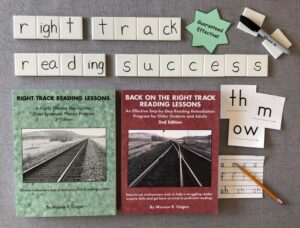
If you are ready to learn more about the effective tools to help your child or student achieve reading success… CLICK TO PREVIEW EFFECTIVE RIGHT TRACK READING PROGRAMS.
This article was written by Miscese Gagen a mother with a passion for teaching children to read proficiently by using effective methods. She is the author of the effective reading instructional programs Right Track Reading Lessons & Back on the Right Track Reading Lessons and a reading tutor with over 20 years’ experience successfully building proficient reading skills in her students. The purpose of this article is to empower parents and teachers with information to help their children or students achieve reading success. We CAN improve reading proficiency, one student at a time! More information is located at www.righttrackreading.com ~ Copyright 2005-2021 Miscese R. Gagen