Decodable Text Explained
What Decodable Text Is, The Importance of Reading Decodable Text for Developing Proficient Reading and How to Find Decodable Reading Material
What is the term ‘Decodable Text’ or ‘Decodable’ in Reading Instruction?
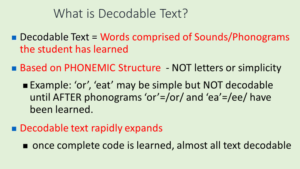
In reading instruction, the term ‘decodable’ refers to words containing only the phonetic code the child or student has already learned. To determine if text is decodable you need to evaluate the phonetic structure of the vocabulary and compare it to the code knowledge the child has already acquired. We often think of ‘decodable’ text as phonetically simple words and text (for example the ‘Bob Books’). Although decodable text is simple in the beginning when the child has limited knowledge of the phonemic code, decodable text rapidly expands as the child learns more of the phonemic code.
Since decodable text is determined by the fact that it matches the phonemic code that the student has learned, you must be aware of the student’s knowledge of the phonemic code. This is one of the primary reasons why a structured, organized presentation of the complete phonemic code is necessary to help students learn to read. For details on the complete phonemic code, see The Building Blocks of Written English: The Phonemic Code Explained and the article Effective Order of Presentation for Effectively Teaching the Phonemic Code.
Why is reading decodable text important? Why is it vital to provide practice reading decodable text to students learning to read?
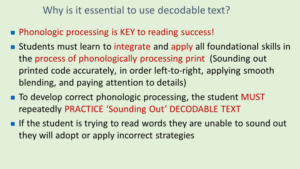
To become a proficient reader, the student MUST develop and practice correct phonologic processing. Decodable text provides the child reading material he has the skills to decode correctly. Decodable text allows the child to use and develop correct print to sound phonologic processing pathways and avoid the potential of developing incorrect reading strategies. Reading decodable text helps children build necessary skills in phonologic processing essential for proficient reading!
It is critical for the student to read phonetically decodable text in beginning reading and in intervention to ensure the student forms correct phonologic neural processing pathways. If students are reading text that is NOT decodable (words comprised of sounds/phonograms they have not yet learned) the student is unable to use correct phonologic processing and often resorts to incorrect strategies that lead to reading difficulties. Having students read text that is not decodable can actually create struggling or dyslexic neural pathways. To learn more about the science of proficient reading and better understand why phonologic processing is essential see the article How Reading Works and the informative article Overview of Children Learning to Read and Developing Proficient Reading.
Bottom line, sounding out/reading decodable text allows the student form the correct proficient phonologic processing pathways. Use of decodable text is necessary to wire (beginning reading) or re-wire (effective intervention) the brain for reading success!
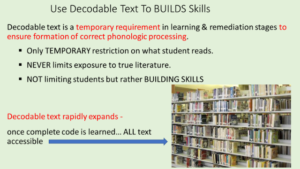
The prudent limits on the material the student practices reading are temporary restrictions to help the child or student learn. Reading decodable text is similar to teaching a child to play the piano. It would not be effective to provide a beginner with advanced pieces of music. The beginner starts with individual notes and simple songs such as Mary Had a Little Lamb. As the student acquires skills, they are able to play more and more songs correctly. Similarly, as the student learns more sounds, the material that is decodable rapidly expands. Before long student learns the entire phonemic code and the student is able to pick up and read any appropriate book.
Does the requirement of using and reading decodable text mean I need to avoid reading real books to my child?
NO, absolutely not. It is critical to recognize, the use of appropriate decodable text ONLY applies to the material the child or student reads to you when the student is learning how to read! This prudent use of decodable text NEVER limits the text you read to your child or student. You definitely should be exposing your children and students to a wide range of books and true literature. The use of decodable text to help your child develop and practice essential reading skills never prevents access and exposure to wonderful children’s books, literature and informational resources.
The use of decodable text in reading instruction does not mean more advanced books are off limits but rather the text the child first reads to you needs to be decodable. For example: If your child likes dinosaurs, go the library, head for the dinosaur section and check out a stack of books. Let him look through all the books. Sit down on the couch and study the illustrations. Read multiple pages of advanced text to him such as “The paleontologist discovered ancient fossilized relics of a Dromaeosaurus from the cretaceous period”. However, when it is his turn to read to you, select decodable text and have him read the beginning decodable book “Tom dug up a big T-rex fossil.” By reading decodable text, the student develops reading skills!
Remember, the purpose of the child reading decodable text in the beginning such as ‘the cat sat on the mat’ and “The pup will swim in the pond’ is to intentionally help the child build and establish necessary phonologic processing pathways. Decodable text is only a temporary restriction to make sure the student builds essential phonologic processing pathways. Decodable text is highly effective tool to help children develop correct reading skills.
The use of decodable text in beginning reading and in remediation does not limit students, but rather effectively helps them build necessary skills so they become proficient readers and can access the limitless opportunities of skilled reading. Reading decodable text builds skills!
Can you give an example of decodable vs. non-decodable words? Can you provide examples of decodable text? What does decodable text look like?
What qualifies as decodable text is based primarily on the phonemic structure of the words. The phonograms in the words must match the phonemic code that the student has already learned. Decodable text contains the phonemic code the student has learned so decodable text expands as the student acquires new code knowledge. Therefore, there is not a single list of ‘decodable words’ or single set of ‘decodable books’. The exact text that is decodable for a particular student, changes depending on what code they have learned and rapidly expands as the student acquires more knowledge of the phonemic code and develops skills.
Remember, decodable is based on phonemic code NOT letters. For example, if the student has learned basic code a=/ă/, s=/s/, t=/t/, r=/r/. The word ‘rat’, ‘sat’, ‘at’, would be decodable. However, even though they contain the same letters, the word ‘art’, ‘tar’ & ‘star’ would NOT be decodable until after the student learned phonogram ‘ar’ = /ar/ sound.
In addition to the phonemic structure of the word, the other factor that contributes to words being decodable, particularly in the early stages, is the length of the word. Young beginners need to start with single syllable words. The simplest words to decode are the short vowel-consonant words (for example: at, in, if, it, am, on, us, up, ….) and the short consonant-vowel-consonant words (for example ran, sit, fun, mom..). After they have mastered simple single syllable words move to more complex single syllable words (for example, stump, plant, strip..) and then to simple 2 syllable words. Remember, phonemic code is still primary, as word length is only part of decodability. Short words can have complex code that is not yet decodable by beginners that only have limited basic code knowledge and have not yet learned vowel combinations and r-controlled vowel combinations. (for example: owl, boy, roar, right, soil, year, graph).
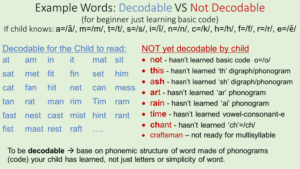
The following examples list the code the student knows and then a list of sample words that would decodable based on that code knowledge.
Example 1: given for a young beginner who is in the initial stages learning the basic code. The child has only learned only a few of the initial basic code. If the student has only learned the following basic code: a=/a/, m=/m/, t=/t/, s=/s/, d=/d/, i=/i/, r=/r/, e=/e/, n=/n, c=/k/, h=/h/, o=/o/)
- decodable words would include words such as: rat, net, miss, rant, hit, cat, and, sit, cast, him, hat, rot, rest, rim, man, nest, not, rod, hot, set, dot,
- words that would not be decodable and why they would not be decodable include words such as: art (the child has not yet learned ‘ar’=/ar/); rain (child does not yet know ‘ai’=/ay/); chair (child does not yet know ‘ch’=/ch/ or the ‘r-controlled vowel combination ‘air’=/air/), ‘hate’ (child has not yet learned the vowel-consonant-e combination)
Example 2: A beginner who is still in the learning stages but has now acquired knowledge of the entire basic code (the base alphabet and common digraphs such as ‘th’ ‘ch’ ‘sh’) and is just beginning to learn some of the complexities. He has just learned the vowel combination ‘ee’.
- decodable words would include words such as: that, this, grab, test, much, ship, trash, math, , step, plan, chest, vet, splash, swim, blast, flip, …etc.. . With learning the new vowel combination ‘ee’ words including: green, sheep, sleet, seen, street, seed, and tree…etc would now become decodable by this student.
- words that would not be decodable would include: Words that would not be decodable would include words containing the vowel combinations, r-controlled vowel combinations and advanced complexities not yet introduced/taught to the child.
As the beginner advances in skills, they master the basic code and then start systematically adding in code complexities. As the student learns new phonograms/expands knowledge of the complete code, more words become decodable: for example, the word ‘rain’ that was not decodable for student in example 1 or 2 would be a decodable word for a student who now learned the ‘ai’=/ay/ sound. That student’ decodable words would now include ‘rain’, ‘wait’, ‘aim’, ‘brain’, ‘faith’, ‘gain’ …etc. Each new phonogram that is learned expands the available words that are ‘decodable’. Once again, the ability to provide decodable text that matches the code knowledge of the child is one of the key reasons why it is essential to teach the phonemic code in a pre-planned direct systematic order.
To view samples of decodable text in an effective direct systematic phonics program and see how the number of words that are ‘decodable’ rapidly expand, please view the following lessons from Right Track Reading Lessons and Back on the Right Track Reading Lessons
From Right Track Reading Lessons
- Lessons 1 and 2:(notice how decodable words are limited when the child first begins learning the code)
- Lesson 16: (notice how decodable word lists rapidly expand as the code knowledge increases)
- Lesson 42: (notice the word list providing direct practice in decoding the new ‘ai’ an ‘ay’ code)
- Lesson 77: (notice the word list providing direct practice in decoding the new ‘er’ code)
From Back on the Right Track Reading Lessons (remediation program for students 3rd grade through adult)
- Reading Lesson 3: (notice the decodable word list when student has limited basic code knowledge, in this lesson the sounds m, t, a, s, d, i , f, r, th, l, o, n, p, e, h, v)
- Reading Lesson 20 (notice the word list providing direct practice of ‘ai’ and ‘ay’)
- Reading Lesson 33: (notice the word list providing direct practice decoding words for both sounds of ‘ow’: Also note how word lists are highly effective in providing older students with much needed correct phonologic decoding practice without having them read juvenile sentences such as “Now the brown cow went down the hill”)
- Reading Lesson 50: (a list of words providing direct practice in decoding the ‘er’ sound)
How do I determine if books are decodable? How do I pick out decodable books for my child or student? How do I find books where my child can practice reading decodable text?
As explained in the previous section, to determine what is decodable, you must look carefully at the printed text and evaluate if the phonemic code used in the text corresponds to your child’s code knowledge. The determination of decodable is based on the code/phonograms the student knows compared to the phonemic structure of the word. Word length is also a consideration. Remember, what is ‘decodable’ changes as your child learns new sounds and expands their code knowledge and as skills advance.
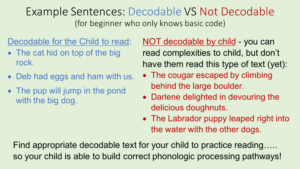
The following examples show several sentences that may be decodable to a beginner contrasted with sentences that would not be decodable by beginners.
CAUTION!!! Always evaluate the vocabulary carefully! Do not rely on the grade level rating printed on the book. Many very simple children’s picture books with only one or two words per page and numerous books actually labeled “early phonics readers”, “Level 1”, “first reader”, etc are full of words like ‘rhinoceros’ and ‘laugh’ that contain complex code or multisyllable word such as ‘carnival’ and ‘investigations’ that are absolutely not decodable by beginners. It is not simplicity of the text, but rather the structure of the words used.
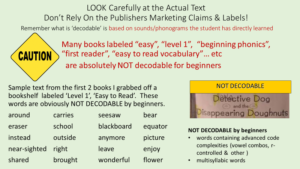
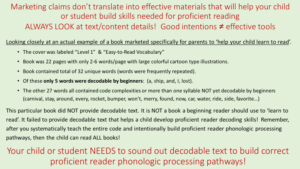
To determine if a book is decodable, evaluate if the phonemic code used in the text corresponds to your student’s code knowledge. Remember what is ‘decodable’ changes as your child learns new sounds and expands their code knowledge.
The following examples give the students code knowledge and then provide sample sentences that would be decodable at the given level of code knowledge. These examples were all taken from Right Track Reading Lessons. Direct instruction in the common ‘irregular’ words is incorporated in the program of instruction (examples: to, do, said, was, of, what, who…) These words are then incorporated into the decodable sentences after they have been directly introduced and taught:
- Student’s code knowledge: m, t, a, s, d, I, f, r, th (young beginning reader in initial learning stages who has only been taught these few basic short vowels, consonants, and the common digraph ‘th’,) Decodable Sentences: Sam is mad. This rat is fat. Tim is sad.
- Student’s code knowledge: the basic code of short vowel sounds, all consonants, and a few key digraphs ‘th’, ‘sh’, ‘ch’ and ‘wh’ Decodable Sentences: This is a fun math class. Pick up the trash that is on the grass. The frog can swim fast and jump on the rock. Can I get the lunch box with the cats on it?
- Student’s code knowledge: the basic code (short vowel, all consonants, key digraphs), plus alternate vowel sounds, alternate consonant sounds such as c=/s/ and g=/j/, and the vowel combinations Decodable Sentences: The book that I just read was great. Mom said that we need to pick up these toys right now. A simple way to keep my room clean is to not throw stuff on the ground. My frogs like a clean tank. Decodable Paragraph: Almost all the kids had a chance to see the little puppy. The cute puppy was only six weeks old. He was mostly black except the small white patch on his face and a white tip on his tail. It was easy to see the bright white tip on the tail wagging as the kids petted him.
- Student’s code knowledge: the basic code (short vowel, all consonants, key digraphs), plus alternate vowel sounds, alternate consonant sounds such as c=/s/ and g=/j/, the vowel combinations and the r-controlled vowel combinations Decodable Sentences: Did you know that beavers are the biggest rodents in North America? Moose are the largest members of the deer family. Rattlesnakes are pit vipers. Decodable Paragraph: I did a report on the state of Montana. I learned it became the 41st state in 1889. The capital of Montana is Helena. The state bird is the western meadowlark. The state flower is the bitterroot.
To help your child build proficient reading, assist your child in selecting and reading decodable text.
I’m having a difficult time finding decodable text. What can I do to provide my child or student more practice with decodable text? What are my options for providing sufficient practice reading decodable text?
In the very initial stages when the child has limited code knowledge, it can sometimes be challenging to find decodable books. As the child’s knowledge of the code increases it becomes easier and easier to find decodable books. The very simple decodable books are just used in the very initial decoding learning stages with young children. Several decodable beginning reader series are commercially available. For example, the ‘Bob Books’ are one series of decodable books. However, you still need to match your student’s code knowledge with the text. It may be simple but if your child hasn’t learned the phonogram, it is not decodable!
Make Your Own Decodable Books
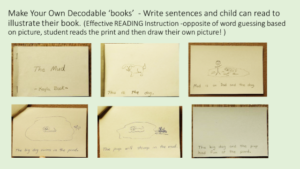
A terrific and inexpensive alternative for younger children is to make your own decodable books. Making your own decodable books is easy and fun. All you need is a paper or a stack of 4×6 index cards and a pencil. Print one simple decodable sentence per page and staple the pages together to make your own decodable story. Make a few simple illustrations or better yet, have your child illustrate their own book after they read the text. Remember you don’t have to be a talented author. This is not literature but rather practice reading decodable text. Make these inexpensive practice decodable readers and save your money for purchasing the real books and literature! List out the sounds the child knows and then write up a few short sentences. For example, if the child knows the sounds: a, i, o, e, u, b, c, d, f, g, h, k, l, m, n, p, r, s, t, v, and ‘th’ you can write a quick simple ‘story’ such as:
The Dog in the Mud
This is the dog.
The dog is in the mud.
The dog can stomp in the mud.
The mud is on the dog.
The dog must get a bath.
Sam can rub the mud off the dog.
The dog is mad at Sam
Examples of short decodable sentences and paragraphs and how the text that is ‘decodable’ expands as the child learns more of the phonemic code can be found in the Right Track Reading Lessons. Find the sentences at the end of the lessons. Please see:
- Lesson 16(notice simple sentences contain only basic code and short vowel sounds that have been taught to the child)
- Lesson 42(notice the decodable sentences now contain the vowel combinations the child has learned)
- Lesson 77(notice the decodable sentences now contain the vowel combinations as well as the r-controlled vowel combinations)
Additional examples of free decodable stories are found on the Resources for Users of Right Track Reading Programs page.

Reading Together Can Expand Choices in Books
You can also expand choices by reading books together. In joint reading, you read all the complex code and have the child read the words containing the code he knows. This shared reading is a fantastic technique for expanding options for providing extra practice reading decodable text. In the beginning when the child’s code is limited, you can point to the words you want him to read. Later on, have him read most words and only jump in to help when you encounter new complex code or complex multisyllable words the child is not yet ready for. You can also help out with specific sounds. When the child is reading a story and comes across a sound they do not know simply point at the sound and say, “we have not learned that sound yet”. Tell him “the sound is ____”. For example, when you encounter the word “right” before the child has learned the sound for “igh”, point out the ‘igh’ and tell him it has the /ie/ sound and then have him continue reading. Remember, reading decodable text is a temporary step. Before long the child will be able to read any appropriate book.
Word lists provide effective, affordable practice reading decodable text:
Also don’t forget, one of the most effective tools for practicing correct phonologic processing is word lists. Type up a list of random decodable words. The child or student reads the words in the list. The advantage of word list is the student must use correct phonologic processing to correctly read the words. The other incorrect strategies such as guessing based on context do not work with word lists. These word lists provide a highly effective tool for helping students develop and practice correct phonologic processing.
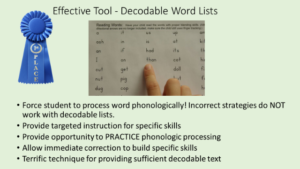
For older students (3rd grade and up and adults), skip the simple decodable sentences and stories completely. While these students absolutely do need practice reading decodable text, the juvenile nature of simple decodable stories usually makes them inappropriate for older students. Instead of practicing with simple stories, rely on extensive use of decodable word lists. These decodable word lists are essential for reading remediation with older students as they provide necessary practice processing print phonetically.
Remember! Simple Decodable Books Temporary Requirement
Very simple decodable books are only necessary in the initial stages. As the child learns more of the phonetic code, he will be able to read many words. As the child’s reading ability develops you can pick out a much wider selection of books. At the point when the student has learned the vast majority of the phonemic code, and had sufficient practice decoding words to establish a strong phonologic processing foundation virtually all age-appropriate text will be decodable. With exception of a few advanced sounds such as ‘tion’ and the development of advanced skills in handling multisyllable words, the foundation of correct phonologic processing should be established. While you no longer need to look for decodable text, you should still help your child or student select level and content appropriate books. For example, a first or second grader who has learned the phonemic code should be able to read “My Father’s Dragon” however “Eragon” would likely be a challenging level inappropriate choice. While you want to help your child build skills, you do not want to frustrate them with material way above their level. For additional information see the article, Finding Appropriate Level Books to Help Students Improve Reading Skills & How to Select Books to Match Your Child’s or Student’s Reading Level
Summary of Decodable Text
In summary decodable text is words consisting of phonograms (print/grapheme=sound/phoneme code) the student has already learned. It is important for students to practice reading decodable text in the initial stages because it helps children develop correct phonologic processing pathways. Therefore, when helping students learn how to read, evaluate and carefully select text that is decodable. The use of decodable text only applies to material the student reads to you. The initial use of reading decodable text in beginning reading and in remediation/intervention does not limit students, but rather effectively helps them build necessary skills so they become proficient readers and can access the limitless opportunities of skilled reading.
As the student advances from the foundational ‘learning how to read’ stage to the ‘reading to learn’ stage, you no longer need to focus on decodable text but do need to continue direct instruction to improve proficiency and develop advanced skills (handling multisyllable words, fluency, comprehension, vocabulary). For additional information, see the section on advanced skills under Skills Needed for Proficient Reading and the article on the highly effective True Guided Reading.
For additional information see the articles:
- Direct Systematic Phonics: Proven Effective
- Key Points for Establishing Phonologic Processing & Effective Multisensory Activities to Directly Establish Phonologic Processing
- The Building Blocks of Written English: The Phonemic Code Explained
- Effective Order of Presentation for Effectively Teaching the Phonemic Code.
If you are ready to learn more about the effective tools to help your child or student achieve reading success, CLICK TO PREVIEW EFFECTIVE RIGHT TRACK READING PROGRAMS.
Empowering parents & teachers with information & effective resources to lead their student to reading success! For additional free information, useful articles, and effective resources on teaching students to read ⇒ CLICK TO EXPLORE FREE READING INFORMATION.
————————————————————————————-
This information was written by Miscese Gagen, a mother with a passion for teaching children to read proficiently by using effective methods. She is the author of the effective reading instructional programs Right Track Reading Lessons and Back on the Right Track Reading Lessons as well as a reading tutor with over 20 years’ experience successfully building proficient reading skills in her students. The purpose of this article is to empower parents and teachers with information to help their children achieve reading success. We CAN improve reading proficiency, one student at a time! More information located at www.righttrackreading.com ~ Copyright 2004-2021 Miscese R. Gagen