How to Help a Student Who Struggles With Reading Overcome Reading Difficulty & Achieve Reading Success
If your child struggles with reading, in almost all cases you can help your student overcome reading difficulty and become a proficient reader. Individuals face reading difficulty because they lack specific essential skills. To help a student overcome reading difficulty, you need to directly help him develop all skills necessary for proficient reading. This article empowers parents, teachers and other caring individuals with information and resources to help a struggling reader achieve reading success.
An overview of steps and additional information on exactly how to help your child or student build skills and overcome reading difficulty are listed below.
Steps for Successful Reading Remediation to Overcome Reading Difficulty and Achieve Reading Success:
“You can use direct effective intervention to help your struggling reader build essential skills so they are able to overcome reading difficulty and achieve reading success”

Step 1: Learn More About Proficient Reading and Reading Difficulty
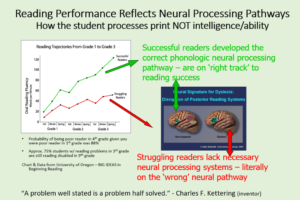
Before you start working with your child or student, empower yourself with information. Discover and explore the science of proficient reading and reading difficulties. Start with the articles:
⇒Students who Face Difficulties Learning to Read: Information on Reading Problems & Dyslexia
⇒Skills Necessary for Proficient Reading
⇒Overview & Visual Representation of Process of Proficient Reading
Step 2: Understand the Intent of Effective Remediation (Intervention)
If reading is difficult for your child, your objective is to directly help him develop proficient reader skills. Successful remediation requires direct, intensive intervention with an effective program. Effective remediation is NOT teaching down to a lower level, helping him learn ways to ‘manage’ his reading difficulties, or continuing practice of impaired reading. Effective remediation directly builds necessary skills so the student acquires the necessary skills and can advance. To read proficiently the student needs to convert print to sound and develop phonologic processing pathways. After fundamental phonemic processing is established, the student needs to build advanced skill. Effective reading remediation programs directly develop all skills necessary for proficient reading so the student is able to overcome reading difficulty and achieve success.
⇒For a summary of effective reading intervention view Effective Reading Intervention to Help Struggling Students Achieve Reading Success
⇒For a real-life analogy of how effective intervention with targeted instruction can help a child succeed click on the article What Can Baseball Batting, a Terrific Dad, and a Bucket Teach Us About Reading?
Step 3: Recognize Direct Intervention is Essential – Never Wait as Student Will Continue to Struggle
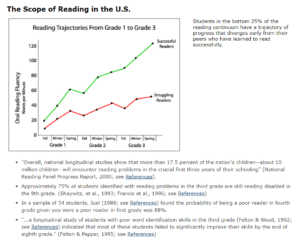
Struggling readers are lacking essential skills and need direct effective intervention. In almost all cases, students do not ‘outgrow’ reading problems. Research data reveals struggling students rarely ‘catch up’ on their own. See ‘The Scope of Reading Difficulties in America’ in the University of Oregon’s Big Ideas in Beginning Reading website (chart shown). As students get older, difficulty reading handicaps them further in all subject areas. They get behind not only in reading but in other areas because they are limited by their inability to easily and proficiently access written language. Intervene immediately to develop correct proficient reader skills. You need to get your child or student on track to proficient reading as quickly as possible. While it is best to remediate early, the neural research proves effective remediation can noticeably improve reading skills and develop proficient reader neural processing pathways in older students and adults. Struggling readers require direct effective intervention to overcome reading difficulty.
Step 4: Evaluate the Student and Identify Deficiencies in Necessary Skills
Carefully evaluate how your child or student is reading and check for specific skills and skill gaps. An evaluation is not a ‘test’ but rather an informal tool to help you determine the exact reading skills you need help your student develop. Students struggle with reading because they lack specific necessary skills. In order to help them overcome reading difficulty, you must identify these specific deficiencies. This is comparable to a coach watching a player perform a task so they can determine the specific weaknesses and then coaching to strengthen those areas. Individual evaluation results identify missing skills and allow you to target instruction to effectively help your student build the necessary skills for proficient reading. For further information on evaluating individuals to determine possible gaps in reading skills and how to use evaluation results to focus instruction see the articles:
⇒For a summary of effective reading intervention and using evaluations view Effective Reading Intervention to Help Struggling Students Achieve Reading Success
⇒The Importance of Evaluations in Reading Remediation: How to Conduct Reading Evaluations
⇒Common Reading Problems: How to identify common reading problems and target instruction to help struggling readers develop necessary skills
⇒Actual Reading Errors Made by Struggling Readers: What These Errors May Indicate, How to Evaluate Errors, Identify Deficiencies and Target Instruction to Build Necessary Skills
Step 5: Set an Effective Remediation / Intervention Plan

Use the results of the evaluation to help set a specific remediation plan. Students who struggle with reading are missing essential fundamental skills. Remember, to be effective in helping the student overcome reading difficulty, effective remediation does not ‘teach down to a lower level’ but rather must directly teach and develop essential skills to build up and raise the student to the proficient level. For additional information see the article Elements of an Effective Reading Remediation Program.
To achieve and maximize effectiveness the remediation program should meet the following criteria:
- Use effective instruction: The remediation must directly establish the skills necessary for proficient reading. The neuroscience reveals the facts on the process of proficient reading. To read proficiently the student must convert print to sound using phonologic processing pathways. Proficient reading requires the acquisition of specific skills. To be effective, remediation must help the student build necessary skills (phonemic awareness, knowledge of the complete code, tracking, blending, attention to detail) and establish proficient reader phonologic processing pathways. Continuing to read the ‘incorrect’ way, additional practice of incorrect strategies, or repeating a program that failed the student the first time around will NOT help the student overcome their difficulties. You must redirect the student and build necessary skills with effective instruction. The brain imaging shows effective direct systematic phonics programs improve reading skills and develop proficient reader neural pathways in struggling readers. After foundational phonologic processing is established, effective remediation also directly teaches the advanced skills.
The neural imaging studies show us that dyslexic readers are literally are on the ‘wrong track’ with their reading and using incorrect processors. Effective intervention needs to be carefully focused to extinguish use of incorrect processors and intentionally develop proficient phonologic processing pathways. Both the validated results-based research and the neural imaging research prove the effectiveness of direct systematic phonics programs in teaching students to read. Read details at Direct Systematic Phonics Proven Effective: Why Parents & Teachers Should Use Direct Systematic Phonics
Be sure the instructional program you select meets the criteria for an effective, direct, systematic phonics-based approach. Intervention with ‘balanced’ or ‘integrated’ approaches fails many students because it allows the student to continue reading the ‘wrong way’ instead of ensuring the student develops the ‘correct’ phonologic processors. The student’s success in achieving reading proficiency depends on effectiveness of the instruction.
- Target instruction: The remediation program needs to be targeted to develop the specific skills the student is lacking. The reading evaluation helps you identify skill deficiencies and target your instruction. See the discussion and articles listed under the preceding evaluation step for information on targeting instruction to help struggling readers develop necessary skills to overcome reading difficulty.
- Directly teach all skills: Always explicitly teach the student exactly what they need to know. Don’t leave it for chance for a student to acquire necessary skills. Effective remediation requires direct explicit instruction. Embedded, implicit, analytical or incidental approaches are ineffective for many students. Direct instruction is particularly critical in remediation, because the student has obviously already missed the skill in previous instruction. To help students overcome reading difficulty, it is vital to directly teach all essential skills. This includes direct instruction in foundational skills as well as in the advanced skills.
- Teach complete skills and knowledge: Effective remediation requires instruction in complete skills and knowledge. Reading requires acquisition of many skills. Help the student by teaching the complete set of skills and knowledge. Start with the foundational skills but do not stop there. Teach all of the essential subskills. Teach the complete phonetic code. (code complexities are often the source of reading difficulty!) Teach each of the advanced skills.
- Present information systematically: Reading is a complex learned skills requiring mastery of many different subskills. To help students learn and master the difficult and complex task of proficient reading, teach information in a deliberate, carefully planned manner. Systematic presentation of material helps students manage and master the complexities of reading. Systematic presentation is especially critical in remediation. A step-by-step approach allows the student time to practice and master individual skills before additional information and complexities are added. Start simple, build the foundation and then progressively add skills and knowledge as the student learns. Directly teach each of the essential subskills in phonemic awareness, blending, tracking, attention to detail and knowledge of the complete phonemic code and directly establish correct phonologic processing. After foundational phonologic processing is established systematically develop the advanced skills. Carefully controlled systematic presentation increases effectiveness because it helps the student learn.
- Use an intensive remediation schedule: An intensive schedule is important for remediation success. An intensive program is necessary to overcome incorrect habits and establish correct proficient reader skills. If you proceed too slowly it is difficult to help the student build necessary skills. This is true for many activities. It is hard to learn how to play a trumpet if you practice only once a week, or to get into shape if you only work out for 20 minutes every other week. Effective remediation requires an intensive and consistent schedule. For reading remediation, a 45-60 minute session 4-5 times/week is ideal. An intensive schedule is not only effective in developing skills but it allows the student to make rapid progress. This rapid progress provides additional benefits as the student sees improvement and gains confidence. Older students need to quickly complete the remediation ‘learning how to read’ stage and advance to proficiency so they can get back on track with their classmates and move ahead with the ‘reading to learn’.
- Individual tutoring is ideal! Individual instruction is the most efficient and effective remediation situation because it offers the best opportunity for direct instruction, careful monitoring and instant feedback. You can monitor exactly what the student is doing, focus instruction, provide immediate correction and feedback, adapt to meet unique needs, and ensure the student acquires necessary skills. Plus working with a student in a one-on-one situation is an enjoyable experience. Individualized, one-on-one instruction by a parent, teacher or other caring adult is the ideal situation for remediation. If you are not able to teach your child, find or hire someone such as a grandmother, uncle, older cousin, friend or neighbor who can work with and tutor your child. Most caring literate adults (and a select few older teenagers) can successfully teach a child to read with well-designed effective direct systematic phonics instructional materials. Struggling students will not acquire skills on their own. It requires effective direct intervention and instruction conducted by someone.
Step 6: Explain the Reading Remediation Plan or Intervention Program to the Student
Before starting an effective reading remediation program with a struggling reader, it is important to explain the program to the student. You need the student to understand the effective remediation directly teaches and develops essential skills to raise them to the proficient level. Make sure the student understands reading remediation is NOT teaching down at lower level but rather building necessary skills to help them overcome reading difficulty and achieve proficiency.
The student’s effort and attitude will affect how quickly they learn. Motivated students progress faster than students with a poor attitude. Help the student develop positive attitude toward remediation. Some older students frustrated with their failure develop a negative attitude towards reading. Remember, this ‘dislike’ of reading is human nature. We tend to ‘dislike’ and avoid activities we find difficult or fail at frequently. Help the student understand 1) reading is a complex learned skill, 2) reading problems are common, 3) reading problems have nothing to do with intelligence or ability, 4) difficulties reading are caused by weakness in phonologic processing and other fundamental skills, 5) Effective instruction improves reading skills, and 6) because they are older and have significant background knowledge and higher level skills they can advance rapidly and 7) with some direct work you are confident they will develop proficient reader skills. Share information and help the student approach the remediation with a positive attitude. For additional information click on the article Explaining an Effective Reading Remediation Program to the Student.
Step 7: Take Action! Teach the Student with Effective Targeted Direct Instruction
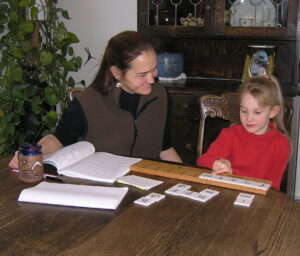
Sit down with your child or student and teach them with an effective program. Select and use a highly effective program that directly helps the student overcome reading difficulty, acquire necessary skills and develop proficient phonologic processing. If your student is not processing print phonetically you need to use a strong direct systematic phonics program that intentionally develops necessary phonologic processing pathways. To be effective in remediation situations the program needs not only to directly develop correct skills but also must extinguish improper techniques.
⇒ For additional information on selecting an effective reading remediation program see the article Elements of an Effective Reading Remediation Program.
As discussed previously, an effective instructional program is essential. However, an effective program is worthless if the material is not actually taught to the student. Struggling readers are unlikely to learn correct skills on their own. The teaching itself is critical. Someone must sit down with the student and spend time directly teaching the necessary skills. Reading success requires two equally critical elements: (1) an effective direct systematic reading remediation program and (2) The actual direct teaching actions and time with a parent, teacher or other caring individual. The equation for reading success is: Effective Remediation Program + Teaching = Reading Success
Conclusion: The author’s personal message for parents who have a child or teachers who have a student struggling with reading:
You can help your child or student overcome reading difficulty and learn to read proficiently! Although the research data provides information on how to help students overcome reading problems, it is my own experience successfully tutoring students who were struggling that have made me so passionate about the importance and proven success of effective direct systematic phonics intervention. Time after time, I have seen a dramatic turnaround in reading skills! All it takes is direct instruction with effective materials and some one-on-one tutoring time. I firmly believe any loving parent, teacher or caring adult willing to sit down with their child or student can have similar success. With an effective direct systematic phonics program and some one-on-one tutoring time, you CAN help your child or student learn to read proficiently. Helping your child or student learn to read proficiently is one of the most valuable gifts you can give your child.
Back on the Right Track Reading Lessons is specifically designed to advance reading skills of older struggling readers (3rd/4th grade and older). Right Track Reading Lessons is designed for younger students (k-3rd grade). These highly effective direct systematic phonics programs provide easy-to-use tools so parents, teachers and other caring adults can help struggling readers acquire necessary skills and achieve success reading. For additional information, preview these highly effective direct systematic phonics programs
We can achieve reading success, one student at a time!
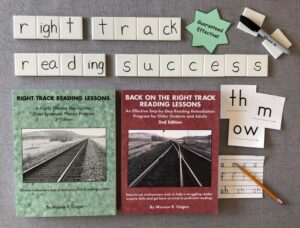
Empowering parents & teachers with information & effective resources to lead their student to reading success!
Reading is complex and requires mastering and integrating many different essential skills. For additional informative articles and resources on teaching students to read CLICK TO EXPLORE FREE READING INFORMATION
If you are ready to learn more about the effective tools to help your child or student overcome reading difficulty and achieve reading success, CLICK TO PREVIEW EFFECTIVE RIGHT TRACK READING PROGRAMS.
This information was written by Miscese Gagen, a mother with a passion for teaching children to read proficiently by using effective methods. She is the author of the effective reading instructional programs Right Track Reading Lessons and Back on the Right Track Reading Lessons as well as a reading tutor with over 20 years’ experience successfully building proficient reading skills in her students. The purpose of this article is to empower parents and teachers with information to help their children achieve reading success. We CAN improve reading proficiency, one student at a time! More information located at www.righttrackreading.com ~ Copyright 2004-2021 Miscese R. Gagen