Phonemic Awareness Explained: What Phonemic Awareness is, Why Teaching Phonemic Awareness is Important & Why You Link Phonemic Awareness to Print
What is Phonemic Awareness?
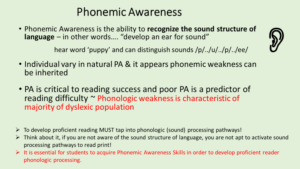
Phonemic awareness is literally ‘sound’ awareness. Phonemic awareness is understanding that words are made up of sounds and being able to hear, recognize and manipulate the individual sounds that make up a word. Phonemic awareness is primarily an auditory skill of distinguishing and recognizing the sound structure of language. For example, phonemic awareness is realizing the word ‘puppy’ is made up of the sounds /p/ /u/ /p/ /ee/ or the word the word ‘shape’ is made up the sounds /sh/ /ay/ /p/. (Note: Throughout this article, sounds are indicated between slashes /_/. For example, the letter ‘m’ has the sound /m/.)
Many children do not realize that the words they hear break apart into smaller hunks of sound. Hearing & distinguishing the individual sounds within a word is difficult because spoken language is so seamless. When we speak, we naturally and effortlessly blend all the sounds together to say and hear the overall word. The natural ease of seamless speech hides the phonetic nature of our spoken language. For example: The child says and hears the word “puppy” as one seamless word /puppy/ and does not recognize or distinguish the separate sounds /p/ /u/ /p/ /ee/ that make up the word.
Children vary greatly in their natural ability to recognize the sounds within words. Some individuals have a definite natural phonological weakness. Research has shown that individuals with poor phonemic awareness struggle with reading and spelling. The child’s natural phonological abilities are not related to intelligence. In fact, many highly intelligent children have phonological weakness that leads to reading difficulty. In addition, tendency for natural phonologic weakness may be an inherited trait as it appears to run in families.
I discovered an antique reading primer from the late 1800’s. In the introduction, the teacher explained how in learning to read, “Children must develop an ear for sound”. Over a century before the neuroscience and the term ‘phonemic awareness’ emerged, this teacher identified the importance of recognizing the sound structure of words to reading development. Her fantastic explanation that beginning readers need to “develop an ear for sound” is absolutely correct! Teaching phonemic awareness is critical to reading success.
**IMPORTANT NOTE: If you suspect a child or student has any hearing difficulty, it is critical to get them evaluated by a professional with medical expertise. Children with unmitigated physical hearing limitations will be challenged or unable to develop phonemic awareness because they cannot physically hear well enough. Obviously, any biologic or environmental hearing issues will impact the student’s ability to hear sound and must be evaluated and addressed by a medical professional. (If the child has difficulty hearing the word ‘puppy’ of course they will not be able to distinguish the sound structure within that word!).
Teaching phonemic awareness has significant positive effect on reading and spelling success!
Why is Phonemic Awareness Important?
Phonemic awareness is important because it is critical to reading and spelling success. A child’s phonemic awareness is a powerful predictor of the likelihood of reading and spelling success. Children who cannot distinguish and manipulate the sounds within spoken words have difficulty recognizing and learning the necessary print=sound relationship that is critical to proficient reading and spelling success. If a child has poor phonemic awareness, they face challenges in establishing the necessary link between print and sound and develop the phonologic processing pathways that are essential for proficient reading. For additional information, see How Reading Works: The Neurobiologic Process of Proficient Reading
The Benefits of Directly Teaching Phonemic Awareness!
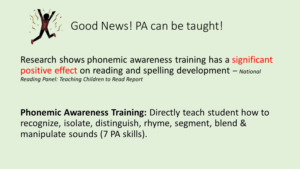
Although some children and adults have a definite natural phonological weakness, the good news is that phonemic awareness (PA) can be taught and learned. The scientific evidence proves that PA instruction has a significant positive effect on both reading and spelling. (National Reading Panel’s “Teaching Children to Read” Summary Report). In other words, we can directly teach children how to hear, recognize and manipulate sounds within words and that the intentional development of PA skills has a positive effect on reading and spelling success. Targeted PA instruction helps children develop necessary skills. Directly teaching phonemic awareness helps children achieve reading success.
From National Institute for Literacy’s highlights of the evidence-based research on phonemic awareness
“Phonemic awareness can be taught and learned. Effective phonemic awareness instruction teaches children to notice, think about, and work with (manipulate) sounds in spoken language.”
“Phonemic awareness instruction helps children learn to read. It improves the ability to read words and comprehend what is read.”
“Phonemic awareness instruction helps children learn to spell. Direct instruction in phonemic awareness, especially in how to segment words into phonemes, helps children relate the sounds to letters as they spell words.”
“Phonemic awareness instruction can help all types of students learn to read, including preschoolers, kindergartners, first graders who are just starting to read, and older, less able readers.”
Specific Phonemic Awareness Skills:
Phonemic awareness is recognizing and being able to manipulate the phonemic structure of language. It includes the following specific skills:
1) The ability to isolate and distinguish individual sounds (the word fish starts with /f/, the word Sam starts with /s/, or the word ‘cat’ ends with /t/)
2) The ability to identifying phonemes (the words ‘bat’, ‘boy’, and ‘Billy’ all start with the /b/ sound whereas ‘tall’ and ‘toy’ start with the /t/ sound)
3) The ability to categorize similar sounds and recognize phonemic patterns: this includes the ability to recognize rhyming words (cat, mat, fat, and sat all rhyme) and the ability to recognize similarities and differences in a group of words (bake and bike start with the same sound but they do not rhyme) or (in the group of words ‘bug’, ‘rug’, ‘run’ and ‘hug’, the word ‘run’ is different)
4) The ability to segment phonemes in a word (the word ‘cat’ is made of the sounds /k/ /a/ /t/, the word ‘shake’ is made up of sounds /sh/ /ay/ /k/)
5) The ability to blend sounds together (the sound /t/ /o/ /p/ put together make the word ‘top’, the sounds /r/ /u/ /g/ together make the word ‘rug’)
6) The ability to delete phonemes. (Say the word ‘train’ without /t/ and the child can say ‘rain’) or (Say ‘mud’ without /d/ and the child says /mu/)
7) The ability to manipulate phonemes making changes/substitutions (What would the word ‘milk’ be if it started with the /f/ sound instead of the /m/ sound? and the child can say ‘/filk/’, What would the word ‘rug’ be if it you changed the /r/ to a /m/? ‘mug’)
When Teaching Phonemic Awareness Link the Auditory Phonemic Awareness Skill to Print!
While phonemic awareness is an auditory skill, oral phonemic awareness activities alone are not sufficient for reading development. It is no surprise that the research shows that the phonemic awareness instruction/training is most effective in developing reading skills when children are taught to manipulate phonemes with letters. In other words, the greatest effectiveness in helping children learn to read occurs when the essential oral phonemic awareness (hearing/recognizing the sounds) is linked directly to the printed letters (the specific black squiggle). This is teaching the child to link the phonemic awareness skills to the alphabetic awareness skills. Not only can they hear that the word ‘monkey’ starts with the /m/ sound but they can point to the printed letter ‘m’. They can recognize and link sounds to the print. Explicitly teaching phonemic awareness linked directly to print is essential for reading development.
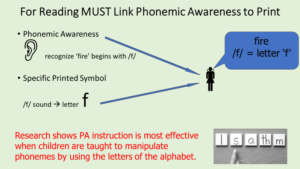
“Phonemic awareness instruction is most effective when children are taught to manipulate phonemes by using the letters of the alphabet. Such instruction makes a stronger contribution to the improvement of reading and spelling when children are taught to use letters as they manipulate phonemes rather than when instruction is limited to phonemes alone.” (from highlights of the evidence based research on phonemic awareness National Institute for Literacy
When can I start teaching Phonemic Awareness?
Begin teaching your child the essential phonemic awareness skills at the preschool level using fun, age-appropriate activities and sound games. Remember in teaching phonemic awareness start developing simple PA skills and build up to the more complex skills. After basic auditory phonemic awareness is developed begin to link the phonemic awareness activities directly to the printed letters. Phonemic awareness instruction benefits preschoolers, kindergarteners, first graders, and in older students struggling with reading.
Exactly How Do I Help My Child or Student Develop Phonemic Awareness Skills?
For additional details and specific activities for teaching phonemic awareness to help your child or student develop these essential phonemic awareness skills, see the articles:
These articles provide the ‘nuts and bolts’ actual activities to empower you to help your child develop essential phonemic awareness skills.
Checking Your Child’s Phonemic Awareness
Right Track Reading’s article Evaluation of Phonemic Awareness: A Free Informal Tool for Checking Phonemic Awareness provides parents a free quick and easy informal tool to check their child’s phonemic awareness.
In addition, numerous phonemic awareness or phonologic awareness evaluation checks are available with an internet search. Look for .edu and .org sites that do not charge for these simple phonemic awareness evaluation tools.
*Note: These type informal evaluations only provide an indicator of phonemic awareness. Reminder: if you have any concerns or questions about your child’s hearing, you must get them evaluated by an appropriate medical professional.
Additional sources of information on phonemic awareness and teaching phonemic awareness:
Further information on phonemic awareness and teaching phonemic awareness skills are located at:
- University of Oregon’s Big Ideas in Beginning Reading: Phonemic Awareness in Beginning Reading http://reading.uoregon.edu/big_ideas/pa/pa_what.php
- Put Reading First: The Research Building Blocks for Teaching Children to Read – This teacher’s guide provides a framework for using the findings of the NRP in the classroom. It includes a complete section on phonemic awareness with suggestions for classroom instruction with examples of how the findings can be implemented. Click on the ‘phonemic awareness instruction’ under contents.
- Highlights from the evidence-based research on phonemic awareness instruction (from National Institute for Literacy) https://lincs.ed.gov/childhood/phonemicIns.html
Reminder: Phonemic Awareness is only one element of reading success:
Phonemic awareness is just one skill necessary for proficient reading. Teaching phonemic awareness to your child helps your child learn to hear, recognize and distinguish sounds with a word. It is primarily an auditory skill. Proficient reading is complex and requires mastering and integrating many different essential skills. To read the child must not only recognize the sound structure of spoken language but be able to link the sounds to the correct printed representation, know the printed phonemic code automatically, process printed letters phonetically, track correctly from left to right, smoothly blend sounds together, pay attention to detail, and repeatedly practice correct phonologic decoding to begin building fluency. These are all fundamental skills necessary to master proficient decoding. These fundamental decoding skills are necessary before the child can advance and begin to master the higher-level skills including fluency, proficiently handling multisyllable words, vocabulary and comprehension. For a visual representation outlining of necessary skills and integration of skills for correct phonologic processing of print and development of advanced skills that lead to proficient reading see Overview and Visual Representation of Overall Processes Required for Proficient Reading.
While teaching phonemic awareness provides an essential foundation for reading success, it alone does not teach kids to read. An effective direct-systematic-phonics program is still the most effective way to ensure your child learns the other skills that are necessary for proficient reading. To Learn more about the effective reading instruction see Direct Systematic Phonics Instruction Proven Effective – Why Parents & Teachers Should Use Direct Systematic Phonics
To discover additional free information, useful articles and effective resources on teaching students to read proficiently EXPLORE FREE READING INFORMATION.
Right Track Reading Empowering Parents & Teachers with information and resources to help their children and students achieve reading success!
This article was written by Miscese Gagen, a mother with a passion for teaching children to read proficiently by using effective methods. She is the author of the effective reading instructional programs Right Track Reading Lessons and Back on the Right Track Reading Lessons as well as a reading tutor with over 20 years’ experience successfully building proficient reading skills in her students. The purpose of this article is to empower parents and teachers with information to help their children achieve reading success. We CAN improve reading proficiency, one student at a time! More information located at www.righttrackreading.com ~ Copyright 2004-2021 Miscese R. Gagen