Attention to Detail Explained:
The Importance of Paying Attention to Detail When Reading Print & How to Help Your Child or Student Develop Attention to Detail for Reading Success
What is ‘Attention to Detail’ in Reading?
Attention to detail is carefully looking at and processing ALL the letters/sounds as you read a word. The student must process all sounds in order, without skipping any sounds or adding sounds that are not actually there. The details are critical in reading printed English words!
Why is Paying Attention to Detail an Essential Reading Skill?
Learning to pay close attention to details and process all letters (phonograms) in a word is an essential foundational skill of proficient reading. Not only is carefully processing of ALL the details of a printed word in order left to right critical to accuracy, it is essential for developing correct phonologic processing and building fluent reading.
Skilled reading involves focus on the internal details of the word. The student must process all sounds in order, without skipping any sounds or adding sounds that are not actually there. The linguistic fact is written English uses only 26 letters to form ALL English words (a total of 470,000 thousand to over 1 million distinct words). Most 5-year-olds understand 10,000 words of their native language. In upper elementary, students know 30-40,000 words. Because entirely different words are composed of similar letters, paying attention to details is critical! (insist-insect-inspect) (stain-strain) (play-ploy) (stay-stray) (form-farm) (tree-three-there) (then-than) (change-charge) (strange-strong-string). Close only counts in horseshoes! Written English words involve precise arrangement of letters and accurate reading absolutely requires paying attention to detail.
Thanks to science, we have learned about the actual neural process of proficient reading. Skilled readers pay attention to and process all the internal details of a word. While it appears fluent readers just visually ‘know’ or ‘recognize’ the word, this assumption is proven false. The brain imaging research shows skilled readers are processing all the letters/sounds in a word. Processing ALL the details of a printed word is essential to developing correct phonologic processing. Accuracy is essential. Directly building skills in paying attention to detail helps students acquire necessary accurate phonologic processing. Fluency is built word by word from repeated practice of correct accurate phonologic processing. If the student is not paying attention and processing carefully, they will not develop the accurate ‘fast/fluent’ neural model of the word necessary to build the fluency. Correct and accurate phonologic processing is the necessary foundation for developing fluency. For additional information, see the article Reading Fluency Explained.
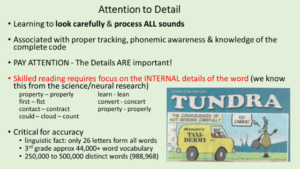
It is important make sure your child or student develops the attention to detail skill critical to reading success. Paying attention to detail is closely intertwined with skills in proper left-to-right directional tracking, knowledge of the complete code and correct phonologic processing. Remember individual skills are not isolated. For a visual representation outlining necessary skills and integration of skills for correct phonologic processing of print and development of proficient reading See Overview and Visual Representation of Overall Processes Required for Proficient Reading
Why do I Need to Directly teach paying attention to detail?
Direct instruction improves effectiveness and ensures your child or student acquires this absolutely necessary skill of proficient reading. While some children develop attention to detail on their own, many do not and run into problems reading. If you explicitly teach and directly develop careful attention to detail, all students will build this essential skill.
Listen to a student who struggles with reading and you will quickly observe how they make numerous errors because they miss details. Despite some claims, the fact is you can NOT read accurately by only looking at the first and last letter. The research shows skilled readers recognize the internal details of the word. The following examples of actual student errors demonstrate how these students absolutely need explicit instruction to develop skills in paying attention to detail. Details do make a difference!
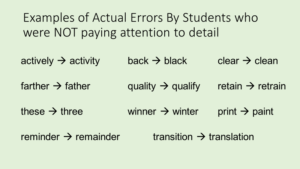
It is also important to realize the detailed, ‘every squiggle is important’, straight line, left-to-right processing essential component of reading printed English is different than the natural biologic process of gathering information by looking around and noticing only important elements and filtering out unnecessary background elements. Because it is not natural, you do need to make sure your child or student develops this skill. To learn more about why reading English is an artificial learned skill and why many students fact difficulty learning to read, See Background of Written English and additional information in article Overview About Children Learning to Read & Why Reading is Difficult for Many Students.
Effective Techniques for Teaching Attention to Detail: How to Help Your Child or Student Develop the Skill of Paying Attention to Details in the Process of Correct Phonologic Processing of Print
The following techniques should be used in reading instruction to help your child or student build attention to detail. The targeted skill/objective is for the student to develop the ability to pay attention and carefully and accurately process all the letters/sounds in a word.
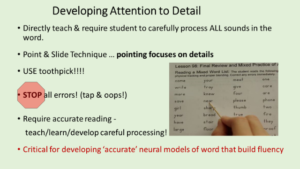
#1 Directly teach the student to look carefully!
Directly teach the student to look carefully and pay attention. Emphasize ‘looking closely, ‘being careful’ and the importance of accuracy. Teach ‘careful’ or accurate reading from the very beginning. I tell the younger students “look carefully, don’t get tricked!” Explain that paying attention to detail is really important.
#2 Have the student use a pointer and apply the technique of ‘point & slide’:
To help build attention on the details of the print, require the student to use a physical pointer when reading words. The act of pointing itself increases the student’s focus and attention on the details of the word. We automatically and naturally ‘look’ at a point! Use the ‘point & slide’ technique. This is the same technique used to establish correct directional tracking of processing all letters in order left to right (for additional details on this effective technique of pointing see article Directional Tracking Explained)
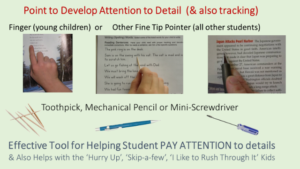
Age adaptations for pointing: Have younger children (k-1st grade) use their ‘reading finger’. For older students (2nd grade & up) have the student use a fine pointer such as toothpick, mechanical pencil or mini-screwdriver. I recommend using a fine tip pointer for all but the youngest students. As soon as student is mature enough to not be distracted by a pointer (or sword fight with the toothpick), I use a toothpick or other pointer. The ‘fine point’ is beneficial for the attention to details. Older students’ fingers are too large to achieve a point focused on individual letters. They really need to use a smaller pointer. In addition, the older students generally prefer to point with an object instead of their finger.
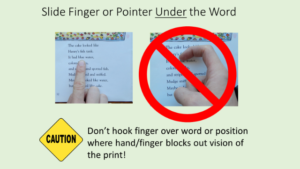
Reminder: Use correct ‘point & slide’ technique. Point directly under the letters and slide across as read. Do not block print with finger, hand or pointer. While it is obvious that blocking print is detrimental to reading, some students ‘block out’ print and need reminder how to point and slide correctly!
#3 Correct the student to help the student develop attention to detail:
Always stop the student when they miss a sound/add a sound that is not there. Have the student reread the word. Often the ‘tap’ with my pencil is all that is needed to indicate ‘oops/look again’. Remind them to ‘look carefully’, if they need the verbal hint. Never let a student continue to practice incorrect skip a few or other attention errors. Require the student read the word accurately. “Practice does NOT make perfect. Only perfect practice makes perfect”. This quote from Vince Lombardi & other coaches applies. Stop the student, and use correction to help them read and practice accurate reading. This creates skills in paying attention. Remember, correction is not a negative action, it is a positive action to help the student learn!
#4 Encourage accuracy over speed in beginning reading and in intervention:
Focus on accuracy, not speed! Speed will develop with time/practice as the student builds fluency. Remember, fluency is built word by word from repeated practice of correct accurate phonologic processing. Accurate correct phonologic processing builds fluency & increases reading speed. Reading fast does NOT create fluency. Speed does not create fluency, speed is the result of building fluency which only happens with accurate phonologic processing. Accurate reading requires paying attention to detail. Therefore, when you require accuracy, the student develops skills that build fluency and eventually result in speed.
#5 Avoid situations where the student is more apt to rush and get in the habit of ‘fast & sloppy’ reading:
This important tip is part of emphasizing accuracy over speed. Avoid timing the student with a stopwatch on a regular basis, as this tends to make students ‘rush’. While the teacher obviously needs to periodically time students to determine reading fluency (words/minute) for evaluation, avoid ‘timing the student’ or using ‘timed reading’ on a regular basis. This is particularly important in the beginning and remediation stages. When you know the clock is running, human nature kicks in, especially if you conduct the timings in a group setting. When the stopwatch starts, it causes students to hurry and rush. When they are rushing, they don’t have time to pay attention to details and often apply/practice bad habits. Avoid the timed reading. (Note: This advice does not translate into avoiding having a class of students read for x minutes every morning, but to not put them under running timer where they are encouraged to read as fast as possible before the buzzer or achieve a faster rate of reading.) Another trick to get around triggering the ‘I need to rush’ mentality is to time in stealth (not let the student know you are timing them).
#6 Avoid using materials where a child can succeed without looking carefully:
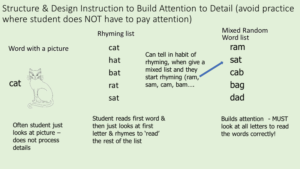
Use structure and design of reading instructional materials to build attention to detail. Avoid, materials that allow student to succeed without applying/building correct skills. Once again, this is important in beginning reading instruction and with intervention. For example, rhyming word lists where the student can develop the habit of only looking at first letter and simply rhyming it with the previous word). Intentionally design effective instructional materials that build (force) careful attention to detail from the beginning. Decodable word lists with words randomly arranged are a fantastic tool for building attention to detail, as accurate decoding requires attention to actual print (no guessing, rhyming..etc
#7 Avoid teaching word families or blended consonants as a cluster/unit:
Not only are word families and blended consonants inaccurate representation of the accurate phonemic code, the word families and blended consonant clusters creates issues with some students. When they learn consonant clusters, some students end up making errors where they insert ‘cluster’ sounds even when they are not present in the word. I only observe these patterns of errors in students who were taught consonant clusters. The following actual reading errors demonstrate this type of attention to detail error: (These are listed as word ⇒ error made by student.
-
- Errors when learn ‘mp’ blend: cap ⇒ camp clap ⇒clamp drop ⇒ dromp step ⇒ stemp
- Errors when learn ‘tr’ blend: teen ⇒treen tide ⇒ tride tease ⇒ trease speak ⇒ spreak
#8 Direct work is necessary with the ‘rush as fast as I can’ students:
Some individual students have a ‘rush’ personality trait. These students tend to rush through much of their work. They make errors not because they can’t perform the skill but rather, because they don’t take the time to perform it correctly. The best way to slow these ‘impatient’ readers down is to STOP them every time they make a mistake and have them back up and re-read the word or entire sentence. Because they remain impatient to finish, they begin to pay closer attention so they are not forced to stop. It takes direct correction, but it does help them build the careful attention to detail that is important to proficient reading.
Remember paying attention to detail is only one of the skills necessary for proficient reading
Attention to detail is just one skill necessary for proficient reading. Reading is complex and requires mastering and integrating many different essential skills.
- For a visual representation outlining of necessary skills and integration of skills necessary for proficient reading See Overview and Visual Representation of Overall Processes Required for Proficient Reading
- For additional details on the multiple skills needed for proficient reading, see the article Skills Necessary for Proficient Reading: Explanation of Foundational Skills for Phonologic Processing and Higher-Level Skills to Advance to Proficient Reading
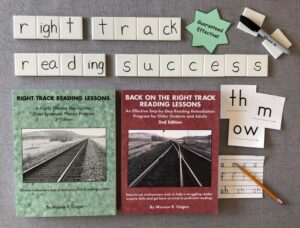
If you are ready to learn more about the effective tools to help your child or student achieve reading success, CLICK TO PREVIEW EFFECTIVE RIGHT TRACK READING PROGRAMS.
Empowering parents & teachers with information & effective resources to lead their student to reading success! For additional free information, useful articles, and effective resources on teaching students to read ⇒ CLICK TO EXPLORE FREE READING INFORMATION.
————————————————————————————-
This information was written by Miscese Gagen, a mother with a passion for teaching children to read proficiently by using effective methods. She is the author of the effective reading instructional programs Right Track Reading Lessons and Back on the Right Track Reading Lessons as well as a reading tutor with over 20 years’ experience successfully building proficient reading skills in her students. The purpose of this article is to empower parents and teachers with information to help their children achieve reading success. We CAN improve reading proficiency, one student at a time! More information located at www.righttrackreading.com ~ Copyright 2004-2021 Miscese R. Gagen