Reading Fluency Explained: What Fluent Reading Is & How Reading Fluency is Developed
How to Help Your Child or Student Become a Fluent Reader
What is reading fluency?
Reading fluency is ‘fast’ or ‘automatic’ reading. Fluent readers are able to read quickly and accurately without effort. We know reading fluency is critical to comprehension and skilled reading. By appearances, the student instantly recognizes words and reads the ‘fast way’ without slowly sounding out. It seems by simply ‘knowing’ the words the student is able to read easily and quickly.
However, it is important to realize appearance of ‘just knowing words’ does not reveal the actual process involved in fluent reading. To help students become fluent readers, we need to learn specifically about the actual process of fluent reading and how fluent reading is developed. The necessary answers lie in the amazing field of modern neuroscience.
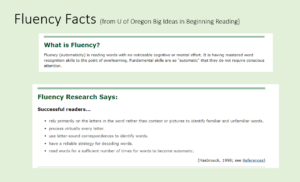
The remarkable advances in neural imaging allow scientists to look closely at the process of fluent reading. Researchers have learned and discovered much about the neural processes involved with fluent reading and how fluent reading is developed. The science has revealed that skilled readers process all sounds in a word. Neuroscientists learned fluent reading uses a ‘fast reading area’ different from the ‘slow’ phonologic processing pathways used by beginning readers. Fluent reading uses a neural ‘expressway’ to process the word. With fluent reading, rapid processing of the word activates a stored neural model. This neural model allows not only ‘fast’ reading but also activates correct pronunciation and understanding of the word. These ‘fast’ pathways allow rapid, effortless reading.
“YOU can directly help your child or student become a fluent reader!“
How is Reading Fluency Developed?
While it appears fluent readers just visually ‘know’ or ‘recognize’ the whole word, this assumption is proven false. The brain imaging research has revealed the actual process of proficient/fluent reading. We now know that skilled readers are processing all the letters/sounds in a word and that development of fluent reading ‘fast neural pathways’ is entirely dependent on phonologic processing.
Importantly, neuroscientists are learning how reading fluency is developed. Fluent reading is established after the individual reads the word at least four to ten times using accurate phonologic processing (slow accurate sounding out). Fluency is built word by word and entirely dependent on repeated, accurate, sounding out of the specific word. Fluency is not established by ‘memorizing’ or ‘recognizing’ what words look like but rather by developing correct neural-phonologic models of the word. Repeated accurate phonologic processing is essential for developing reading fluency. In simplified terms, the repeated accurate phonologic processing literally engraves a neural model of the word. This neural model is then is stored in the ‘fast reading area’ available for rapid retrieval. An individual’s storehouse of fluent ‘fast’ words is built word by word and is dependent on repeated accurate print to sound (phonologic) processing.
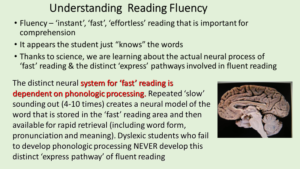
Neuroscientists also discovered dyslexic readers do not develop these fluent or ‘fast reading’ pathways. Struggling readers do not convert print to sound. Because the struggling readers are not accessing the initial phonologic processing pathways the neural models of the words are never made and reading fluency is not developed. Consequently, struggling readers fail to develop fluent ‘fast’ reading pathways. Without these ‘fast’ reading pathways, reading remains slow and takes much effort. Students who fail to establish initial correct phonologic processing do not develop fluency.
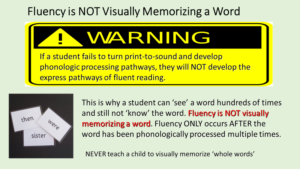
In summary, ‘fast’ or fluent reading IS different than slow sounding out using a different area of the brain. However, this rapid effortless reading is entirely dependent on initial phonologic processing. Individuals build reading fluency one word at a time by repeatedly sounding out individual words using correct phonologic processing pathways. Phonologic processing is key to developing fluency. Skilled readers process all the sounds in a word.
This science provides critical information to how we can help students become fluent readers. Unfortunately, much of the instructional approaches to building fluency that have long been used in the educational system are based on the incorrect assumptions and invalid ‘appearance’ that fluency was visually ‘recognizing’ words. To help students become fluent readers, we need to apply what we have learned from the neuroscience and intentionally create phonologic processing pathways and directly help the student build fluency.
How Do I Help a Student Become a Fluent Reader?
The critical information to keep in mind for effective reading instruction is reading fluency or effortless ‘fast’ reading is developed word-by-word based on repeated accurate phonologic processing of specific words. To develop reading fluency, the student FIRST has to be reading by correct, accurate phonologic processing. The student must be ‘sounding out’ the words correctly. THEN, the student needs to build their storehouse of fluent or ‘fast’ words by repeated accurate phonological processing of individual words. This expansion of fluent reading requires practice repeatedly reading individual words.
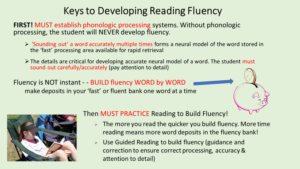
To help a student develop reading fluency:
- First you must ensure the student is reading using proficient phonologic processing pathways. The best way to ensure your student is reading with phonologic pathways is to teach him with an effective direct systematic phonics program. If the student is NOT using phonologic neural processing pathways to convert print to sound, he will be unable to develop the neural ‘expressway’ of fluent reading. The initial phonologic processing or ‘slow sounding out’ is essential to developing fluency. To learn more about creating phonologic processing see Direct Systematic Phonics Proven Effective and the article Key Points and Effective Multisensory Activities to Directly Establish Phonologic Processing.
- Teach the student the complete phonetic code (all the vowel combinations, r-controlled vowel combinations and other complexities). This gives the student the necessary knowledge to process print to sound proficiently and form accurate phonologic models of the word. If their code is incomplete, they may not be processing the word accurately. Knowledge of the complete phonetic code is a necessary subskill of correct phonologic processing. To learn more see the article The Building Blocks of Written English: The Complete Phonemic Code
- Teach the student to pay attention to details as he reads. The details are critical to form accurate neural models of the word. The science has shown that skilled readers are processing all the sounds/letters in a word. To learn more see the article Attention to Detail Explained
- Remember reading fluency is built one word at a time based on repeated phonologic reading. This requires repeated accurate reading. Practice is essential! Repeated practice reading correctly builds a student’s ‘storehouse’ of ‘fast reader neural models. With practice the student adds word-by-word to their fluency. Obviously, the more the student reads the more words he will repeatedly read correctly and the quicker he will build reading fluency. Because reading fluency is built word-by-word, students do not develop fluency overnight. The bottom line is… practice! practice! practice!
- After fundamental skills are established, guided oral reading is the single most effective way to help your student develop and build reading fluency. The guided reading has significant positive impact on reading skills across all age and reading levels. Guided reading works! Note: Guided reading is NOT the same as silent independent reading. With guided reading, the student reads out loud to an adult with feedback and correction. For additional information see the article The Importance of Guided Reading.
- Another highly effective tool for building reading fluency on individual words is phonologic writing/spelling of specific words. This is spelling/writing the word by sound (writing down as you say the sounds not spelling by letter name). For this to be effective in developing fluency, the student must repeatedly print the word by sound. Have the student print the word 5 to 10 times, saying the sounds as they print. Then have the student read the word a few times paying careful attention to the specific print=sound relationship. The repeated writing by sound helps the student form the ‘fast’ neural model of the word necessary for fluency on the specific word.
Remember, reading fluency is built word-by-word and entirely dependent on repeated, accurate phonologic processing of the specific word. Reading fluency is not established by visually ‘memorizing’ what words look like but rather by developing correct neural-phonologic models of the word. Repeated accurate phonologic processing is essential for developing fluency and practice reading is essential for expanding fluency.
Fluency is only one of the advanced skills necessary for proficient reading. To learn more about other necessary skills see the article Skills Necessary for Proficient Reading: Explanation of Foundational Skills for Phonologic Processing and Higher-Level Skills to Advance to Proficient Reading
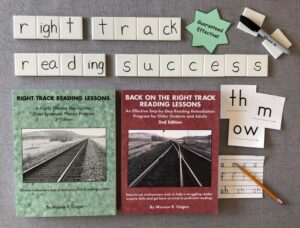
Empowering parents & teachers with information & effective resources to lead their student to reading success!
Reading is complex and requires mastering and integrating many different essential skills. For additional informative articles and resources on teaching students to read CLICK TO EXPLORE FREE READING INFORMATION
If you are ready to learn more about the effective tools to help your child or student achieve reading success, CLICK TO PREVIEW EFFECTIVE RIGHT TRACK READING PROGRAMS.
This information was written by Miscese Gagen, a mother with a passion for teaching children to read proficiently by using effective methods. She is the author of the effective reading instructional programs Right Track Reading Lessons and Back on the Right Track Reading Lessons as well as a reading tutor with over 20 years’ experience successfully building proficient reading skills in her students. The purpose of this article is to empower parents and teachers with information to help their children achieve reading success. We CAN improve reading proficiency, one student at a time! More information located at www.righttrackreading.com ~ Copyright 2004-2021 Miscese R. Gagen