Key Points to Develop Phonologic Processing and Effective Multisensory Activities to Directly Establish Phonologic Processing & Help Students Achieve Reading Success
Phonologic Processing is the Foundation of Proficient Reading and Reading Instruction Needs to Explicitly Develop Phonologic Processing or print-to sound Processing
To become a proficient reader the student must develop phonologic processing pathways. This phonologic processing is the essential foundation for developing skilled reading. Students need to read by ‘sounding out’ words. Phonologic processing is the foundation for proficient reading and essential to develop fluency. To become a skilled reader, the student first needs to read by converting print to sound. For additional information see the article How Reading Works and the article Overview Children Learning to Read & Developing Proficient Reading
Because establishing phonologic processing is essential for skilled reading, the targeted objective for foundational reading instruction (beginning reading and reading intervention) is to ensure the students develop proficient phonologic processing of print.
This page shares information on HOW TO use effective multisensory activities to intentionally develop phonologic processing.
Key Points for Effective Reading Instruction to Develop Phonologic Processing:
- Don’t leave it to chance! Reading printed English is not a natural biologic development and students do not ‘grow’ into reading. Make sure students establish this correct phonologic processing pathways for efficiently converting print to language by using explicit instruction targeted to intentional develop phonologic processing.
- Use an effective direct systematic phonics program to explicitly teach students to read by converting print to sound and intentionally develop phonologic processing. Mixing methods does NOT work! See the article Direct Systematic Phonics Proven Effective: Why Parents and Teachers Should Use Direct Systematic Phonics
- Correct phonologic processing is a complex process and requires integration and application of many different fundamental subskills. Students need to convert print to sound so they can tap into the brains phonologic processors designed for effortlessly processing spoken sound. To do this efficiently the student must recognize the sound structure of language (phonemic awareness), directly and automatically know the phonemic code including the complexities (knowledge of the complete code). They must process print from left to right (tracking), smoothly combine sounds (blending) and pay close attention to all the letters in the words (attention to detail). Learning isolated skills is NOT sufficient. The student must not only master these individual skills but also integrate and automatically apply these skills when they read. In addition, as with all learned skills, practice with correct phonologic processing is essential to developing proficiency.
- For additional information on essential skills see Overview and Visual Representation of Overall Processes Required for Proficient Reading.
- For additional details about the multiple skills needed phonologic processing, read the section on foundational skills in Skills Necessary for Proficient Reading. This also provides links to additional detailed articles on how to help your child or student establish these key skills.
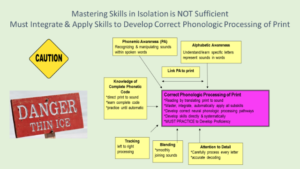
- To develop correct phonologic processing pathways the student must practice reading decodable text. Students must practice converting print to sound in the process of reading words, sentences and stories. The key for developing phonologic processing is not just teaching the individual skills in isolation but having the student practice these skills by sounding out words when reading decodable text. Decodable text is words made up of sounds/phonograms (phonemic code knowledge) the student has learned/acquired. For additional information to learn exactly what is decodable text and how to select decodable text see Decodable Text Explained.
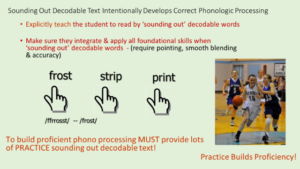
- Sufficient PRACTICE reading decodable text & other activities to directly develop phonologic processing is absolutely essential. The need for PRACTICE cannot be emphasized enough! One of the biggest flaws of many reading instructional programs is they fail to provide sufficient practice of correct phonologic processing of decodable text. Learning isolated skills is NOT sufficient. The student MUST receive sufficient guided practice in sounding out decodable text to develop phonologic processing. This is where the student learns to integrate and apply all skills in the actual process of sounding out decodable words and is developing those proficient phonologic neural processing pathways. Practice builds proficiency. Like I tell some of my intervention students, “you can’t play varsity if you don’t practice”. Practice is essential in accurate sounding out of decodable text and other activities that directly develop phonologic processing neural pathways. Information on effective activities to directly develop phonologic processing is included in the next sections of this article.
Effective Activities to Directly Develop Phonologic Processing of Print:
As with all learned skills, practice is essential to develop proficiency. The following activities can be used to provide the student practice in correct phonologic processing of print. These are the actions that actually develop phonologic processing in your child or student. Click on the activity title or scroll down the page to find details.
- Practice Reading Decodable Text:
-
- Reading Decodable Word Lists
- Reading Decodable Sentences, Paragraphs and Short Stories
- Word Making Activities with Multisensory Sound Tiles
-
- Word Making Activities with Sound Tiles
- Word Changing Activities with Sound Tiles
- Spelling by Sound ~ Recoding or ‘writing words’
- Guided Reading
#1. Practice Reading Decodable Text:
The student must practice correct phonologic processing by reading decodable text. The student needs lots of practice applying all skills including phonemic awareness, knowledge of the code, smooth blending, proper tracking and attention to detail in the process of correctly ‘sounding out’ words. An important reminder, the ability to smoothly blend sounds together (see Blending Explained) is integral to proper sounding out and development of phonologic processing and must be emphasized in the beginning stages.
In order to develop proficient phonologic processing pathways, the student MUST practice reading decodable text. In reading instruction, the term ‘decodable’ refers to words/text containing only the sounds (phonetic code) the child or student has already learned. Although decodable text is simple in the beginning when the student has limited knowledge of the phonemic code, the amount of text that is decodable rapidly expands as the student learns more of the phonemic code. For more information on why decodable text is essential, how the material that is decodable rapidly expands, and examples of decodable words see Decodable Text Explained.
The necessary ability to create and provide decodable text is one of the key reasons it is essential to introduce and teach the phonemic code in a pre-planned direct systematic order. (Please see the article Teaching the Phonemic Code: Sequence for Teaching Letters and Sounds of the Phonemic Code).
The essential practice reading decodable text can include word lists, simple sentences, paragraphs and eventually stories. The student needs lots of practice reading decodable text to develop phonologic processing pathways and establish the neural systems essential for acquiring ‘fast’ fluent reading.
Reading Decodable Word Lists:
Create word lists of decodable words for the student to read and have the student practice reading these word lists. Once again, these word lists must be decodable based on the sounds/phonemic code the student has learned.
Word lists are especially beneficial and highly effective because, by design, they force the student to develop and use correct phonologic processing skills. When reading isolated words in a list, the student must look at the sounds and use correct processing. The word cannot be guessed from pictures or context clues. Incorrect strategies will not work. Word lists compel the student to develop correct phonologic processing! Word lists are useful as they provide a quick way to offer practice in decodable text when sound knowledge is limited and it is challenging to create sufficient sensible decodable sentences and stories.
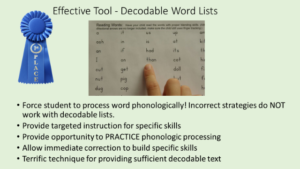
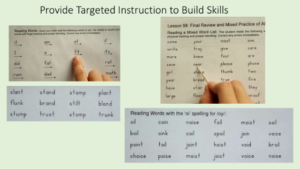
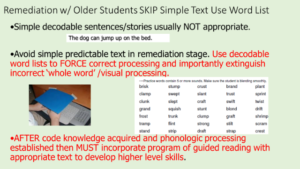
In addition, word lists are highly effective in remediation as not only do most older students do not care to read the ‘easy’ decodable text such as “The cat sat on the rug”, but by design these word lists extinguish incorrect strategies most struggling readers tend to use and instead force the student to use phonologic processing to read. The purpose of effective remediation is to intentionally re-wire the brain to develop phonologic processing pathways and decodable word lists are a highly effective tool for accomplishing this goal!
Samples of word lists in lessons from Back on the Right Track Reading Lessons (remediation program for students 3rd grade through adult)
- Reading Lesson 20(notice the word list providing direct practice of ‘ai’ and ‘ay’)
- Reading Lesson 33: (notice the word list providing direct practice decoding words for both sounds of ‘ow’: Also note how word lists are highly effective in providing older students with much needed correct phonologic decoding practice without having them read juvenile sentences such as “Now the brown cow went down the hill”)
- Reading Lesson 50: (a list of words providing direct practice in decoding the ‘er’ sound)
Word lists offer a terrific tool for developing phonologic processing and providing practice. Decodable word lists can also be created quickly and inexpensively (type up a list of decodable words) and can be easily customized to fit the needs of the student. For example, if the student needs extra practice with the ‘oi’ sound, then just add a few more of those words in the list. To create a decodable word list start with the sounds/code knowledge you have directly taught the student and then create words using only those sounds. Remember decodable text is based on the sounds/phonemic code NOT the letters. Additional information and explanation can be found in the article Decodable Text Explained.
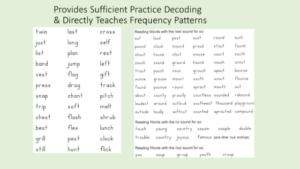
Decodable word lists are an extremely effective terrific tool for making sure students develop and practice correct phonologic processing!
Reading Decodable Sentences, Paragraphs and Short Stories
Practice reading decodable sentences, paragraphs and short stories is essential. The child needs to learn how to combine words into sentences and then combine sentences into paragraphs and stories. Remember to build proficient phonologic processing, this beginning reading material MUST be decodable.
To select effective decodable beginning reader material, you must evaluate the words used in the text. To determine if a book is decodable, evaluate if the phonemic code used in the text corresponds to your student’s code knowledge. Remember what is ‘decodable’ changes as your student learns new sounds and expands their code knowledge
When selecting decodable books, always evaluate the vocabulary used in the book carefully! Do not rely on the grade level rating printed on the cover of the book. Many very simple children’s picture books with only one or two words per page and numerous books actually labeled “early phonics readers” are full of words like ‘rhinoceros’ and ‘laugh’ that contain complex code and multisyllable word such as ‘carnival’ and ‘investigations’ that are absolutely not decodable by beginners. It is not simplicity of the book, but rather the phonemic structure of the words used. In addition, even books that are specifically written to be decodable need to be compared to the student’s code knowledge to see if they are decodable for that student at that point in the development of code knowledge.
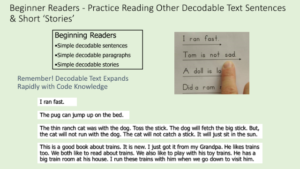
For details and specific examples of decodable text (words, sentences, paragraphs, and short ‘stories’), see Decodable Text Explained and view the samples of decodable word list and sentences listed below. The ability to provide decodable text that matches the student’s code knowledge is one of the key reasons why it is essential to teach the phonemic code in a pre-planned direct systematic order.
In the samples below, notice how decodable words are limited in the beginning but rapidly expand as code knowledge increases and how new lists and sentences incorporate the new as well as all previously taught code/phonograms:
Samples of decodable sentences from Right Track Reading Lessons
- Lesson 16 (Notice the simple sentences contain only basic code and short vowel sounds that have been taught to the student)
- Lesson 42 (Notice the word list providing direct practice in decoding the new ‘ai’ an ‘ay’ code now includes those sounds in the decodable words list. Also notice, the decodable sentences now contain the vowel combinations the child has learned)
- Lesson 77 (Notice the word list provides direct practice in decoding the new ‘er’ code. Also notice, the decodable sentences now contain the vowel combinations as well as the r-controlled vowel combinations that have been taught to the student.)
Additional examples of free decodable stories are found on the Resources for Users of Right Track Reading Programs page.
After the complete phonemic code has been directly taught to the student, and they have had the opportunity to practice applying the complete code, the student can decode virtually all words. At his point, the student has established the foundation of phonologic processing can read all age and content appropriate text.
#2. Word Making Activities with Multisensory Sound Tiles:
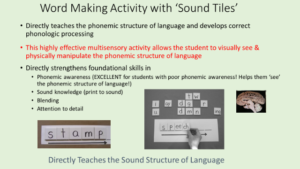
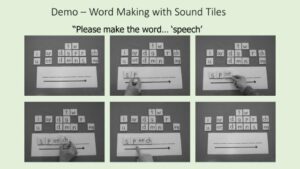
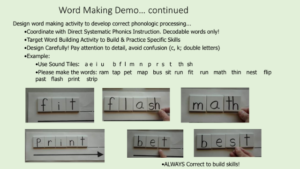
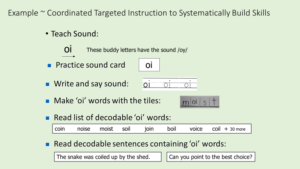
A highly effective multisensory technique for directly developing phonologic processing is ‘word making activities’ conducted with sound tiles. The ‘sound tiles’ allow the student to actually see and physically manipulate the accurate phonemic structure of our language. The word making activity provides a tangible way to learn correct phonologic processing. The activity forces the student develop phonemic awareness, visualize and identify sounds as proper printed units and physically combine these distinct printed sounds into words. By design, these activities integrate kinetic, visual, and auditory processes to develop correct phonologic processing of print. These ‘sound tile’ activities are especially beneficial in beginning and remedial situations as they directly teach and develop correct phonologic processing. They help students ‘see’ understand the phonemic structure of our language. As a bonus, these activities are enjoyable. Even older students enjoy ‘making words’ with these effective multisensory sound tiles. For a description of these effective activities, pictures and sample lessons, please see Sound Tiles Explained: Highly Effective Multisensory Word Making Activities.
Activities Making Words with ‘Sound Tiles’
In word making activities, the student listens to a spoken word and then ‘makes’ the word with the sound tiles. Once again to be effective in developing phonologic processing, the words that you give the student to make must be decodable based on the sounds/code knowledge the student has learned. The student listens to the word and then makes words by sound with tiles containing correct graphemes/phonograms. Use this highly effective sound to print multisensory activity to directly strengthen and develop phonologic processing!
Activities Making & Then Changing Words with the Sound Tiles
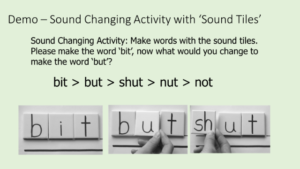
This is another word making activity with the sound tiles, except the student listens and determines how to change the word one sound at a time. This activity is particularly effective for building specific phonemic awareness and attention to detail skills. Word lists are designed to change one sound such as making the word ‘stamp’ and then changing it to ‘stump’ and then to ‘slump’ and then to ‘plump’. The student listens and makes the necessary change with the tiles. Once again, these word changing activities need to be conducted with decodable words so student is correctly processing phonemic changes.
#3 Spelling by Sound ~ Writing Words or Recoding:
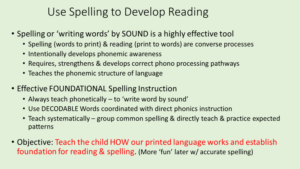
Spelling or ‘writing words’ based on sound (spoken sounds/phonemes to print/grapheme or phonograms) is the converse of reading (print to sound). This multisensory process of spelling or ‘recoding spoken words to print’ strengthens phonologic processing. This is similar to the word making activities with sound tiles, except with ‘writing words’, the student is writing words on paper instead of making the word with tiles. Spelling can also be a terrific tool to build phonemic awareness as the student must listen to the sounds to write the word. Writing spelling words directly links and targets the process of saying the sounds (oral), hearing the spoken sound (auditory), physically forming the letters (kinetic) and seeing the printed letters (visual) to help the students effectively develop phonologic processing. Repeated word writing can also be an effective tool to help build fluency of new words. This activity is not a spelling test, it is a tool to directly teach and build phonologic processing. Once again, the words must be decodable for the student/based on sounds they have learned. The student needs to say the sounds of the words NOT the letter names.
When using spelling/recoding to develop reading skills:
- use decodable word lists (base on the student’s current knowledge base)
- beginning spelling should be simple and phonetic
- group by spelling patterns to teach code
- teach systematically/coordinate with reading instruction
- the student can use paper pencil, individual whiteboards, or sound tiles if writing is difficult
- have student repeat word into their phonic phones before spelling to enhance phonologic link and help develop phonemic awareness
For additional information on linking spelling and reading see the informative article Effective Spelling Instruction: Teaching Children How to Spell
For examples of effective beginning decodable spelling lists see Decodable Spelling Lists for Right Track Reading Lessons.
#4 Guided Reading:
Guided reading is essential in the learning and remediation stages. The validated research shows that guided out loud reading has significant beneficial impact on word recognition, fluency and comprehension across a range of grade levels. True guided reading is reading out loud to an adult, or other proficient reader, with feedback. This is NOT independent silent reading and it is not a commercial program that uses this term. In order to achieve significant beneficial impact on word recognition, fluency and comprehension: #1 The student must read out loud to an adult (or other proficient reader) and #2 The adult must provide correction, feedback and instruction on specific skill development.
To build skills, have your student read to you out loud and provide ‘guidance’ and feedback so you can help them develop skills. In the beginning this guided reading will be with simple decodable text and simple decodable stories and will then rapidly expand to include more advanced text as the student progresses. For further information, please see the articles:
- The Importance of Guided Reading: The Significant Benefits of Guided Reading & Specific Instructions on How to Use Guided Reading to Help Your Child or Student Advance Reading Skills
- Finding Appropriate Level Books to Help Students Improve Reading Skills & How to Select Books to Match Your Child’s or Student’s Reading Level
Summary to Help Your Child or Student Develop Phonologic Processing
In conclusion, the key to proficient reading is the development of phonologic processing pathways. The student must convert print to sound. We need to help students develop this proficient phonologic processing by targeting instruction with an effective direct systematic phonics program that directly teach all skills and by requiring practice sounding out decodable text. Techniques such as practice with decodable text, word making activities, and decodable spelling can be used to intentionally develop these proficient phonologic processing pathways. It is also important to recognize practice builds proficiency. Sufficient practice of correct phonologic processing is essential. We can help our children and students achieve reading success!
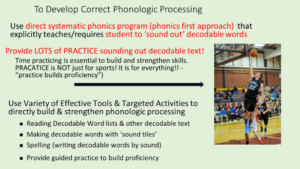
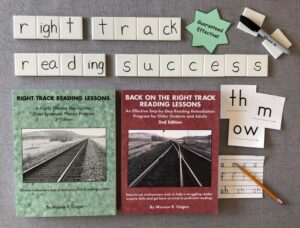
An example of an effective instruction where activities are coordinated and targeted to intentionally build phonologic processing is shown in Right Track Reading Lessons.
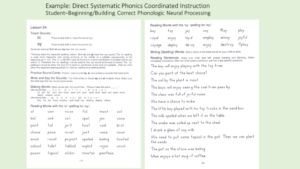
To learn more about why direct systematic phonics instruction is effective in building proficient reader phonologic processing pathways, see the article Direct Systematic Phonics Explained.
To learn more about Right Track Reading Lessons & Back on the Right Track Reading Lessons and how you can use these effective reading programs to help your child or student build proficient phonologic processing Preview Right Track Reading Programs.
Translating science into effective actions ~ The tools to achieve reading success!
Empowering parents & teachers with information & effective resources to lead their student to reading success! For additional free information, useful articles, and effective resources on teaching students to read ⇒ CLICK TO EXPLORE FREE READING INFORMATION.
————————————————————————————-
This information was written by Miscese Gagen, a mother with a passion for teaching children to read proficiently by using effective methods. She is the author of the effective reading instructional programs Right Track Reading Lessons and Back on the Right Track Reading Lessons as well as a reading tutor with over 20 years’ experience successfully building proficient reading skills in her students. The purpose of this article is to empower parents and teachers with information to help their children achieve reading success. We CAN improve reading proficiency, one student at a time! More information located at www.righttrackreading.com ~ Copyright 2004-2021 Miscese R. Gagen