When a Student Has Low Reading Comprehension Determining WHY They Struggle with Comprehension is Essential
When a student has low reading comprehension, look carefully for the exact reasons why he or she struggles acquiring meaning from text. Reading comprehension is a higher-level advanced skill. The end result of ‘low reading comprehension’ or ‘poor comprehension’ is caused by various factors. In many students, low reading comprehension is actually caused by factors other than an inability to understand the content of the text. Often reading comprehension challenges are created by gaps in foundational skills rather than inability to understand. If a student has not developed the foundational skills necessary for proficient reading where they can easily and accurately change print to words the result is often low reading comprehension and poor fluency.
To effectively help the student build skills and achieve reading success we must first accurately identify the exact reason or reasons why the student struggles with comprehension. After we identify the root cause of the comprehension difficulty, we can then target intervention to directly develop those specific missing skills.
Importance of Evaluating to Determine the Cause of Low Comprehension
To identify the root cause of low reading comprehension, closely scrutinize actual reading performance. This is not simply noting overall performance in words per minute or comprehension of content but carefully observing and recording all specific errors and challenges. To evaluate possible skill gaps in reading, have student read several pages of grade level, appropriate content, straight text. Avoid pictures, predictable text, or any material the student has previously read. You need to determine how well the student is converting print to language, not how well they can memorize, predict or guess. For example, my 18-month-old nephew “reading” the book Go Dog Go from cover to cover fails to provide useful information on his reading comprehension skills. It just shows he is smart and can memorize a favorite story. For useful information for a reading evaluation, you need to scrutinize actual performance decoding print and record all specific errors and difficulties. The specific errors are enlightening in identifying where certain skill gaps exist and importantly what action is needed to effectively target instruction/remediation.
“Students face low reading comprehension for different reasons. To help them succeed we first need to determine WHY they are struggling with comprehension. Then we can effectively target needed instruction”
Common Reasons for Low Reading Comprehension & How to Effectively Target Instruction
The following sections of this article summarize some of the areas where skill gaps occur when students struggle and exhibit ‘low reading comprehension’. These descriptions outline the various skill gaps, overview some of the indicators of observed in reading evaluations and summarize intervention/remediation actions that are necessary to effectively help the student build missing skills. Once again, the key is identifying the root cause of the low reading comprehension so you can target and design intervention to help the student achieve reading success.
⇒Gaps in foundational decoding skills:
The student who is not able to accurately and easily convert print to words WILL have low reading comprehension. The difficulty in reading the individual words interferes with the ability to comprehend text. These students have frequent accuracy errors in decoding (read printed words incorrectly) or read printed words with great effort (slow, laborious decoding). Observations of reading performance reveal repeated accuracy errors including, misreading words, frequent ‘whole word’ mistakes, skipped words, substituting words and slow/laborious reading of individual words.
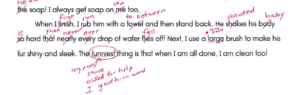
Below is an actual example of a 2nd grade student who was flagged by the school for “poor comprehension and low fluency”. His mom had contacted me for tutoring. However, as the evaluation shows, this student’s low reading comprehension was not caused by a lack of understanding (inability to comprehend) but rather significant gaps in foundational skills and his inability to decode print proficiently. The image below shows his performance on a simple passage about giving a dog a bath. As a 2nd grader he read approx. 25wpm with a 25% error rate, well below first grade benchmarks on this 1st grade passage. He struggled to read this passage and was not able to answer simple questions about what he read. In contrast, he fully understood the content/language/vocabulary of the passage when I read it to him. He even elaborated and related elements to when he gave his own dog a bath.
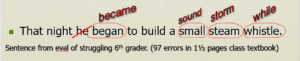
Another actual example is taken from a 6th grader who was also identified with low reading comprehension. When I listened to her read, she made 97 errors in reading 1 ½ pages of her classroom social studies textbook. Once again, her comprehension challenges in social studies were caused by her inability to decode the text not by a lack of understanding. She understood content when it was presented orally.
Obviously, these types of difficulty accurately and easily reading the individual words severely impact the ability of the student to understand what they were reading directly creating low reading comprehension. You can’t understand what you can’t read.
In summary, students such as these exhibit low reading comprehension because they encounter difficulty accurately and easily decoding the grade level printed text. Check. When the student struggles with reading print but is able to completely understand the text content when it is read to them, it verifies the issue is decoding (inability to turn those black printed squiggles into language!), rather than issues with true comprehension. Commonly, the end result of low reading comprehension is caused by a lack of foundational reading/decoding skills. In over 20 years experience working with struggling readers, the vast majority of students flagged for ‘low reading comprehension’ have significant gaps in foundational decoding skills that create significant reading comprehension challenges. Skill gaps can be in any of the foundational skills (phonemic awareness, knowledge of the complete phonemic code, smooth blending, correct directional tracking, attention to detail) and importantly the integration and application of these skills to establish correct phonologic processing (the hallmark of proficient reading!). See the discussion on foundational skills needed for proficient phonologic processing in the article Skills Needed for Proficient Reading.
In these students, successful intervention to resolve low comprehension skills, must FIRST establish the foundation of correct phonologic processing. Intervention that attempts to develop higher level comprehension or fluency skills when the student lacks a foundation of proficient decoding will not be successful. The foundation of accurate decoding/correct phonologic processing must be established before the advanced skills can be developed. These students need a strong direct systematic phonics instruction/intervention to build necessary foundational skills. For detailed information and links to research see the article Direct Systematic Phonics Instruction is Proven Effective: Why Parents and Teachers Should Use Direct Systematic Phonics
Effective intervention works! The 2nd grade student who struggled significantly reading the ‘dog bath’ passage, was above grade level reading in just under 20 hours of direct intervention tutoring sessions with Right Track Reading Lessons effective direct systematic phonics instruction. As soon as we filled in skill gaps and he learned proficiently convert print to sound/developed correct phonologic processing pathways, all difficulties with ‘comprehension’ were resolved. His ‘comprehension problem’ was actually a decoding problem. If your student is struggling with reading the print accurately see the article, Information on Effective Intervention to Help Struggling Readers Achieve Reading Success & Using Reading Evaluations to Target Effective Instruction
⇒Lack of Fluency:
Fluency only develops for students who have established the correct neural phonologic processing pathways. They must be converting print to sound. It is essential to examine what we now know about the process of fluency from neuroscience. Proficient readers who establish the necessary foundation of phonologic processing develop the ‘fast’ reading system. Students who are not converting print to sound do not develop these fast neural systems. The foundation of phonologic processing is essential to building fluency. While gains in fluency are obviously critical to reading comprehension, intervention to build ‘fluency’ is only effective when the correct phonologic foundation has been established. If the student has not developed the correct phonologic processing pathways, re-reading a passage over and over does NOT build fluency!
See the article Reading Fluency Explained: What Reading Fluency Is, How Fluent Reading is Developed and How to Help Your Child or Student Become a Fluent Reader
⇒Gaps in Vocabulary ~ Not Understanding the Meaning of Words or phrases:

This is where the student decodes the word or words accurately but does not know the meaning of the words in oral language. This commonly occurs when students encounter new vocabulary or new expressions and idioms. Examples of new vocabulary are when a young student reads “timid” perfectly but lacks understanding because they don’t know the meaning of the word. This includes understanding the meaning of expressions and idioms as well as individual words. A student may read “lock, stock, and barrel” correctly but has no idea this expression means “all of it”. In evaluations, check if the student knows the meaning of the word or expression orally. If the student does not know the meaning of the word or expression orally, then it is a vocabulary issue. Instruction targeted to expand a student’s vocabulary knowledge is critical and leads to gains in comprehension.
See the article Expanding Vocabulary Knowledge: How to Help Your Child or Student Expand Their Vocabulary Knowledge
⇒Gaps in Knowledge of the English Language:
This is similar to gaps in vocabulary except the source of the problem is a lack of knowledge of the English language. This language issue has significant impacts on reading comprehension with students who are learning to speak the English language. For example, a first-grade girl whose first language was Spanish and was just learning the English language, read “We made a raft” perfectly but did not comprehend because she didn’t know the meaning of the English word ‘raft’. Targeted instruction to learn the meaning of English words is necessary to resolve these language issues. English for Speakers of Other Languages or English as Second Language instruction involves a different and additional focus than teaching reading for English speaking students. Reading instruction must also involve language instruction (targeted instruction to directly teach and learn the English language).
⇒Gaps in ‘Paying Attention’ and Lack of Essential Comprehension Skills & Strategies :

This includes both those students who decode accurately and quickly but do not pay attention at all to what they are reading and those who have not developed the higher-level comprehension skills. A few students will decode easily and accurately (excellent accuracy, good speed/fluency) but just don’t pay attention to what they are reading even when content is relatively simple. Examples would be the 2nd grader who can zip through a chapter of the story the class is reading but not tell you what he just read or the 7th grader who reads the entire section in social studies quickly and accurately without retaining any content information. These students must learn to pay attention to what they are reading and must develop the essential comprehension skills. These students benefit greatly from direct instruction in comprehension strategies to develop comprehension skills. It is also important to help students advance from the initial basic comprehension skills to higher level comprehension skills.
See the article: How to Develop Reading Comprehension: Overview of Reading Comprehension & Specific Actions to Help Students Develop & Improve Reading Comprehension
⇒Gaps in Content Knowledge:
This classic ‘comprehension’ challenge occurs when students encounter new content and can decode words perfectly without understanding content of the material. This is not a reading/decoding issue or a lack of comprehension skills but rather lack of understanding and knowledge of the actual content. This occurs when students are learning new concepts especially with complex material. For example, when a student is first learning about acceleration of gravity in physics, they may need additional background or explanations to fully understand the concepts of what they just read in the text. This also occurs when students attempt to read material that is above or beyond their understanding. For example, if I pick up my daughter’s advanced medical text, I can decode the text perfectly. However, I definitely lack comprehension of “thromboembolic disease consequent to atherosclerosis …” because it is beyond my knowledge base. These types of advanced comprehension issues usually require additional instruction and learning to acquire knowledge in order to understand the content of text. This is where the student encounters the excitement of learning new concepts and information. This essential expansion of content knowledge frequently comes from additional reading. Unfortunately, students who lack foundational skills and struggle with the ability to easily and accurately decode print are at a significant disadvantage in learning content. The ability to read proficiently opens the door to learning!
⇒Medical Impacts:
Some students’ ability to comprehend text will be impacted by specific medical or biological situations. If the student has hearing, vision, developmental or other medical concern, the student must be evaluated by a doctor or other appropriate professionals. Examples may be a student who has fetal alcohol syndrome, a student with severe hearing disability, a student with autism, or a student with other biological challenges. These types of issues need to be addressed by appropriate professionals. Reading instruction needs to be designed to meet the unique needs and challenges of the individual student.
Note: Low Comprehension Often Caused by More than One Factor
These general areas of skill gaps encountered in low reading comprehension typically do not occur in isolation. There is obviously overlap and interaction between the skills needed for comprehension. For example, a student who lacks foundational skills and can’t easily decode print may also lack vocabulary knowledge. Vocabulary gaps affect content knowledge. A lack of higher-level comprehension skills will limit gains in content knowledge. However, the key point is when a student has low reading comprehension, we need to identify specific missing skills impeding comprehension and then carefully target instruction to resolve the specific obstacles to comprehension.
Summary: Effective Intervention Must Be Targeted to Build Missing Skills
To be effective, intervention to help students improve comprehension must address the root cause of the low reading comprehension and then target instruction to directly build missing skills. It is critical to recognize when a student struggles with any of the foundational skills since this inability to easily and accurately decode print with continue to impede comprehension and fluency. Intervention must first establish a strong foundation of proficient phonologic processing before developing the higher skills.
The neuroscience has provided us with a ‘map’ to proficient reading. Key lessons that we have learned from the neuroscientific studies on proficient reading include:
- Proficient readers convert print to sound using phonologic processing pathways. Phonologic processing is key to proficient reading
- Dyslexic readers fail to convert print to sound
- Phonologic processing is required to develop the ‘fast’ or ‘expressway’ systems for ‘fast’ reading. Dyslexic readers fail to develop these fast reading systems because they are not turning print to sound (failed to develop the essential phonologic processing pathways)
- And the most exciting element of neural research, direct phonologic instruction builds correct proficient reader phonologic processing pathways and re-wires the brain for reading success
If the student struggles with the foundation of accurate decoding, additional information is found in the articles:
⇒Students Who Face Difficulties Learning to Read: Information on Reading Problems and Dyslexia
⇒ It Works! Direct Systematic Phonics Instruction Proven Effective (includes links to research)
Additional Information on Building Reading Comprehension Skills is located in the article:
Empowering parents & teachers with information & effective resources to lead their student to reading success!
Reading is complex and requires mastering and integrating many different essential skills. For additional informative articles and resources on teaching students to read CLICK TO EXPLORE FREE READING INFORMATION
If you are ready to learn more about effective, easy-to-use and affordable tools to directly help your child or student achieve reading success PREVIEW Right Track Reading Lessons (designed for younger children) and Back on the Right Track Reading Lessons (specifically targeted for older struggling readers 3rd/4th grade to adult). Translating the science and evidence-based research into actions YOU can use with your student!
This information was written by Miscese Gagen, a mother with a passion for teaching children to read proficiently by using effective methods. She is the author of the effective reading instructional programs Right Track Reading Lessons and Back on the Right Track Reading Lessons as well as a reading tutor with over 20 years’ experience successfully building proficient reading skills in her students. The purpose of this article is to empower parents and teachers with information to help their children achieve reading success. We CAN improve reading proficiency, one student at a time! More information located at www.righttrackreading.com ~ Copyright 2004-2021 Miscese R. Gagen